
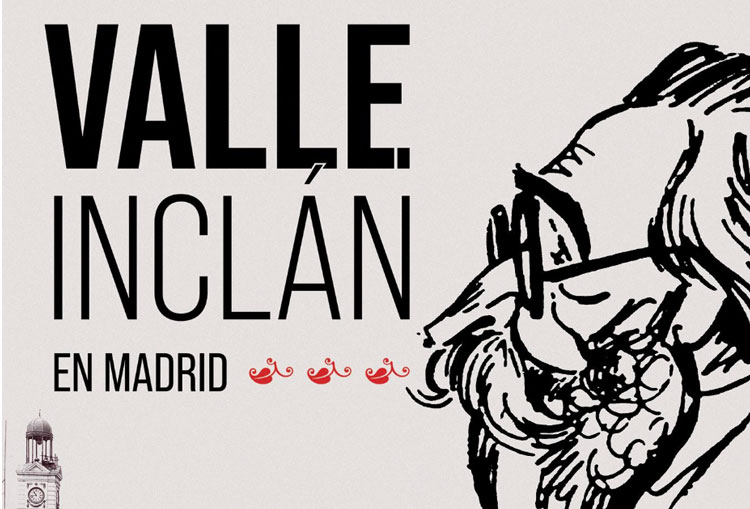
Until next June 21, the Exhibition Hall of the Biblioteca Regional of Madrid (Ramírez de Prado street, 3) displays the exposition Valle-Inclán in Madrid.
The exhibition, curated by Joaquín Valle-Inclán Alsina, offers visitors a tour of the three rooms that the renowned author made in Madrid, and the most significant works and activities of each period, without forgetting his facet as an editor and designer, nor the importance that both friends -on either side of the ocean- and Madrid’s life, had in their literary vision and approaches.
Dramatist, poet and novelist, Ramón María del Valle-Inclán is undoubtedly one of the most important writers in Spanish literature of the 20th century. Member, along with others such as Azorín, Baroja or Unamuno of the so-called Generation of 98 and creator of a literary concept as innovative as ‘Esperpento’.
Within his imaginary and his trajectory, this exhibition focuses on the eras in which he chose Madrid as his residence, dating from 1891 to 1892, 1895 to 1912 and, finally, 1925 to 1935, and proposes to the visitor to immerse themselves, not only in the literary career of the author, but in the activities and relationships he undertook in these periods of his life.
The exhibition also shows other aspects of Valle-Inclán, such as his role as an editor or designer, the importance for him of the tours he undertook throughout his life in various American countries, and which are reflected in the exhibition, and the friendships he cultivated on both sides of the ocean. Without forgetting, of course, the literary gatherings that were so characteristic and vital in the Madrid of that time, a city, by the way, which became one more character in Valle-Inclán’s work.
Letters, manuscripts, first editions, periodicals, drawings, photographs and objects of various kinds make up this exhibition that includes pieces from the collection of the Regional Library of Madrid, as well as other institutions, including the National Library of Spain, the Hemeroteca Municipal de Madrid or the Valle-Inclán Museum, and the personal collection of the Valle-Inclán family.