
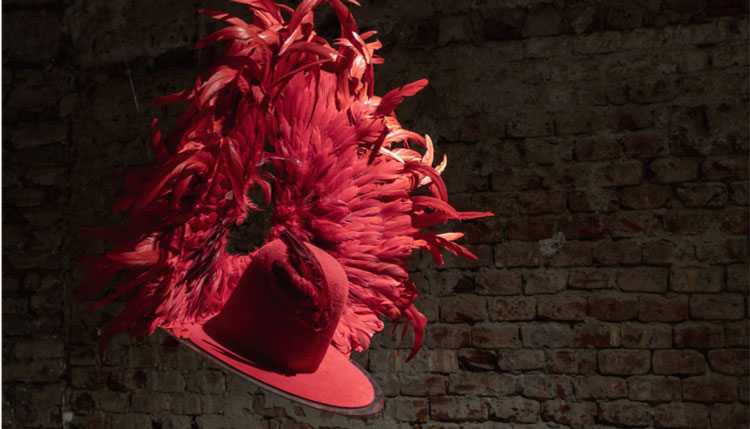
Under the auspices of the Romanian Embassy, in collaboration with the Instituto Cervantes in Bucharest, and on the occasion of Women’s Day last Tuesday, the Instituto Cultural Rumano presented the exhibition The dialogue of hats: elegance and fascination in 16 portraits of women from Romania and Spain, by Cosmina Nicolescu.
The exhibition in Madrid, which will be open to the public until next April 24 at the headquarters of the Instituto Cultural Rumano (Plaza del Cordón, no. 1, under dcha.) showcases unique works created especially for the event and is the first collaboration with the Romanian designer. Entry is free.
Based on a quote from the famous Spanish poet and playwright Federico García Lorca (1898-1936): One takes off his hat, the other asks permission, Cosmina Nicolescu proposes an original exhibition that pays tribute to sixteen extraordinary women of Spain and Romania, with blood ties, real or similar interests, which have opened doors, changed mentalities, laws and history. The verse, taken from Lorca’s lyric, contains some tension, a wait, a ritual, since, by keeping the hat on the head, a shadow may appear, a challenge, a rebellion against the rules, a silent imposition or a provocative erotic game. This ambivalence inspired the author of the exhibition to create symbolic hats for women who reversed social and gender roles, challenged customs, abolished restrictions, undermined patriarchy, and created the tension needed as a means of renewal.
Some are reflexes, face-to-face images, like the two first queens: Queen Maria of Romania and Queen Victoria Eugenia of Spain, who proudly wore the veil of nurse instead of the tiara; others are overlapping portraits, as in the case of Calypso Botez, one of the initiators of the feminist movement and co-author of obtaining the right to vote, with a fate similar to that of Clara Campoamor, politician and activist whose success in 1931 powerfully influenced Spanish society. Others are exceptional because they belong to the rarest category of number one: Sofonisba Anguissola, the first official woman painter (1559) at the court of a Spanish king, or Sarmiza Bîlcescu, the first woman in Romania and the second in Europe to obtain a doctorate in law.
Visitors will be able to admire sixteen hats created specifically for the exhibition in Madrid and associated with emblematic figures of Romanian literature and culture. These are such powerful figures that, when their names are spoken, a web of memories and literary fragments is instantly reactivated, like a living background of reading. Next to them, as a reflection, emblematic figures of the culture and history of Spain will be exhibited, in an authentic intergenerational and symbolic dialogue between both European countries.