
Text and photo: Juan David Latorre.
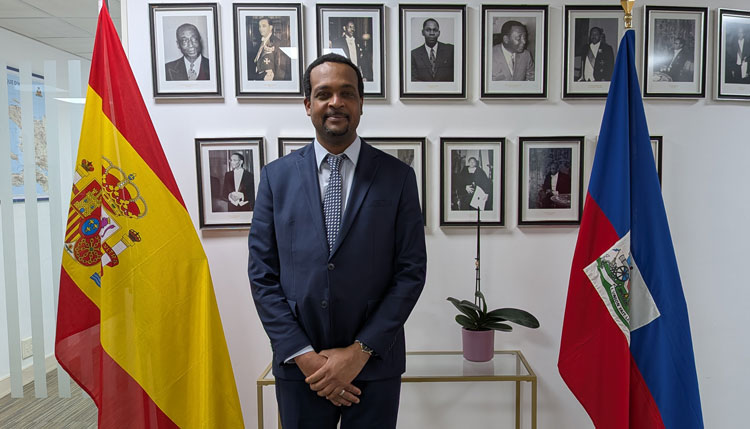
The Diplomat in Spain contacted the new Haitian ambassador, Wooldy Edson Louidor, and conducted an interesting interview detailing the current political and social situation in the Caribbean country.
.- Dear Ambassador, the International Rescue Committee (IRC) emphasized in a report presented last Tuesday that political instability and violence in Haiti show no signs of abating and could even worsen in 2026. Dear Ambassador, how would you describe the social and political situation in your country?
Haiti is going through a difficult period that has been ongoing and combines several challenges simultaneously. The current situation is marked by security problems, institutional fragility inherited from years of crisis, as well as significant social and economic difficulties.
From an academic and analytical perspective, it is essential to observe the concrete effects of this situation on the population, particularly through internal displacement and migration patterns outside the country. Widespread violence and a lack of access to basic services have forced more than 1.4 million people to flee their homes and become internally displaced, representing one of the highest internal displacement figures ever recorded and reflecting the profound impact of instability on citizens’ daily lives.
At the same time, it is important to emphasize that institutions continue to function, civil society remains mobilized, and numerous communities are organizing around clear priorities: restoring security, strengthening the state, and rebuilding a stable democratic framework.
Currently, efforts are underway by the transitional authorities and the government, with the support of international partners, particularly the European Union and Spain, who are accompanying Haiti during this crucial phase.
The Haitian people have always demonstrated a remarkable capacity for adaptation and resilience. The challenge today is to transform this resilience into lasting stability, for the benefit of the entire nation.
.- The mandate of the Presidential Transitional Council, which currently governs Haiti, will remain in effect until February 2026, and this Council approved the ratification of an electoral law to hold general elections. What future does this Council envision?
The Presidential Transitional Council plays a central role in the current phase. It is a temporary structure, established within a specific political framework and with a clearly defined mandate.
Its main objective is to create the necessary conditions for a return to constitutional order by organizing credible, inclusive, and transparent elections. Legal and institutional foundations have been established to facilitate the organization of the electoral process.
Within this framework, there is an electoral decree that precisely defines the scope of the process, which includes presidential, legislative, and territorial elections, intended to elect both national authorities and those of the municipalities and departments. The Provisional Electoral Council now has its executive body in place and functioning, allowing for concrete progress in preparing for the elections.
The electoral process anticipates holding the first round of elections on August 30, 2026, followed by a second round in December of the same year, in an atmosphere of trust and responsibility, with the goal that, by February 7, 2027, Haiti will have a president and fully legitimate authorities.
Beyond the timeline, the main achievement of this stage has been the contribution to creating the minimum conditions for organizing the elections, both in terms of electoral procedures and security, governance, and institutional trust. This was precisely the mandate entrusted to the Presidential Transitional Council.
The authorities are working jointly with political and social forces, as well as international partners, to reach broad consensus, guarantee an orderly and inclusive transition, and avoid any institutional vacuum, while ensuring the continuity of the State.
Do the Haitian people seem eager for elections, to go and vote? In other words, are they not afraid of abstention after all this recent history, also dominated by gang activity and other issues? Do you think the Haitian people will respond to these elections?
It is still too early to accurately assess the level of citizen participation, but the essential thing today is to work to restore the trust and mobilizing the population are crucial. The electoral process is not limited to the act of voting; it is part of a broader dynamic of a political, institutional, and social nature.
The credibility of electoral institutions, particularly the Provisional Electoral Council, is a determining factor. Without trust in the rules of the game and in those who organize them, participation can hardly materialize. Respect for the electoral calendar is equally fundamental: when commitments are announced, they must be fulfilled to strengthen citizens’ trust.
The issue of security is equally central. Candidates must be able to conduct their campaigns throughout the country, and citizens must be able to exercise their right to vote without fear.
Furthermore, successive crises have had a profound impact on the population. Many Haitians have been forced to flee their homes, generating a sense of uncertainty and, in some cases, discouragement. The State must take these realities into account. However, if the process is managed properly, the elections can also become a moment of hope, an opportunity for citizens to once again look toward the future and rebuild their connection with their country.
This process is, above all, the responsibility of Haitians themselves: the State, civil society, and the political class. Nevertheless, it cannot be carried out in isolation. The support of the international community, and in particular of Haiti’s friendly nations, is essential. In this regard, Spain has played an important role, not only through its financial and technical support, but also through a constant and committed presence.
The presence of international partners on the ground is a positive sign. It reflects confidence in the country’s future and demonstrates that Haiti continues to move forward. This hope must be the result of collective and coordinated work between national actors and the international community.
.- Not long ago, tourism in northern Haiti was promoted, with claims that this part of the island did not suffer from the social problems caused by gangs in the central and southern regions. Is this still the case? Is it truly safe to travel to this part of the island?
Northern Haiti continues to benefit from a relatively more stable situation compared to other areas of the country. It has infrastructure, connectivity, and an environment that have allowed for the development of tourism promotion initiatives based on this relative stability.
However, it is important to address this issue with a strong sense of responsibility. Security is a dynamic factor and, in the upcoming political and electoral context, requires constant and reinforced attention from the authorities. The goal is precisely to preserve the progress achieved and continue guaranteeing a peaceful environment for both local communities and visitors.
In this regard, the State, in coordination with local stakeholders and with the support of international partners, is working to ensure that security conditions are maintained and strengthened when necessary. Travel to the north of the country remains possible, always within a framework of prudence, up-to-date information, and respect for official recommendations.
The priority is clear: to protect the population, safeguard the region’s tourism potential, and ensure that Haiti can continue opening up to the world responsibly and progressively.
.- What news are you receiving about the situation of Haitian migrants in the United States in light of abuses by Immigration and Customs Enforcement (ICE)? Has it been proven that Haitian migrants do not “eat” Americans’ pets?
Regarding the aforementioned rumor, it is important to point out that it is part of a disinformation campaign, with narratives that in some cases incorporate elements of stigmatization and prejudice against the Haitian population.
Currently, approximately 521,000 Haitian citizens in the United States are awaiting a decision on the renewal of their Temporary Protected Status (TPS). This is a matter of great importance, since the non-renewal of this protection mechanism could lead to an increase in deportations and create a situation of greater vulnerability for those affected.
The authorities are closely monitoring these issues and are calling for decisions that respect the human rights and dignity of those affected.
.- As the newly appointed Ambassador Extraordinary and Plenipotentiary to Spain, how are you carrying out your duties so far to strengthen relations between our two countries? What sectors are currently priorities for Haiti in Spain?
Since my arrival in Spain, I have assumed this role with a firm commitment to strengthening and deepening relations between Haiti and Spain, based on balanced, respectful, and constructive cooperation. The goal has been to consolidate a relationship measured not only by the resources mobilized, but also by the quality of dialogue, mutual trust, and reciprocal respect.
In this regard, we have actively worked to reinforce existing cooperation mechanisms, expand spaces for political dialogue, and promote a greater Haitian presence in multilateral forums, particularly within the Ibero-American sphere. Diplomatic efforts have also focused on bringing Haiti closer to institutional, academic, and cooperation actors in Spain, with a long-term vision.
Regarding priority sectors, Haiti has identified strategic areas where Spanish cooperation provides significant value. These include water and sanitation, essential sectors for the well-being of the population and sustainable development. Education and training also occupy a central place, with special emphasis on university cooperation and training opportunities for young Haitians. It should also be emphasized that this cooperation is carried out with an inclusive territorial approach, not limited solely to the capital, Port-au-Prince, but extending to other departments of the country, thus contributing to more balanced development. For Haiti, investing in youth and education is investing in the future.
Ultimately, our work in Spain seeks to strengthen a relationship of friendship and mutual support, based on solidarity, respect, and the conviction that well-structured cooperation contributes not only to Haiti’s development but also to strengthening the ties between our peoples.
.- To conclude this interview on a more relaxed note, Mr. Ambassador, how do you see the role of the Haitian National Football Team in the upcoming World Cup to be held next June and July?
I believe it is one of the few recent news items that has been able to lift the spirits of the Haitian people and help them regain confidence and a sense of dignity. In this context, the Haitian national team’s qualification for the next World Cup, after half a century of waiting, is a truly historic moment.
Beyond the sporting arena, this achievement represents an immense source of pride, unity, and hope for the Haitian people. The Haitian national football team symbolizes that collective hope and unity, reminding us that Haiti still exists, continues to rise, and remains part of the international community.
Participating in a World Cup has profound significance. It is a global competition that allows Haiti to assert itself on the international stage. Regardless of the sporting results, the mere fact of being present, competing with dignity, and delivering a strong performance is already a source of pride for the entire country.