Text and photos: Juan David Latorre
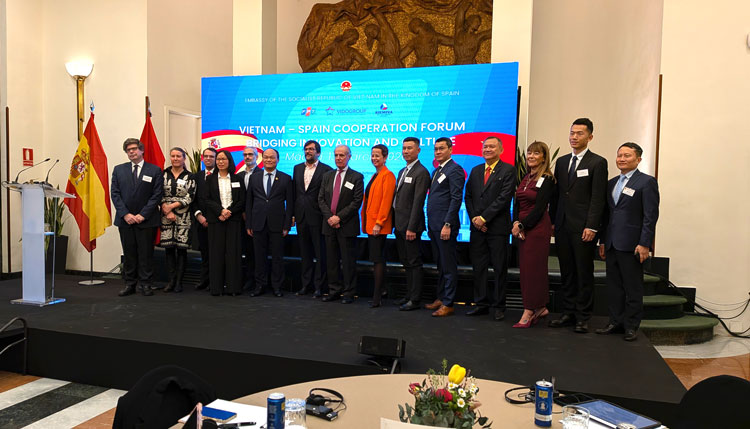
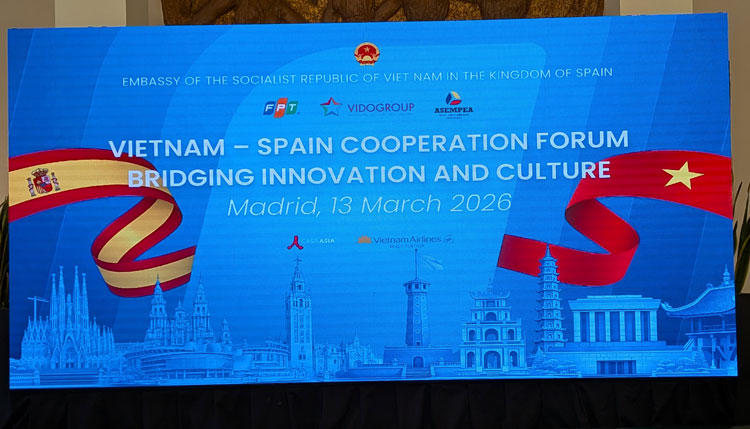
Last Friday, the Vietnamese Embassy hosted the Vietnam-Spain Cooperation Forum: Uniting Innovation and Culture at the InterContinental Hotel. The event brought together numerous businesspeople and investors interested in establishing trade relations between Spain and the Asian country.
Following welcoming remarks by Ambassador Doan Thanh Song, Juan Luis Gimeno, Director General of Economic and Commercial Intelligence at the Spanish Ministry of Economy, Trade and Business, and Álvaro Schweinfurthh, Deputy Director of the International and Multilateral Organizations Department at the Spanish Confederation of Business Organizations (CEOE), two panels analyzed the current state and opportunities of economic and trade relations between Spain and Vietnam.
The first session, titled Tourism: A Bridge Between Cultures, addressed the roles of Spain and Vietnam in the tourism sector, how Vietnam can position itself in high-end tourism, Vietnam’s tourism strategy and priority markets, opportunities for cooperation with Spanish companies, green transformation and sustainable tourism development, experiences and best practices from Spain, and combining cultural preservation with fostering creativity. The session was moderated by Carmen Bedoya, Program Coordinator at Casa Asia.
The panelists were Li Yang, Program Officer, Regional Department for Asia and the Pacific, UNWTO Tourism; Thai Ha Hoang Pham, representative of Vietnam Airlines; Nguyen Xuan Nam, Vice President of Vidogroup; and Susanna Mander, Brand Expansion Director, Meliá Hotels International.
The second panel, titled Vietnam-Spain Strategic Partnership, followed, focusing on the technological ecosystem and artificial intelligence in Spain and Vietnam; and digital solutions supporting energy efficiency, smart mobility, and sustainability. Sharing the experience of Spain and Vietnam in technological development and digital education; exploring practical cooperation opportunities with Vietnamese partners; and Vietnam’s role as a reliable technology partner for EU companies. This session was moderated by Antonio Viñal Casas, Secretary General of ASEMPEA, and the panelists included: Patricia Sánchez Pacheco, Department of Foreign Technological Action and Division of Technology and Internationalization, Centre for the Development of Industrial Technology (CDTI); Ezequiel García Collantes, Director of Institutional Relations, State Mercantile Society for the Management of Innovation and Tourism Technologies, S.A.M.P. (SEGITTUR); Géraldine Filippi, Senior Vice President of Public Affairs at Amadeus; Dang Tran Phuong, Senior Executive Vice President of FPT Corporation; and Borja Bordel Sánchez, Director of the School of Systems Engineering, Polytechnic University of Madrid.
Vietnamese Ambassador Doan Thanh Song noted in his speech that “the presence of sponsors and guests reflects the growing interest in strengthening collaboration between Vietnam and Spain, especially in areas such as innovation, tourism, digital transformation, and cultural exchange.”
The ambassador recalled the visit made last year by the President of the Government of Spain, Pedro Sánchez, to Vietnam. “This visit opened a new chapter in strengthening political trust and expanding cooperation in trade, investment, infrastructure, and sustainable development. At the same time, Spain’s Asia-Pacific strategy reflects the growing importance that Spain attaches to strengthening its commitment to Asia, including, of course, Vietnam.”
“In this context,” Ambassador Doan Thanh Song continued, “Vietnam, one of Southeast Asia’s most dynamic economies and an active member of ASEAN, is ideally positioned to be a reliable partner and an excellent avenue for expanding Spain’s cooperation with the region. Building on this positive momentum, today’s forum offers an ideal opportunity to explore new areas of cooperation, particularly in technology, innovation, digital transformation, tourism, and cultural exchange, so that our partnership can grow more substantially and with a forward-looking vision. Vietnam is today a dynamic and highly open economy with a population of over 100 million. It boasts a young workforce and an increasingly attractive business environment. Since the start of our economic reform in 1986, Vietnam’s economy has grown almost a hundredfold, while GDP per capita has increased more than eighteenfold. Vietnam currently ranks 34th globally in terms of GDP and is among the top 20 economies in the world in trade and attracting foreign investment”.
The Vietnamese ambassador also highlighted his country’s role as one of Asia’s most promising emerging centers for innovation and technology. Our digital economy is one of the fastest growing in Southeast Asia, expanding at around 38% annually, while our e-commerce market is among the top 10 fastest growing globally. According to the Vietnam Innovation and Capital Report, produced by the Boston Consulting Group and the National Innovation Center, Vietnam is attracting increasing investment in artificial intelligence, semiconductors, renewable energy, and high-tech industries. Vietnam is positioning itself as a dynamic innovation hub in Southeast Asia, with artificial intelligence and digital technologies as cornerstones of its future development strategy. At the same time, Vietnam remains firmly committed to sustainable development and the green transition, which constitutes the national pledge to achieve carbon neutrality by 2050. By 2030, Vietnam aspires to become a developing country with a modern industry and upper-middle-income status, and by 2045, a developed, high-income nation.”
Doan Thanh Song continued his speech by noting that “Spanish companies can find in Vietnam not only a dynamic and promising market, but also reliable partners for technological cooperation, digital transformation, innovation projects, and regional expansion in Southeast Asia. In this regard, I would also like to acknowledge the role played by leading Vietnamese technology companies, such as FPT and Viettel, which have significantly contributed to our international economic integration and the expansion of technological cooperation with Europe. Likewise, Vietnamese companies can look to Spain as a bridge to the European Union, benefiting from its advanced research ecosystem, global brand, and high standards in governance and sustainability.” Innovation, however, is not just about technology, but also about people, talent, and cultural understanding. This brings us to the second pillar of the current issue: tourism and cultural exchange. Spain is recognized as one of the world’s leading tourist destinations, with tourism contributing significantly to its economy and international influence. Spain’s success is based not only on its cultural and natural heritage, but also on its advanced infrastructure, effective national branding strategies, and leadership in sustainable and smart tourism.”
The Vietnamese ambassador concluded by noting that “Vietnam, a country with an extraordinary cultural heritage, natural beauty, growing international connectivity, and a heroic history, is, of course, an attractive destination for Spanish entrepreneurs and investors. In 2025, more than 97,442 Spanish tourists visited Vietnam, bringing the total to nearly 98,000. Reflecting a growing interest in countries, Vietnam is eager to learn from Spain’s valuable experience in developing high-quality, sustainable tourism that combines cultural heritage with innovation and modern tourism management.” Vietnam offers a wonderful combination of cultural heritage, breathtaking scenery, and world-renowned cuisine. On a relatively short trip, visitors can experience extraordinary diversity, from ancient traditions and vibrant local life to stunning natural landscapes. Beyond its attractions, what leaves the deepest impression is the health and hospitality of the Vietnamese people. In both technology and tourism, our countries share a common commitment to sustainability, inclusion, and long-term value creation”.