
Ane Barcos
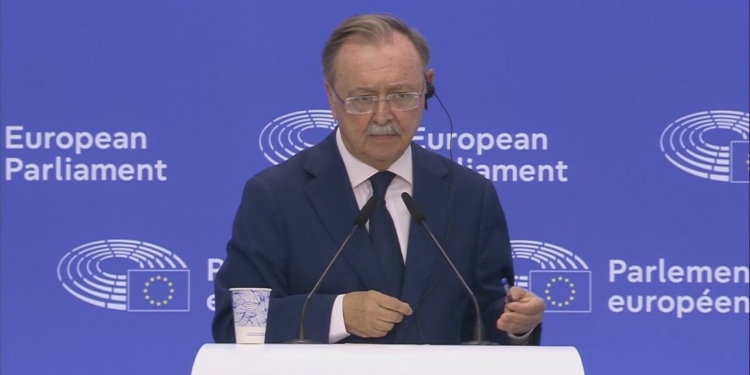
The president of Ceuta, Juan Jesús Vivas, stated this Tuesday that the massive influx of migrants on July 30 and 31 was made possible by “Morocco’s participation or consent” and called for greater involvement from European institutions to reinforce the border, facilitate the return of those remaining in the city, and provide economic support to Ceuta. He also requested a “specific status” for the city that recognizes its “extremely unique situation.”
Vivas, who appeared before the media at the European Parliament, denounced the “constant policy of harassment” that, according to him, Morocco maintains toward Ceuta and Melilla, and asserted that the neighboring country “constantly seeks the harassment and dismantling” of both cities.
The president of Ceuta accused Morocco of using border controls and migratory pressure to “jeopardize our territorial integrity, to cause the collapse of our reception services, and to destabilize Ceuta in every respect.”
In this context, he called for greater involvement from EU institutions, stating that “Europe means a great deal to Spain, and because Europe means a great deal to Ceuta.”
Vivas demanded a greater EU presence in Ceuta, both in border and migration matters, through Frontex and the European Asylum Agency, and financial support for the necessary infrastructure at the border and to address the reception situation, especially that of unaccompanied foreign minors.
He also demanded that Morocco contribute to the return to their country of the people who arrived in Ceuta on July 30 and 31 and who are still in the city. In his view, this measure is necessary for the city to return to normal.
A “specific status” for Ceuta
Beyond measures related to the migration situation, Vivas proposed that Ceuta and Melilla be granted a “specific status” within the European Union that takes into account their particular circumstances.
“I don’t know if it will be comparable to that of the outermost regions; it could be a starting point. I don’t know if integration into the customs union could be an option,” he explained.
He detailed that this status should address issues such as state aid, the possibility for products originating in Ceuta to enter the EU market “under a free circulation regime, without any obstacles,” the validation of the city’s special economic and fiscal regime, and increased funding through European structural funds.
The proposal, he noted, stems from recognizing Ceuta’s “extreme uniqueness,” referring to its “conditions, limitations, difficulties, and also, as is evident, threats.”
Vivas also called for Ceuta and Melilla to be incorporated into the European Committee of the Regions. “If there is one region in Europe that, due to its specific characteristics and unique circumstances, must be represented on the Committee of the Regions, it should be Ceuta and Melilla,” he stated.
In this regard, he thanked the president of the Spanish Federation of Municipalities and Provinces (FEMP), María José García-Pelayo, mayor of Jerez, for relinquishing her position as representative of Spanish municipalities on the Committee of the Regions to facilitate Ceuta’s representation. Vivas highlighted the decision as a gesture of “generosity” so that “the voice that is most needed today, that of Ceuta, is heard in Europe and represented on the Committee of the Regions.”
An European response to Morocco
When asked about Brussels’ tone toward Morocco, which the European Commission considers an “important strategic partner” on migration issues, and whether the EU should have hardened its stance, Vivas defended maintaining cooperation with the neighboring country, but insisted that it be based on respect for borders.
“We are the neighbors. We have the greatest interest in ensuring that relations between Europe and Morocco are fruitful and collaborative,” he replied.
However, he maintained that this cooperation must take into account the episodes of migratory pressure that he attributed to Morocco. “The reality cannot be denied,” he stated, before pointing out that the neighboring country “has twice used border control and migratory pressure to jeopardize the territorial integrity of Ceuta, of Spain, and of Europe.”
Given this, he considered that a European response is necessary. “We believe that this cannot be tolerated and that it must elicit a strong response from Europe,” he affirmed.
Vivas insisted that this response must be linked to the continuation of cooperation with Morocco. “We must tell Morocco that if we want a fruitful and beneficial cooperation policy, we must start from a foundation of respect,” he maintained. “Respect begins with respecting our borders and our territorial integrity,” he concluded.