
The Diplomat
The governments of Russia and Israel have categorically rejected the accusations made by Spanish Prime Minister Pedro Sánchez regarding their possible involvement in the migration crisis that erupted in Ceuta on July 30 and 31.
In statements to the Cadena SER radio program “Hoy por Hoy” on Monday, Sánchez asserted that the crisis began as a result of “fake news” spread on social media following the Supreme Court ruling that prohibits summary deportations of migrants who swim across the border. These “fake news” accounts, he added, were disseminated by social media networks “associated with both Russia and Israel, and with an international far-right movement that always uses migration, not only to attack Spain, but also Europe.”
Sánchez also asserted that he had consulted a report by the European External Action Service (EEAS) on disinformation campaigns related to Russia and Israel. “If Russia engages in disinformation on this issue, or if Israel also engages in disinformation by criticizing the Spanish government, it won’t be because they are concerned about migration in Spain or Europe,” he stated, but rather because of the Spanish government’s “courageous political stances” regarding Gaza and the Russian invasion of Ukraine.
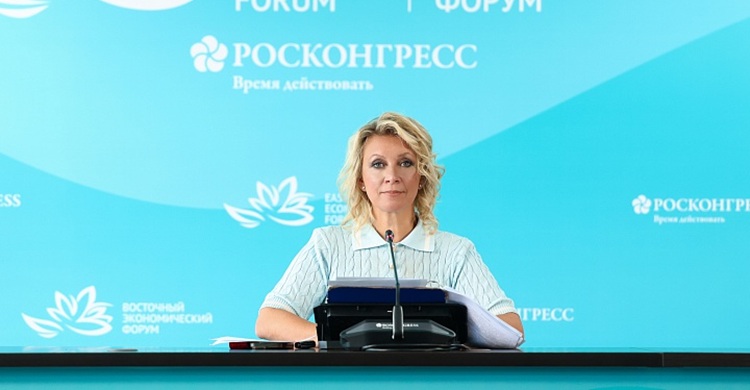
In response to these remarks, Russian Foreign Ministry spokeswoman Maria Zakharova demanded on Tuesday that Moscow be provided with “some material to support Spain’s concerns—transcripts, photographs, video footage, or a screenshot,” because “when there are accusations, there must be verifiable facts.”
“Instead of going to our Embassy in Madrid, to the specialized channels for bilateral relations, they rush to a microphone to make statements without any backing, without providing any evidence,” she added, as quoted by the Interfax news agency.
“Instead of going to our Embassy in Madrid, to the specialized channels for bilateral relations, they rush to a microphone to make statements without any support, without providing any evidence,” she added.
Russian presidential spokesman Dmitry Peskov also asserted that Russian authorities “have no connection whatsoever” with the mass arrival of migrants in Ceuta. “Statements about Russia’s alleged involvement in the migration crisis in the Spanish autonomous city of Ceuta do not correspond to reality,” the Russian Embassy in Madrid posted on its Telegram channel.
Meanwhile, Israeli Foreign Minister Gideon Sa’ar accused Sánchez of “blatantly” lying. “He has lied again by surprisingly accusing Israel of spreading misleading information about the events in Ceuta,” he posted on social media. “Continuing to spread defamatory lies will not distract from Sánchez’s shameful failure to manage his country’s affairs,” he added.
For her part, government spokesperson Elma Saiz asserted on Tuesday that the Executive is working “with evidence” and maintained that actors linked to the international far right and various digital forums, including profiles associated with Russia and Israel, amplified the events “with the intention of fracturing and polarizing Europe and, consequently, even Spanish society.”
In the press conference following the Council of Ministers meeting, Saiz added that she was referring to internal reports from the Ministry of Foreign Affairs and affirmed that the European Commission “already identified Russia on August 6 as a source, or rather, a source of disinformation regarding the events in Ceuta in recent days.”
The EU
The European Commission, in fact, avoided commenting on the substance of the matter on Tuesday and referred to the work of the European External Action Service (EEAS) on foreign information manipulation and interference (FIMI).
EU spokesperson Paula Pinho explained that the issue falls under the purview of the EEAS and stated that the Commission has no information of its own on this matter. “We have no independent information on this matter,” he stated, before referring the questions to the informal Foreign Affairs Council and the hearings scheduled for these days to obtain more information.
However, EU sources previously indicated that the amplification of content linked to Russia regarding the Ceuta incidents occurred in the days following July 30, the date of the mass entry, and that they did not detect any such activity prior to those events.
EU sources explained that, from the perspective of the FIMI (International Federation of Migration and Foreign Affairs), various channels linked to Russia rapidly amplified the situation once the events had taken place. These channels included state-controlled media, diplomatic channels, and sources aligned with Moscow.
“What we have seen is that, through different FIMI channels, particularly Russian ones, they rapidly amplified the situation we had observed on the ground after the events,” these sources indicated.
The same sources specified that “before July 30 we did not detect any amplification,” placing this activity in the days following the mass entry and not as an element prior to the events.