Cristina Marcén
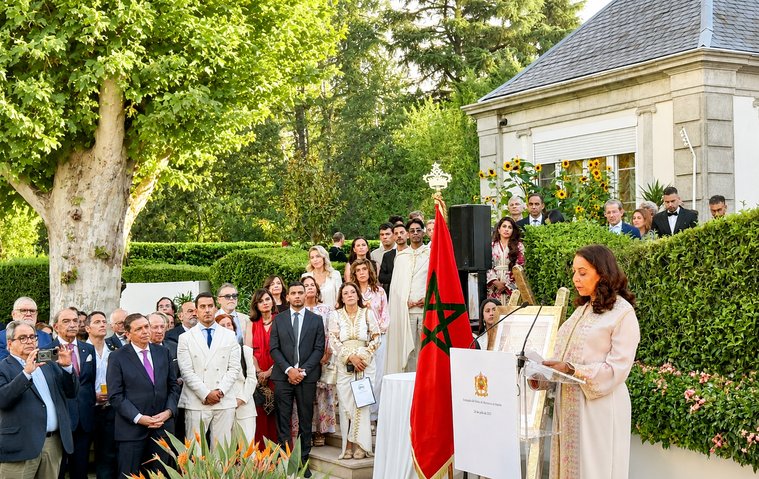
All eyes were on Karima Benyaich. Her remarks were expected to provide Morocco’s first public response to the events unfolding in Ceuta after the mass arrival of Moroccan nationals in the Spanish city. Meanwhile, the traditional Throne Day reception at the ambassador’s residence coincided with one of the most delicate moments in Morocco-Spain relations in recent months. As a result, her speech became the focal point of the evening.
The reception is regarded as one of the highlights of Spain’s diplomatic calendar. It brought together members of the Government, the diplomatic corps and senior representatives of the country’s leading institutions.
Among those attending were Minister of Agriculture, Fisheries and Food Luis Planas, former Prime Minister Felipe González, Spain’s Ombudsman Ángel Gabilondo, National Court judge Santiago Pedraz and journalist Juan Luis Cebrián. The guest list also included a large number of ambassadors, particularly from Arab countries, together with leading figures from business, academia and culture.
The Moroccan Ambassador to Spain did not shy away from the issue dominating the headlines. She stressed that the governments of Morocco and Spain remain in constant contact to manage the situation in Ceuta and reiterated her country’s commitment to “legal, orderly and safe” migration.
“Our governments and our ministers are in continuous contact to resolve this situation,” she said.
Benyaich added that Morocco wants those who crossed the border illegally to return and acknowledged that “this is not something that pleases us.”
She then described cooperation as the cornerstone of the bilateral relationship. She highlighted the close coordination between Morocco and Spain on security, counterterrorism, the fight against organised crime and migration management. In addition, she pointed to initiatives such as circular migration programmes and Operation Marhaba, which every summer facilitate the transit of millions of Moroccans living in Europe.
“Only fourteen kilometres separate us—and unite us,” she said, in one of the most memorable moments of her address.
With that remark, Benyaich encapsulated the central message of her speech: geographical proximity has made Morocco and Spain strategic partners with shared interests and an increasingly close agenda of cooperation.
The ambassador also reviewed Morocco’s transformation during the twenty-seven years of King Mohammed VI’s reign. She highlighted the country’s investment in infrastructure, the growth of strategic industries such as automotive manufacturing, aerospace and renewable energy, as well as the expansion of social protection and policies aimed at attracting foreign investment.
Benyaich also recalled that Spain has been Morocco’s leading trading partner for more than a decade and underlined the strength of bilateral economic ties. She referred to joint initiatives such as the organisation of the 2030 FIFA World Cup, which Morocco will co-host with Spain and Portugal, describing the tournament as another opportunity to strengthen relations across the Strait of Gibraltar.
Following the formal proceedings, the evening turned to a celebration of Moroccan culture. Guests gathered in the gardens of the ambassador’s residence for a reception showcasing the Kingdom’s renowned gastronomy. The event concluded with a performance by Sanaa Marahati, one of the leading voices of contemporary Moroccan music and a celebrated interpreter of the classical Andalusian repertoire, who offered guests a glimpse of Morocco’s rich musical heritage.