Coinciding with the 250th anniversary of US independence, the PSJM collective presents the exhibition “American Democracy” at Casa de América, comprised of two shows: “American Colors” and “American Democracy.” These two projects are key to their artistic process, called “social geometry,” through which PSJM generates minimalist compositions based on statistical data or election recounts.
PSJM, a creative, theoretical, and management team formed in 2003 by Cynthia Viera (Las Palmas de Gran Canaria, 1973) and Pablo San José (Mieres, 1969), has been included among the one hundred most representative artists of socially engaged international art in Art & Agenda: Political Art and Activism (Gestalten, Berlin, 2011). Awarded the 2025 Can de las Artes prize by the Gran Canaria Island Council, their works are part of important collections such as the Jerry Speyer Collection in New York and the Lidia Rubinstein Collection in Los Angeles, and are featured in numerous international exhibitions.
The double exhibition will take place from Thursday, June 25 to Wednesday, September 30, 2026. Monday to Friday, 11:00 a.m. to 7:30 p.m. Saturdays, 11:00 a.m. to 3:00 p.m. Closed Sundays and holidays. Casa de América-ABANCA Gallery | Guayasamín and Torres García Rooms. Entrance at C/ Marqués del Duero, 2, Madrid. Free admission until capacity is reached.
American Colors
Guayasamín Room. Ground floor
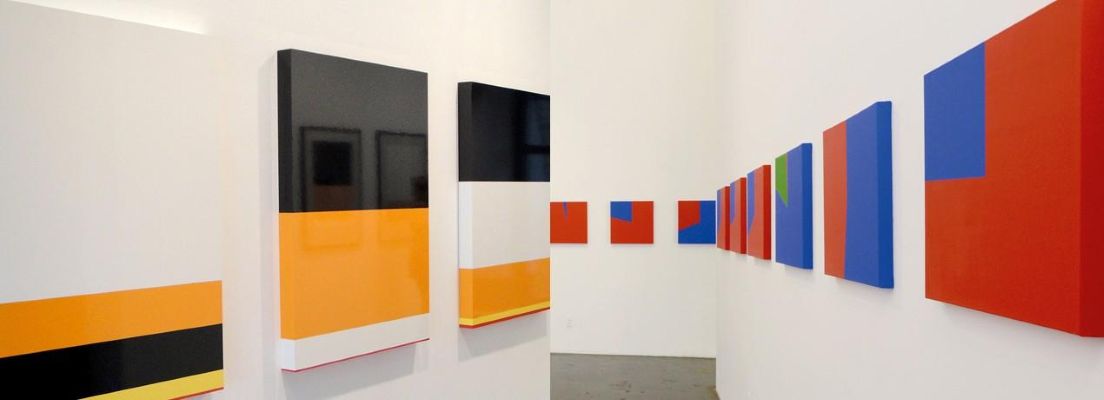
American Colors (2009-2010) is the series with which the collective began its “social geometry.” These are different works that use the five colors conventionally associated with race and subject their composition to the census percentage of the population, the prison population, and the poverty index by ethnicity in the USA. Formalist language is rethought, moving beyond intuitive compositions or those conditioned by meaningless arithmetic or geometric progressions. Here, it is statistics—not abstract, but equally mathematical—that dictates the percentage of each color used in the painting.
Color is employed in such a way that it carries meaning, conceptually linked to the use of language to refer to different races. These are, therefore, paintings that are meant to be read. The raw material processed by the knowledge society is information, and this is precisely what underpins the artistic strategy of “social geometry,” where infographics and the tradition of American color field painting are combined with sociological study to offer a critical reflection. The title of each painting, for example, USA Population by Race or USA Prison Population by Race, leads the viewer to a rather different perspective than the one they might initially have upon seeing these artistic objects, which, in their execution—Formica on wood—reproduce the finishes of lifestyle design.
American Democracy
Torres García Room. 1st floor
American Democracy (2022) is a large installation composed of 59 historical paintings: a pictorial portrait of the political history of the United States interpreted in a geometric key. With this project, PSJM continues the development of its own language within the field of abstraction, which the collective has termed “social geometry,” in which, as mentioned, geometric compositions are generated from statistical data or election results.
The creation of American Democracy involved rigorous research into presidential elections throughout the history of the United States, a nation founded as a democracy and which has remained so uninterruptedly throughout time. This fact provides us with a privileged timeline that crystallizes in a large-scale installation, allowing us to visually depict the fluctuations of a democratic system.
250th Anniversary of the Birth of the United States
In 2026, Casa de América will commemorate the 250th anniversary of the founding of the United States, an event that recalls the foundational process that led to the birth of the country at the end of the 18th century.
The exhibitions that make up “American Democracy” are part of the activities surrounding this event, through which Casa de América will serve as a platform for encounter, reflection, and artistic creation of the diverse realities of the Americas. The celebration of this 250th anniversary offers an opportunity to reflect on the historical, political, and cultural construction of the United States, as well as its relationship with the rest of the American continent.