The Diplomat Editorial Staff
The Residence of the Italian Embassy in Madrid hosted this week a high-level discussion on one of the defining political challenges of our time: the ability of liberal democracies to uphold the rule of law in an international environment increasingly shaped by polarization, the rise of authoritarianism, and declining public trust in institutions.
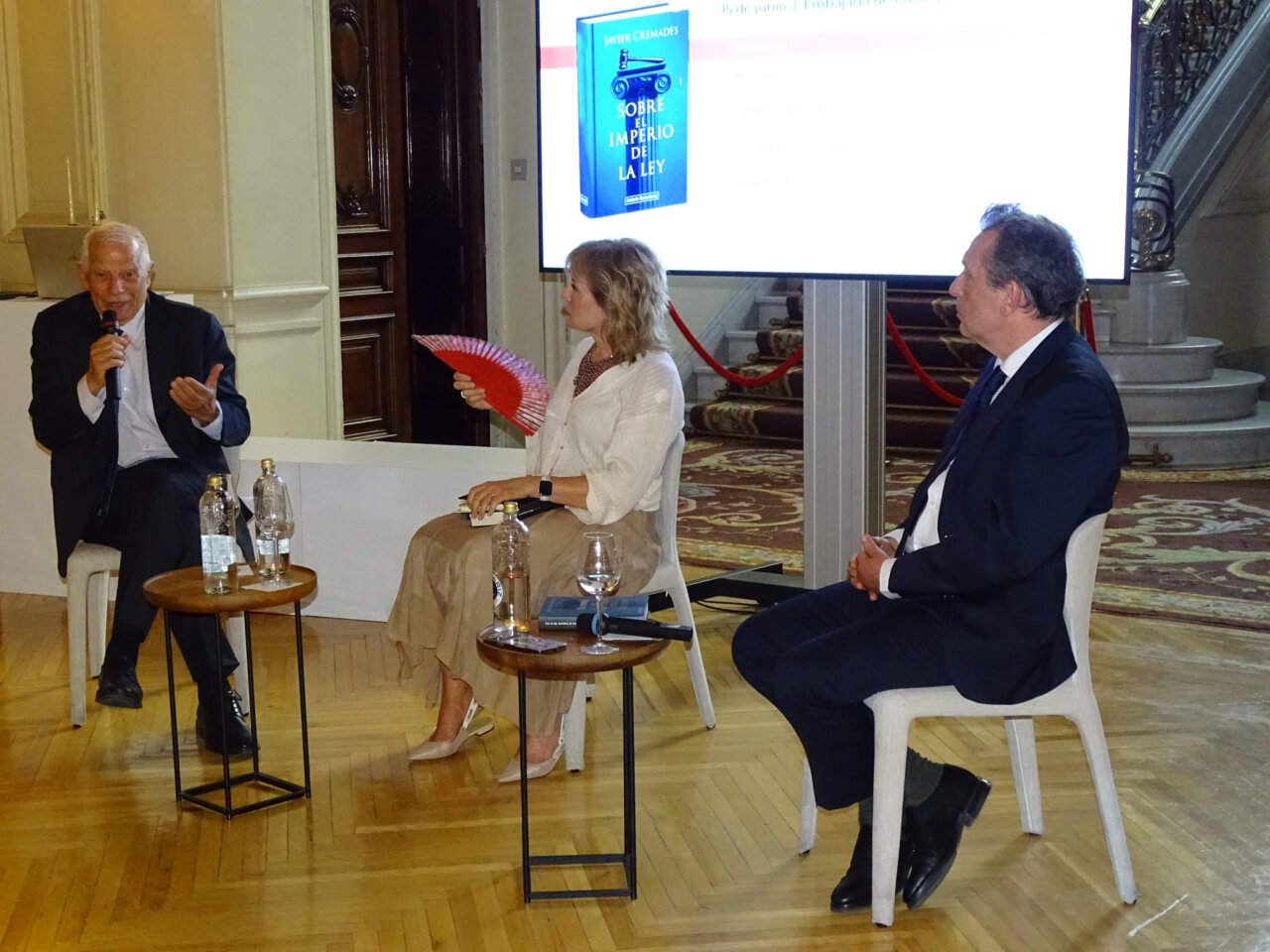
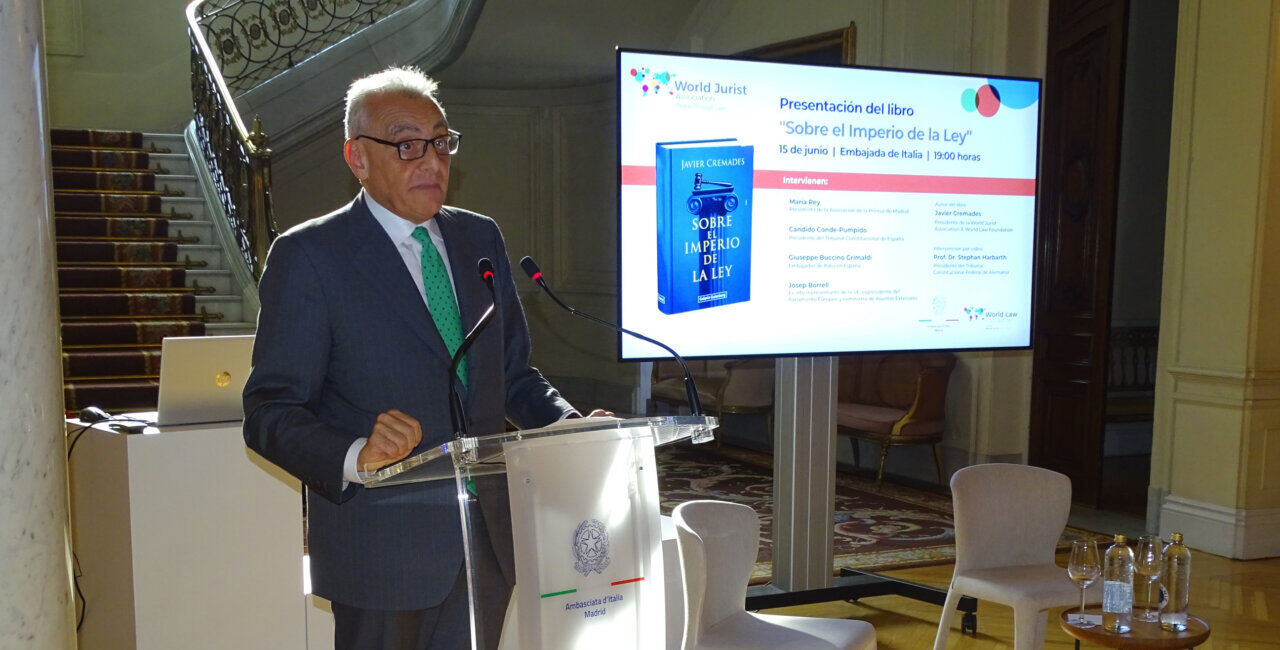 The event was held on the occasion of the presentation of On the Rule of Law, the latest book by Spanish jurist Javier Cremades, President of the World Jurist Association, and brought together leading figures from the legal, diplomatic, and institutional spheres. The central conversation offered two complementary perspectives on democratic governance: that of Cremades himself and that of Josep Borrell, former High Representative of the European Union for Foreign Affairs and Security Policy, in a dialogue moderated by journalist María Rey.
The session was opened by the President of Spain’s Constitutional Court, Cándido Conde-Pumpido, while Italy’s Ambassador to Spain, Giuseppe Buccino Grimaldi, hosted an event attended by numerous ambassadors accredited in Madrid, representatives of the legal community, and prominent members of civil society.
Far beyond the presentation of a book, the discussion evolved into a broader reflection on the growing tension between the rule of law and the power dynamics that increasingly characterize the contemporary international landscape. Borrell returned to an argument that has featured prominently in many of his public interventions since leaving office: the distinction between an order governed by rules and one sustained solely by relations of power.
At a time when conflicts such as the war in Ukraine, tensions in the Middle East, and challenges to democratic institutions in various parts of the world are testing the resilience of the liberal international order, the former EU foreign policy chief stressed that no legal norm can be effective without the capacity to enforce it. His remarks touched upon one of today’s central geopolitical debates: the widening gap between international legal legitimacy and the practical ability of multilateral actors to ensure compliance.
For his part, Cremades warned against the spread of political systems that combine formal democratic mechanisms with increasingly authoritarian practices. According to the President of the World Jurist Association, the erosion of public confidence in representative institutions is one of the key factors driving this trend.
During the discussion, both speakers agreed that Western democracies are experiencing a period of institutional vulnerability that requires renewed commitment to constitutional culture and respect for common rules. In this regard, Cremades noted that constitutions now regarded as firmly established—including those of Spain, Italy, and Germany—remain relatively recent from a historical perspective and should still be viewed as political projects under continuous construction.
 The European dimension of the debate was also evident throughout the event. In his opening remarks, Ambassador Buccino Grimaldi emphasized that the rule of law should never be regarded as an irreversible achievement, but rather as a delicate equilibrium that depends upon strong institutions, respect for due process, and acceptance of the limits that constitutional frameworks impose on political power.
One of the most significant themes of the evening concerned the relationship between justice and politics. At a time when many democratic societies are engaged in intense debates over judicial independence and the legitimacy of court rulings, participants agreed that the true strength of the rule of law is demonstrated when citizens and institutions respect judicial decisions even when they disagree with them.
Conde-Pumpido echoed this principle by highlighting Spain’s 1978 Constitution as the framework that has enabled the longest period of democratic stability in the country’s contemporary history. While acknowledging that current international affairs offer numerous examples in which force prevails over law, he argued that democratically enacted legislation, applied impartially, remains the only viable foundation for free societies.
A video message from Stephan Harbarth, President of Germany’s Federal Constitutional Court, reinforced this argument. Harbarth warned of the climate of uncertainty and anxiety affecting many Western democracies and stressed that the defence of the rule of law remains an indispensable condition for safeguarding both political freedom and democracy itself.
The event concluded with a reflection on legal interpretation and the inevitable fallibility of human judgment. Drawing on a number of judicial precedents, Borrell and Cremades examined how evolving social and cultural attitudes influence the development of legal decisions, illustrating that the rule of law is not merely a body of rules but a living framework that evolves alongside the societies it serves.
At a moment of growing geopolitical uncertainty, the discussion in Madrid arrived at a shared conclusion: the defence of the rule of law is no longer solely a legal or constitutional matter, but a central component of the competition between political models that is shaping the international order of the twenty-first century.