
David Martínez Calderón
International Affairs Analyst
Ágora Diplomática
On the frigid morning of February 26, 1992, the city of Khojaly, a small but strategically important settlement in the Azerbaijani region of Karabakh, became the scene of one of the most atrocious massacres of the late 20th century in the post-Soviet era. More than 600 Azerbaijani civilians, including 106 women and 63 children, were killed by Armenian armed forces; the whereabouts of 150 of them remain unknown. Entire families were wiped out, children were orphaned, and the survivors were left scarred both physically and emotionally. The events of that day were not isolated acts of violence, but rather part of a policy of ethnic cleansing aimed at expelling Azerbaijanis from the region. In the decades since, the wounds of Khojaly have remained, permeating the collective memory of a nation still seeking justice.
The massacre was a calculated maneuver by Armenian military leaders to terrorize Azerbaijanis and expel them from the Karabakh region. It was part of an open war, initiated by Armenia against Azerbaijan to occupy this region. In an interview with Thomas de Waal in December 2000, Serzh Sargsyan, who would become President of Armenia from 2008 to 2018, admitted that the massacre of civilians in Khojaly was intended to “put an end” to Azerbaijani resistance and instill fear among other local Azerbaijani residents, who until then had not believed the Armenian army capable of using its weapons against civilians. The assault on the city was crucial to Armenia’s overall strategy of consolidating control over Karabakh and its surrounding districts. Journalists and human rights organizations, such as Human Rights Watch, documented the atrocities, recognizing the Khojaly massacre as “the largest massacre to date in the conflict” between Armenia and Azerbaijan.
For three decades, Khojaly symbolized both the human cost of Armenian aggression and the unresolved injustices of the Karabakh conflict. Azerbaijan’s diplomatic efforts secured international recognition of the tragedy. To date, 17 national legislative assemblies, 24 U.S. states, the Organization of Islamic Cooperation, and the Organization of Turkish States have officially condemned the massacre, calling it a crime against humanity and an act of genocide. However, despite growing awareness and international recognition, until recently, the perpetrators remained largely unpunished.
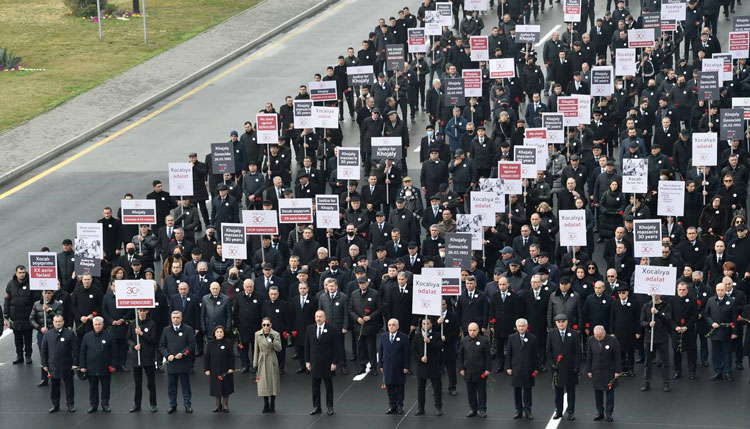
With Azerbaijan’s decisive victory in the 44-Day War, also known as the Second Karabakh War, in 2020, the situation began to change. After nearly three decades of occupation and repeated attempts at negotiation with various international mediators, Azerbaijan restored its territorial integrity, liberating the lands that had long been held by the Armenian armed forces and the separatist regime established in the occupied territories. The military operation of September 2023 toppled the separatist regime, creating unprecedented conditions for bilateral dialogue between Baku and Yerevan. The liberation of the Karabakh region, including Khojaly, was not only a military achievement but also allowed Azerbaijan to commemorate the victims in the cities where the tragic events took place. In February 2024, Azerbaijan commemorated the 30th anniversary of the Khojaly genocide for the first time in a liberated Khojaly, a symbolic act of remembrance that underscores the scars on Azerbaijan’s contemporary conscience.
With the restoration of territorial sovereignty, investigations and legal proceedings were conducted to determine responsibility for crimes committed during the hostilities. In early February 2026, the Baku Military Court concluded one of the most significant trials in the history of the Karabakh conflict: former leaders of the dismantled Artsakh separatist regime, including Arayik Harutyunyan, Levon Mnatsakanyan, Davit Manukyan, Davit Ishkhanyan, and Davit Babayan, were sentenced to life imprisonment, convicted of crimes against peace and humanity, war crimes, genocide, and terrorism. Other defendants, such as Arkadi Ghukasyan and Bako Sahakyan, were sentenced to 20 years in prison for similar crimes. The tribunal examined evidence linking the defendants to atrocities committed against the Azerbaijani civilian population, including missile attacks on residential areas of cities like Ganja, forced displacement of people, torture, and the creation of illegal armed militias. The sentences constitute a historic step in the fight against terrorism.
The pursuit of justice and post-conflict reconciliation. Beyond Azerbaijan’s military successes, the pursuit of lasting peace and reconciliation remains the top priority for the people and government of the Caucasus nation. The peace process between Azerbaijan and Armenia has advanced significantly, particularly with the Washington Summit in August 2025. Hosted by US President Donald Trump, the Summit brought together Azerbaijani President Ilham Aliyev and Armenian Prime Minister Nikol Pashinyan to sign a comprehensive Peace Treaty. This agreement formalized the mutual recognition of sovereignty and territorial integrity and addressed the reopening of regional transport links.
The Washington Summit represented a unique opportunity to transform the South Caucasus from an area of recurring conflict into a region of lasting stability. By promoting political normalization, achieved through tangible economic and connectivity projects, it has created incentives for cooperation, thereby reducing the likelihood of renewed hostilities. The year since the Summit has been the most peaceful period in relations between Armenia and Azerbaijan since both countries regained their independence from the Soviet Union in 1991. In early February, the leaders of Armenia and Azerbaijan received the Zayed Human Fraternity Award in the United Arab Emirates, recognizing the efforts and steps taken by both to end decades of conflict between their countries and advance the normalization of relations.
Looking ahead, Azerbaijan continues to insist that effective reconciliation will require more than treaties and infrastructure projects: it will require an examination of legal accountability, transparent historical documentation, and international recognition of crimes committed against the civilian population. These factors will help break the cycle of mistrust and violence that has plagued these two peoples who lived and developed together for centuries before the ethnic hostilities of the 20th century. The memory of Khojaly is preserved in the hearts of the survivors and in the national consciousness and exemplifies the brutality of the conflict between Azerbaijan and Armenia; as well as illustrating the value of peace and the need for historical reconciliation of both peoples.