
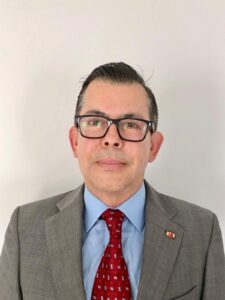
Jesús A. García R.
Retired Major of the Army. Engineer. Master in Public Management and former Consul of Venezuela in Madrid

I am writing this article on the night of February 3rd and 4th. Both dates are important for Venezuelans.
A month ago, the illegitimate Nicolás Maduro was removed from his compound in Fort Tiuna, Caracas.
Thirty-four years ago, Lieutenant Colonel Hugo Chávez took up arms, leading a minority of the Venezuelan Army. He failed spectacularly in his attempt, but it was a turning point, a turning point from day to night.
Venezuela is going through an unprecedented situation: the president elected by Venezuelans in the last general elections is in self-imposed exile in Madrid. The usurper president is imprisoned on multiple charges in a federal prison in New York. The president-in-waiting of many Venezuelans is like an ant without an antenna, making herself visible… and, in the exercise of the presidency, in an interim capacity, is a citizen whom no one has elected and whose only legitimacy is the 90-day provisional term, renewable, granted to her by the Constitution. A complete mess.
A month after Maduro’s capture, many things have changed in Venezuela, but many more remain to be changed. We will mention the most relevant aspects.
Politically, not all of the opposition is spotless and made up of “saintly men,” nor is all of Chavismo made up of crooks, heartless individuals, and criminals. There is a very important space outside the Manichean view of good and bad. Therein lies the most fertile ground of the country’s human resources. At the beginning of Chávez’s term, there were competent and honest officials who were pushing for the optimization of public administration. They fell by the wayside.
There was no single Hugo Chávez. The man mutated, and from being a president with an overwhelming majority, democratic will, and democratic methods, he transformed into an autocrat and veered toward a radical leftism influenced by Cuban Castroism, to which, at the end of his life, he literally surrendered. He designated Maduro, the Cubans’ godson, as his successor. His worst decision.
Maduro began his reign in 2013 lacking the necessary training, talent, and love for Venezuela. He ordered the imprisonment of the best minister in his first cabinet, and Miguel Rodríguez Torres, known as “Maduro’s prisoner,” spent five years behind bars. He destroyed national cohesion, ruined the economy, expelled more than seven million Venezuelans, filled the prisons with political prisoners, popularized extrajudicial killings, shattered institutions, and corrupted priests, judges, military personnel, and politicians. With a penchant for plunder, he promoted it from within the State, turning Venezuela into a haven and logistical base for anyone, person or organization, whose aim was to destroy Western culture, especially the United States.
His latest crime was stealing the elections of July 28, 2024. A grave error… Talleyrand said that “power without morality is only a source of corruption”… that phrase seems directed at Maduro: immoral, illegitimate, and corrupt.
The usurper president became unpalatable, and it was only a matter of time before an agreement with the Americans to remove him “at any moment” germinated within his inner circle. Those same Armed Forces that Maduro detested and disrespected so often were his Achilles’ heel, as he wounded them until they were a eunuch organization, without training, without vocation, and without morals. Twenty-seven minutes were enough for them to take away their brand-new Commander-in-Chief in a tactically flawless operation. No one fired. No one reacted. No one complied. No one defended them.
Padrino López and the Larez brothers, figurehead generals, will go down in history as the epitome of incompetence, mediocrity, and betrayal of the Code of Honor.
Finally, in this transitional phase, there is Delcy Rodríguez, walking a tightrope: on one side, she is pressured by radical Chavistas, and on the other by the US, the only actor that has taken a firm stand. For her to move forward, she must appease both sides somewhat and have enough time. Anyone who truly loves Venezuela must contribute their efforts to a peaceful transition, so that the long-awaited general elections are not held tomorrow. This is not a time for haste, but for prudence and patience. At this moment, Delcy’s success is the success of all Venezuelans.