
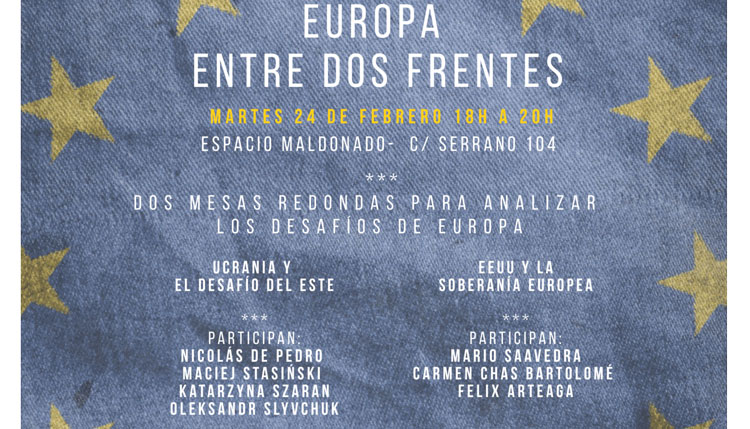
On the fourth anniversary of the invasion of Ukraine, the Fundación Amberes, the Polish Embassy, the Instituto Polaco de Cultura and the University of Comillas are organizing a meeting entitled Europe between two fronts on Tuesday 24 February at 6 p.m. which will take place in the Espacio Maldonado (Serrano Street, 104). Free admission until full capacity.
The meeting is conceived as a space for reflection and dialogue on the major strategic challenges facing the European continent today. The event will be organised around two round tables that will address key issues for Europe’s present and future:
— Ukraine and the Eastern Challenge, with the participation of Nicolás de Pedro, Maciek Stasiński, Katarzyna Szaran and Oleksandr Slyvchuk.
— US and European sovereignty, with Mario Saavedra, Carmen Chas Bartolomé and Félix Arteaga.
On Tuesday, February 24, it will be four years since Vladimir Putin’s invasion of Ukraine by Russia began, the most serious challenge to the European Union since the fall of the Berlin Wall in November 1989 ended the Cold War. Security, sovereignty, and international standing have been challenged simultaneously from the East and the West. The continent is forced, as Canadian Prime Minister Mark Carney just reminded us, to stand up and respond to two uncontrollable threats: an open war on its eastern border and growing uncertainty about the strength of the transatlantic link that has underpinned its security architecture for nine decades.
To the east, the war in Ukraine has gone from being a peripheral conflict to becoming a central factor of the European order. Russia’s aggression, together with its hybrid pressure strategies and recurring tensions in the airspace of countries like Poland, raises questions about the European Union’s deterrent capacity, political cohesion, and inalienable autonomy.
To the West, US withdrawal and the return of Donald Trump’s brazenly unilateralist speech make unavoidable the questions that Europe has postponed for too long, such as the real cost of resigning defense and outsourcing it to Washington and the resulting impact on European sovereignty in a world of great superpowers, where the territory of Greenland is under the sovereignty of a NATO ally and EU member, appears as an interchangeable piece according to the appetites of American hegemony.
This call proposes to think Europe without complacency, rhetorical havens or prefabricated clichés. It is not limited to the analysis of external threats, but seeks to ask whether it has a political project capable of sustaining itself in a hostile environment or if it continues to manage obsolete inertias in a world that has already changed. The crucial question facing Europe is whether to remain a protected area or become an actor conscious of its historical responsibility.