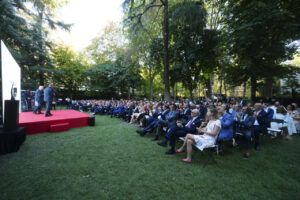
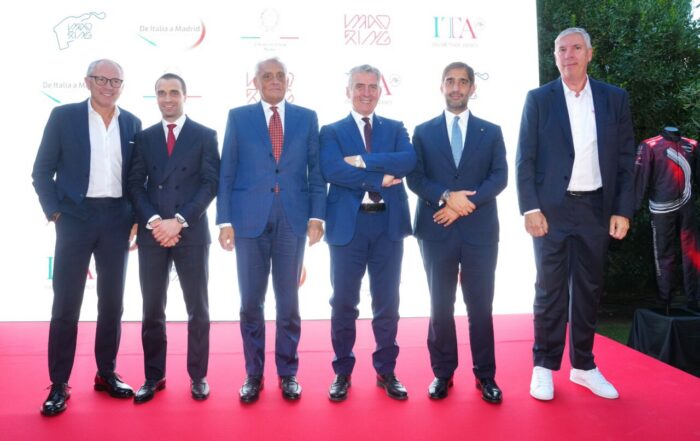
The arrival of Formula 1 in Madrid has also brought one of Italy’s great industrial strengths into the spotlight. On Thursday, on the eve of MADRING’s debut, Italy’s Ambassador to Spain, Giuseppe Buccino Grimaldi, brought together leading figures from Formula 1 and the Italian automotive industry.
The event, “From Italy to Madrid: Passion Travels in Formula 1,” brought together Formula 1 President and CEO Stefano Domenicali; IFEMA Madrid President José Vicente de los Mozos; Automobile Club d’Italia (ACI) President Geronimo La Russa; Dallara General Manager and Motor Valley and MUNER President Andrea Pontremoli; and Scuderia Ferrari Deputy Team Principal Jérôme D’Ambrosio.
The discussion was moderated by Carlo Vanzini, a Sky Sports F1 journalist and one of the best-known voices in Italian Formula 1 coverage.
Italy and Spain: Formula 1 as a new platform for connection
Buccino Grimaldi placed Madrid’s arrival on the Formula 1 calendar within the context of a bilateral relationship that extends far beyond sport.
“Formula 1 is once again building a bridge between Italy and Spain,” the Ambassador said. He highlighted the shared history of the two countries and their ability to turn tradition, talent and innovation into performance.
Madrid’s role as the setting for this connection is significant. Bilateral trade between Italy and Spain reached €71 billion in 2025, according to the Ambassador. Spain is therefore one of Italy’s main economic partners.
For Italy, Formula 1 is also a powerful tool for showcasing its industrial base. Motorsport provides an international platform for capabilities ranging from engineering and design to advanced manufacturing, electronics and materials.
As a result, sport has become part of Italy’s external action as a form of economic diplomacy. It can create business opportunities while strengthening ties between the two countries.
Domenicali summed up that relationship from a more personal perspective: “For an Italian, talking about engines is like talking about music, a music that stays in the heart.”
The remark reflects the cultural importance of the automobile in Italy. It also helps explain why Formula 1 is such an effective platform for showcasing Made in Italy.
Madrid wants to enter Formula 1 with its own identity
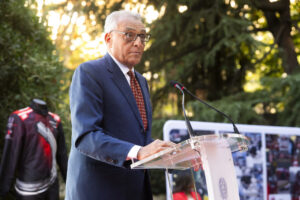
José Vicente de los Mozos focused on the opportunity represented by Formula 1’s return to the Spanish capital 45 years after the last race held in Madrid.
The President of IFEMA Madrid underlined the symbolic importance of the moment. He also stressed that Madrid’s arrival on the calendar cannot be separated from its relationship with Italy.
“It is no coincidence that the person leading this competition is an Italian,” he said, referring to Domenicali.
However, Madrid does not want simply to replicate other Grands Prix. De los Mozos defended a project with its own personality. It should combine the best of international motorsport with an identity rooted in Madrid and Spain.
At the same time, the circuit should be “fun, demanding and technical”. The Grand Prix should also create a distinctive experience and generate an economic return across the city.
“We want to create a new standard for Grands Prix,” he said.
That ambition is closely aligned with Formula 1’s own strategy. Domenicali argued that the Madrid project demonstrates that Europe still has the capacity to invest and grow around the championship.
For years, there had been a widespread perception that future growth would increasingly take place outside the continent.
“It was said that Formula 1 no longer had room for infrastructure growth in Europe. Madrid has proved exactly the opposite.”
The Formula 1 President and CEO described Madrid as a “very interesting, different and unique” project. He also said that the new race has significant potential for further growth.
For Domenicali, the project is only getting started. There is still room for new ideas to develop around the Grand Prix.
He also highlighted a particular feature of the Madrid circuit: the limited margin for error that drivers will have at certain points of the track. This could become one of MADRING’s distinctive sporting characteristics.
From the “ego-system” to the “eco-system”
While Domenicali spoke about Madrid’s opportunity within Formula 1, Andrea Pontremoli explained what lies behind Italy’s ability to build such a competitive automotive industry.
The Dallara General Manager and President of Motor Valley and MUNER summed up his approach in a striking expression:
“We need to move from the ego-system to the eco-system.”
The idea is that competitiveness does not depend solely on the strength of Ferrari, Dallara or any other major company. It also depends on the network connecting manufacturers, suppliers, small and medium-sized enterprises, universities, research centres and specialised professionals.
This is one of the defining features of Motor Valley. The concentration of knowledge and capabilities in the region allows companies of different sizes to work together across the same value chain.
Formula 1 is one of the clearest examples of this model. It requires the coordination of very different disciplines and areas of expertise.
The visible result is a single-seater car. Behind it, however, lies a network encompassing engineering, design, manufacturing, electronics, materials, tyres, software and data analysis.
Pontremoli’s point is particularly relevant to Madrid. The arrival of Formula 1 could provide an opportunity to build stronger links between the Grand Prix and Spain’s industrial, technological and academic ecosystem.
Design as part of the competition
This vision of an ecosystem was also reflected in the contribution of Nicola Girotti, Head of Product Design at Pininfarina. He focused on the relationship between design, functionality and innovation.
In Formula 1, design cannot be understood simply as a matter of aesthetics. Every solution must respond to demands related to performance, efficiency, aerodynamics and functionality.
Pininfarina’s presence in Madrid also had a particularly symbolic expression.
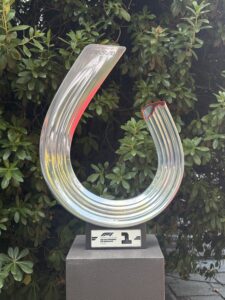
The trophy that will be lifted by the winner of the first Spanish Grand Prix at MADRING, named “Monumental,” was designed by the Italian firm. It was also on display during the event at the Italian Embassy.
The piece takes inspiration from one of the Madrid circuit’s most recognisable features. That element has been translated into the design of a trophy that is set to become part of the history of the new Grand Prix.
For Pininfarina, the challenge went beyond creating a sporting trophy. The firm has stated that “designing a trophy means designing a symbol, not only of the sport, but also of the people and the country hosting it.”
The result adds another connection between Italy and Madrid. An Italian company with a long-standing reputation in automotive design has helped shape one of the first symbols of the new Grand Prix.
Technology, data and performance: what the spectator does not see
The technological dimension of Formula 1 emerged clearly in the contributions from industry specialists. They offered a very different perspective on the competition from the one seen on the track.
At Marelli, Riccardo De Filippi, Head of its Motorsport Division, addressed the growing importance of electronics and real-time data processing.
Data management has become an essential part of racing. Decisions can depend on information coming directly from the car and on the immediate analysis of thousands of variables.
Meanwhile, Pirelli’s Dario Marrafuschi, Head of Motorsport, focused on one of the elements that most directly influences a race: tyres.
Temperature, degradation, performance and strategy are closely interconnected. Every tyre choice can therefore become a technical decision capable of changing the outcome of a Grand Prix.
The discussion also turned to infrastructure. Roberto Grilli, Director General of DZ Engineering, and Alexandros Miotto Haristos, Director of Operations at Racing Force Group, addressed the less visible side of the spectacle.
Their contributions covered the systems, facilities and safety devices required for a race to operate according to current Formula 1 standards.
As a result, Formula 1 operates as an innovation environment under extraordinary pressure. Teams must constantly improve performance. This drives the development of solutions in engineering, electronics, materials and data management.
Some of these technologies can later find applications in other industrial fields.
Italy’s Formula 1 ecosystem looks towards Madrid
The presence of Jérôme D’Ambrosio, Deputy Team Principal of Scuderia Ferrari, brought Ferrari’s perspective into the debate on the future of Formula 1 in Madrid.
His contribution focused on the relationship between tradition, technology and talent, three elements that continue to define Italy’s position in the championship.
Alongside Ferrari, the presence of Dallara, Pininfarina, Pirelli and Marelli illustrated the breadth of an ecosystem that does not depend on a single company or a single technology.
The participation of Luis García Abad, Director of the Spanish F1 Grand Prix, also brought the perspective of the Madrid project. His contribution highlighted the challenges involved in bringing the capital into a global championship.
The initiative by the Italian Embassy therefore offers a perspective that goes beyond the debut of a new Grand Prix.
Madrid is entering Formula 1 as Italy highlights the value of the entire ecosystem behind it.
The opportunity for both countries lies precisely there. The competition can do more than measure the performance of the cars over a race weekend. It can also create new connections between companies, technology, talent and institutions.
Ultimately, one of the defining features of the Italian model is its ability to turn the excellence of a handful of major brands into a complete industrial ecosystem.
Madrid now has the opportunity to decide which elements of that model it wants to incorporate into its own project.