
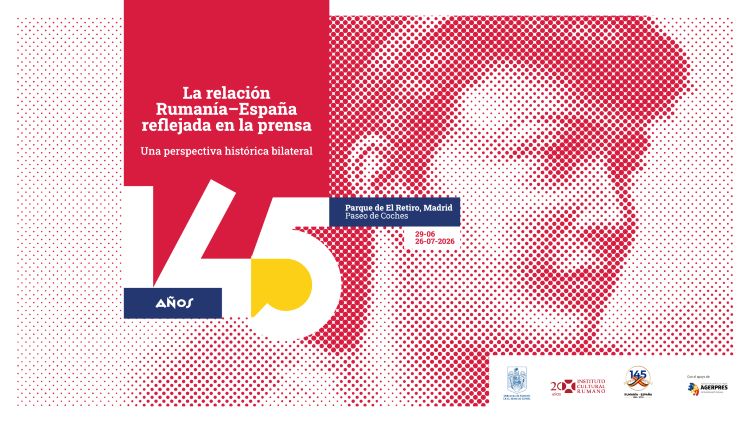
The Embassy of Romania in Spain and the Romanian Cultural Institute are presenting the exhibition “The Relationship Between Romania and Spain as Reflected in the Press: A Bilateral Historical Perspective” from June 29 to July 26 in El Retiro Park, Madrid (Paseo de Coches). For more information, call +34 91 3454553 or visit http://madrid.mae.ro. Admission is free.
Romania and the Kingdom of Spain will commemorate 145 years of diplomatic relations in 2026, an anniversary celebrating a bond built on dialogue, mutual respect, and cooperation. To mark this occasion, the Embassy of Romania in the Kingdom of Spain and the Romanian Cultural Institute in Madrid, with the support of the National Press Agency AGERPRES, are organizing the exhibition “The Relationship Between Romania and Spain as Reflected in the Press: A Bilateral Historical Perspective.” “A Bilateral Historical Perspective,” open to the public from June 29 to July 26, 2026, on the Paseo de Coches in Retiro Park.
On June 23, 1881, during the reigns of Carol I of Romania and Alfonso XII of Spain, the two countries established diplomatic relations at the legation level with the presentation in Bucharest of the credentials of Pedro de Aladro y Kastriota, Chargé d’Affaires ad interim (a.i.) of Spain. This moment marked the beginning of a lasting bilateral relationship, which has developed over time through dialogue, cooperation, and cultural exchange.
The exhibition invites the public to discover this shared history through the press, a privileged witness to the political, social, and cultural transformations that have brought the two countries closer together. From the first articles published in 19th-century newspapers to contemporary reports, the materials presented illustrate moments, personalities, and events that have contributed to strengthening bilateral dialogue.
Comprising 20 thematic panels, the exhibition offers a chronological and thematic journey through the history of relations between Romania and Spain. The documentary selection is based on Romanian and Spanish sources, bringing together articles, photographs, and archival material relevant to understanding the evolution of relations between the two countries. The Spanish press materials have been selected from the digital archives of the National Library of Spain and the Spanish Ministry of Culture (Historical Press), as well as from the archives of several leading newspapers. The Romanian section of the exhibition was produced with the support of the National Press Agency AGERPRES, which provided archival material and relevant documentary resources to illustrate the evolution of bilateral relations.
Visitors will learn about the beginnings of diplomatic relations, the role of the Royal Houses in consolidating ties between the two states, the contributions of prominent figures who have worked across both cultural spheres, and emblematic moments of the Romanian presence in Spain. Culture is given prominence through sections dedicated to literature, music, visual arts, film, and theater, highlighting the exchange of ideas, the mobility of artists, and the development of joint cultural projects. The exhibition also reflects how the press has covered the presence of Romanian culture in Spain and Spanish culture in Romania.
Topics such as sports, tourism, the economy, cultural heritage, and traditions are also addressed, along with the evolution of the Romanian community in Spain and its contribution to strengthening social and human ties between the two countries. References to the Romanian language and its Latin heritage underscore the cultural and linguistic affinities that have fostered dialogue and closer ties between the two societies.
The final sections of the exhibition trace the evolution of relations between Romania and Spain within the context of European and Euro-Atlantic integration, illustrating their transformation into a solid partnership based on shared values, strategic cooperation, and membership in the European Union and the North Atlantic Alliance. The exhibition highlights the continuity and enduring relevance of a relationship that transcends the bilateral framework and is part of a shared European project.
Located in one of Madrid’s most emblematic public spaces, the exhibition helps promote Romanian culture and image in Spain and offers the general public the opportunity to rediscover a shared history reflected in the pages of the press.