Eduardo González
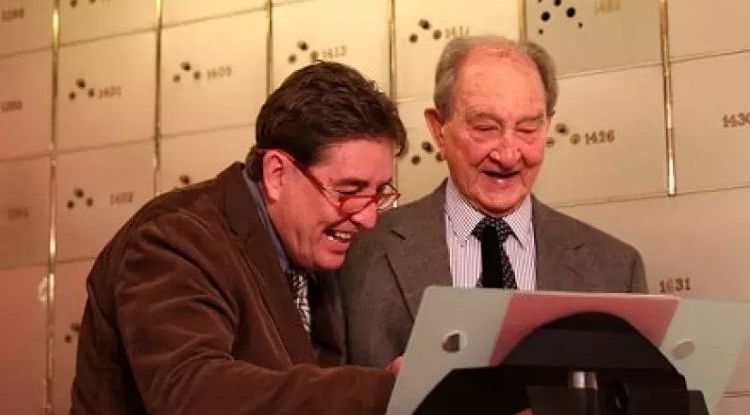
King Felipe VI has awarded the Grand Cross of the Order of Isabella the Catholic to historian and university professor Nicolás Sánchez-Albornoz, the first director of the Cervantes Institute from 1991 to 1996.
The decision was made at the Council of Ministers meeting last Tuesday, February 3, at the proposal of the Minister of Foreign Affairs, José Manuel Albares, and published this Thursday in the Official State Gazette (BOE).
Born on February 11, 1926, in Madrid (and therefore about to turn one hundred years old), he was caught up in the outbreak of the Spanish Civil War when he was only ten years old. Along with his family, he spent that period in the French city of Bordeaux, until he returned to Spain with his sisters in 1940. In contrast, his father, the historian Claudio Sánchez-Albornoz (Minister of State or Foreign Affairs in 1933, ambassador to Portugal in 1936, and President of the Council of Ministers of the Republic in exile between 1962 and 1971), escaped to Argentina.
On March 23, 1947, Nicolás Sánchez-Albornoz was arrested in Madrid along with a group of students for his activities in the University Student Foundation (FEU) and sentenced by the Francoist dictatorship to forced labor. In 1948, he escaped from the Valley of the Fallen, along with Manuel Lamana, with the collaboration of Paco Benet, an anthropologist and brother of Juan Benet, the American writer Barbara Probst Solomon, and Barbara Mailer (sister of the American writer and journalist Norman Mailer). His escape was depicted in the film “The Barbarous Years” (1998), directed by Fernando Colomo.
For decades, he lived in exile in Argentina, where he developed much of his academic career. After the military coup led by dictator Juan Carlos Onganía in 1966, he emigrated to the United States (1968), where he taught Spanish and Contemporary Latin American History at New York University, becoming a full professor in 1972.
From 1976 onward, Nicolás Sánchez-Albornoz traveled to Spain frequently during vacation periods to teach courses and publish. He was the editor of the ‘Alianza Médica’ collection from 1985. In the spring of 1990, he left New York University and moved to Spain.
On September 13, 1991, he was appointed by the Council of Ministers as director of the Cervantes Institute, becoming its first director (1991–1996). After this period, he returned to teaching, holding the Jordan Davidson Chair at Florida International University in the United States.
He has conducted research at universities such as New York University, the National University of the Littoral, the University of Buenos Aires, Columbia University, and Yale University. He is Professor Emeritus at New York University. His research has earned him honorary doctorates from the Autonomous University of Barcelona, Carlos III University of Madrid, Jaume I University (Castellón), Pablo de Olavide University (Seville), and the University of Oviedo.
He is a historian specializing in the economic history of Spain and the social history of Latin America. Author of numerous books and articles on these subjects, one of his latest works is ‘Prisons and Exiles’ (Anagrama, 2012).
He is a member of the Royal Academy of History of Spain and the academies of history of Portugal, Argentina, and Ecuador. Among other awards, he has received the Order of Civil Merit.
The Order of Isabella the Catholic is, hierarchically, the second most important distinction in Spain, after the Order of Charles III, but it is considered the most prestigious in the field of foreign relations.
Established by King Ferdinand VII on March 14, 1815, as the “Royal and American Order of Isabella the Catholic,” with the aim of “rewarding unwavering loyalty and merits acquired in favor of the prosperity of those territories,” it was reorganized in 1847, when it became known simply as the “Royal Order of Isabella the Catholic.” According to its Regulations, this new name distinguishes “extraordinary acts of a civil nature, performed by Spanish and foreign persons, that benefit the Nation or contribute significantly to fostering friendly relations and cooperation between the Spanish Nation and the rest of the International Community.”
The King serves as Grand Master of the Order, and the Minister of Foreign Affairs, as Grand Chancellor, submits proposals for the awarding of the Order’s higher degrees to the Council of Ministers, which grants them by Royal Decree. More than 70,000 people worldwide have this distinction in one of its various levels.