Eduardo González
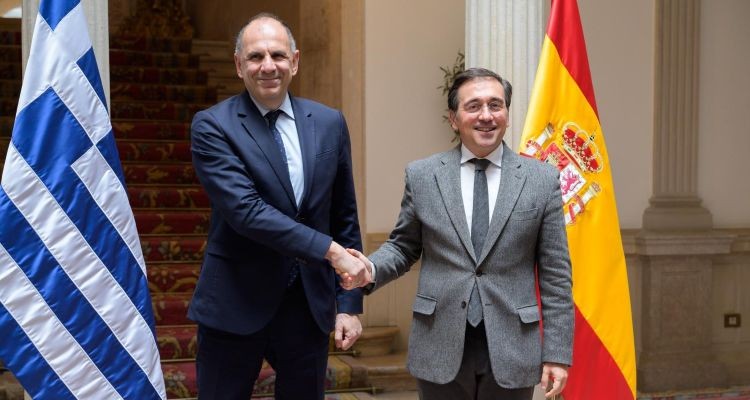
Foreign Minister José Manuel Albares and his Greek counterpart, Georgios Gerapetritis, agreed on Tuesday, February 3, that the strategic shift of the United States government will force the European Union to move “decisively” toward strategic autonomy, including the creation of a joint deterrence mechanism.
“I believe that transatlantic relations have been beneficial for the United States and for Europe for many decades, both from the point of view of progress and from the point of view of deterrence,” but “we have to recognize that the new US administration has a new vision,” Albares stated during the joint press conference with Gerapetritis, held at the Ministry headquarters in the Palacio de Viana, Madrid.
“We have to recognize that the new US administration has a new vision.” Therefore, he declared, the time has come “for Europe to decisively advance its sovereignty and independence.” “It is essential that we achieve economic sovereignty, remove the last obstacles to the internal market, move towards a genuine European capital market in which European money primarily finances European ideas and innovation, and continue seeking new partners,” the minister continued.
“We have a large-scale conventional war with an aggressive power like Russia on our doorstep,” and therefore, “it is necessary that we modernize our defense industries to produce what Europe needs,” he warned. “We believe that now is the time, without further delay, to move towards a European army, because we must guarantee the European way of life; we must be prepared to deter any attempt at threat or coercion,” he insisted.
For his part, Georgios Gerapetritis agreed with Albares that “it is necessary to take a significant step towards strategic autonomy, addressing challenges that will allow us to reduce our critical dependence in energy, technology, and defense.”
Transatlantic cooperation has allowed us to “maintain peace and prosperity in the world,” and “I am optimistic; I believe this very important relationship will continue.” However, “the administration in the United States is giving us an incentive to review some of the ideas we had about Europe and about European autonomy,” he warned.
In this regard, the Greek minister emphasized the importance of having “a joint deterrent mechanism,” of continuing the expansion of the European Union “so that there is an increasingly cohesive and stronger Europe,” and of promoting “strategic development that not only highlights the competitiveness of the European Union continent, but also those issues related to social cohesion, the climate crisis, and food security.”
“Overall, I think we should be satisfied with the progress we are trying to make in Europe to become more resilient, more autonomous, while at the same time maintaining collaboration with the United States, keeping these bridges open with the United States, which have always been strong and which must be maintained in the future,” he insisted.
Economic and cultural relations
Albares stated that Spain and Greece maintain “very dynamic economic relations,” with 3,700 Spanish companies exporting to Greece, and that both ministers agreed that “there is room to continue advancing and deepening our economic relations.”
“I also conveyed to him the importance that Spain attaches to the reintroduction of Spanish as an optional foreign language in the Greek public school system and, of course, I told him that, if this initiative is successful, we are willing to collaborate on training Spanish teachers in public education.”
Gerapetritis, for his part, indicated that both ministers had discussed “how to strengthen our economic cooperation, especially with regard to trade, investment, and energy,” and recalled a visit made last May by “the Greek Business Community” to Madrid.
The Greek minister also highlighted the desire of both countries to “strengthen our ‘soft power’, culture and education” and noted that “Greek is a language taught at many universities in Spain.”