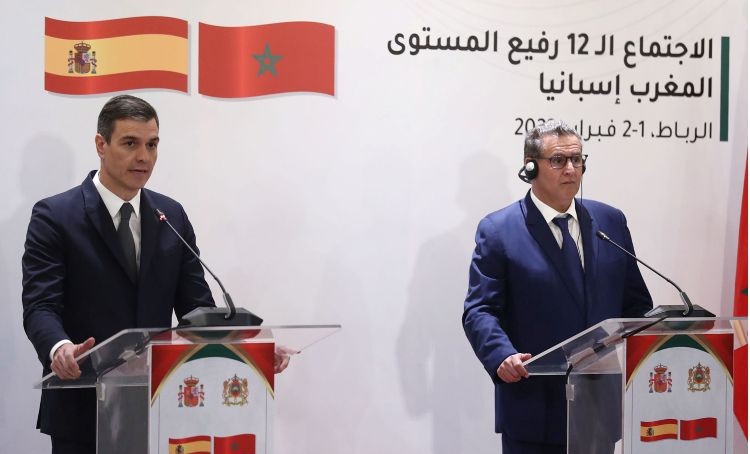
<h6><strong>Eduardo González</strong></h6> <h4><strong>Madrid will host the thirteenth High-Level Meeting (HLM) between Spain and Morocco this Thursday, December 4th. The Spanish government has linked this event to "the excellent bilateral relations" and it will practically coincide with the recent UN resolution in favor of the proposed autonomy for Western Sahara. This development could embolden Rabat to increase pressure on Spain regarding two of its main bilateral demands: full control of Sahrawi airspace and the expansion of maritime boundaries and, therefore, of underwater exploration.</strong></h4> “Within the current framework of excellent bilateral relations between Spain and Morocco, both governments have decided to hold the 13th High-Level Meeting on December 4 in Madrid, preceded by a business meeting between the two countries on December 3 in the Spanish capital,” the Spanish Ministry of Foreign Affairs explained in a statement last week. According to the Moroccan government and media, which have used the same conciliatory tone as the Spanish government, the High-Level Meeting will address migration, security cooperation, energy projects, strengthening maritime traffic, and several regional issues that have a direct impact on the stability of the Western Mediterranean. The meeting is expected to culminate in the signing of new agreements in areas such as energy, transport, investment, security, and higher education. The previous High-Level Meeting between Spain and Morocco was held on February 1 and 2, 2023, in Rabat. That summit began amid controversy due to Mohammed VI's snub of the Spanish Prime Minister, Pedro Sánchez, and concluded with a Joint Declaration in which both parties expressed their desire to "enrich" the "excellent relations that have always united them," reiterated their "commitment to human rights," and pledged to "promote trade and investment." Furthermore, the two countries reached a "commitment to mutual respect" whereby both their discourse and political practice would "avoid anything that we know offends the other party, especially as it affects our respective spheres of sovereignty," an obvious reference to Ceuta and Melilla, on the one hand, and Western Sahara, on the other. In fact, that High-Level Meeting was the first since the Spanish government's unexpected decision in 2022 to accept Morocco's autonomy plan for Western Sahara as "the most serious and realistic basis" for resolving the conflict. <h5><strong>The UN resolution and its bilateral consequences</strong></h5> The main development in the lead-up to the Madrid High-Level Meeting occurred on October 31, when the UN Security Council approved a resolution, with eleven votes in favor, three abstentions (Russia, China, and Pakistan), and none against, which, among other things, described the proposed autonomy for Western Sahara as “the most viable solution” and, at the same time, defended “the self-determination of the people of Western Sahara.” For now, the Minister of Foreign Affairs, José Manuel Albares, will have to appear before Congress on December 10 to, as decided by the Board of Spokespersons, “explain the Government’s position regarding the resolutions adopted by the UN concerning Western Sahara and their implications for the Moroccan occupation and the right to self-determination of the Sahrawi people.” Although the resolution does not expressly recognize Moroccan sovereignty over the territory and does not eliminate the right to self-determination, Morocco described this resolution as “Historic victory,” and in fact, it is very likely that Rabat will use this new text to push through, either in the RAN or at any other time, two of its major demands regarding Spain. On November 27, <a href="https://medias24.com/2025/11/27/sahara-mont-tropic-fir-les-nouveaux-rapports-de-force-entre-rabat-et-madrid-1585124/">Médias24</a>, a clearly pro-government Moroccan newspaper (journalist Francisco Carrión, of El Independiente, links it to Foreign Minister Nasser Bourita), reviewed Morocco’s main legal demands in its relationship with Spain: the complete transfer of Western Sahara’s airspace and the maritime boundary delimitation. <h5><strong>Airspace and maritime delimitation</strong></h5> Regarding the first point, Spain has managed the airspace over Western Sahara (in its status as a “non-self-governing territory pending decolonization,” according to the UN) since 1976 through ENAIRE, the public business entity that manages air traffic in Spain, and by mandate of the International Civil Aviation Organization (ICAO). The airspace over Western Sahara is controlled from the Canary Islands, and therefore Spain is responsible for authorizing flights arriving in the territory. However, the territory's airports are controlled by Morocco, which has militarily occupied the former Spanish colony since 1975. As a result, Morocco already effectively controls between 15% and 20% of the Sahara's airspace, where it has established no-fly zones for military exercises. According to Médias24, the Security Council resolution represents a turning point in this regard, as it “legitimizes Morocco's claim to regain control of its airspace.” In December 2024, José Manuel Albares assured the plenary session of the Congress of Deputies that Spain has no intention of ceding the airspace over Western Sahara to Morocco. Last June, the Congress's Foreign Affairs Committee urged the Government (at the proposal of the People's Party, PP) to guarantee Spanish management of Western Sahara's airspace through ENAIRE (the Spanish air navigation service provider). In the joint declaration signed by Pedro Sánchez and King Mohammed VI on April 7, 2022, just after Spain's about-face on Western Sahara, it was agreed to open a dialogue on the management of Western Sahara's airspace through the creation of an air cooperation working group. However, according to the PP, "since then, this group has met without the Government offering any information on the scope of these negotiations, nor on the impact they could have on air traffic management." The other important point for Morocco in its standoff with Spain is the maritime boundary. According to the aforementioned Moroccan media outlet, “for decades, a certain interpretation attempted to impose the idea of a strict median line, drawn equidistant between the Canary Islands and the Moroccan coast,” but this position has become “legally obsolete” because “Morocco has an irrefutable argument: the significant geomorphological asymmetry” between “a continuous continental coastline of more than 3,500 kilometers” and a mere archipelago. “Applying a mechanical equidistance would imply giving the same legal weight to islands as to an entire continent, creating a disproportionate distortion to the detriment of Morocco,” warned Médias24. Based on this argument, and invoking the “principle of equity” provided for in international law “when particular circumstances so require,” Rabat will attempt to move forward with its campaign to extend the continental shelf, exclusive economic zones, and submarine exploration rights. Spain has asked the UN to extend its maritime zone to 350 nautical miles, but if Western Sahara is considered part of Morocco, the maritime boundary would have to start from the coasts of the former Spanish territory, which would allow part of the Canary Islands' waters to be included within Morocco. One of Morocco's objectives, according to the aforementioned newspaper, is to gain control of the exploitation of Monte Tropic, an underwater volcano located southwest of the Canary Islands and which, according to Spain, is a natural geological extension of the archipelago. Monte Tropic, according to the newspaper, is rich in tellurium, cobalt, and rare earth elements, "critical minerals for the global technological transition." In November 2023, during his speech commemorating the 48th anniversary of the Green March, Mohammed VI asserted that “national diplomacy has made it possible to advance the recognition of Moroccan sovereignty over Western Sahara” and that his country “is now in a stronger and more solid position” to develop its “megaprojects” in the “southern provinces” (Morocco’s usual term for Western Sahara) in order to establish an “integrated economy,” based, among other things, “on the exploration of natural resources at sea.” In response to these remarks, the Ministry of Foreign Affairs merely reiterated that “all exploration, exploitation, conservation, and management of marine resources must respect the United Nations Convention on the Law of the Sea and all other provisions of international law.”