
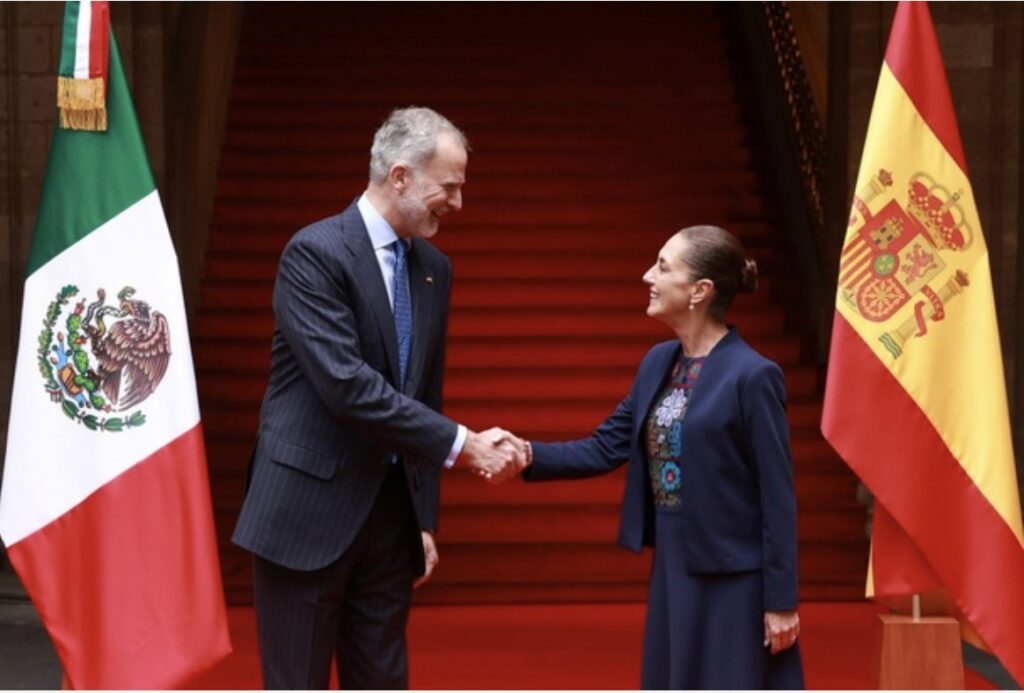
Mexico and Spain are going through a period of renewed intensity in their bilateral relationship. The meeting held last June between Mexican President Claudia Sheinbaum and King Felipe VI at the National Palace confirmed the commitment of both countries to deepening ties underpinned by close historical, cultural and human connections.
Against this backdrop, Madrid has consolidated its position over the past year as one of the main platforms for Mexico’s international outreach. The Embassy, headed by Ambassador Quirino Ordaz Coppel, has gone well beyond a strictly diplomatic agenda, developing a presence that brings together political, economic, tourism and cultural interests.
One of the highlights was Mexico’s participation as Guest Country at FITUR 2026, which turned Madrid into a major showcase for the country’s diversity. Mexico presented the largest pavilion in its history at the trade fair, covering 1,800 square metres and bringing together representatives from all 32 states, as part of a delegation of more than 800 officials, business leaders and tourism professionals. The Embassy played a supporting and facilitating role in meetings with government authorities and state delegations, helping to connect tourism promotion with new business and investment opportunities.
The initiative was not confined to IFEMA. The strategy developed around FITUR sought to extend Mexico’s presence across different parts of Madrid through cultural, gastronomic and tourism-promotion activities. The aim was to project an image of Mexico that went beyond its traditional association with sun-and-beach tourism and also showcased its heritage, gastronomy, handicrafts, emerging destinations and capacity to attract investment.
Culture as an Instrument of Public Diplomacy
The cultural dimension is another constant feature of Mexico’s activities in Spain. The Mexican Cultural Institute, which also serves as the Embassy’s cultural affairs office, maintains a regular programme of exhibitions, conferences and events that brings Mexican artistic and intellectual production to Madrid while extending its reach to other regions of Spain.
The 2026 programme has included, among other initiatives, an exhibition devoted to the life and work of José Alfredo Jiménez, organised as part of FITUR, as well as various events focusing on Mexican literature and thought. Among these was a conference dedicated to Rosario Castellanos, examining the Mexican writer’s work from a contemporary perspective.
The cultural agenda also maintains a clear focus on contemporary issues. This week, the Mexican Cultural Institute in Spain inaugurated the exhibitions “Prácticas de re-existencia” and “Llegar con las olas”, both open from 9 September to 16 October. The former brings together artists connected to the Mexican diaspora in Spain and explores issues including identity, memory, territory, migration and belonging.
A Relationship Also Built Through the Community
Mexico’s presence in Spain also has a consular and community dimension. The Embassy serves a broad consular district covering Madrid and much of Spanish territory, while the Consulate of Mexico in Barcelona is responsible for Aragón, Catalonia, the Balearic Islands and the Valencian Community.
Engagement with Mexican citizens outside Madrid is part of this broader strategy. Consular initiatives carried out in the Canary Islands have brought documentation and protection services closer to a community then estimated at between 1,500 and 2,000 people, while also strengthening ties with local associations and cultural initiatives.
This community dimension becomes particularly visible each September. Last year, the celebration of the 215th anniversary of Mexico’s Independence brought together hundreds of people in Plaza de Chamberí, consolidating the event as one of the main gatherings of the Mexican community in Madrid and as a significant fixture on the capital’s diplomatic calendar.
The past year therefore points to a Mexican diplomatic presence in Spain that combines representation, political engagement and the promotion of national interests with a growing emphasis on public diplomacy. The economy, tourism, culture and community are all part of a single strategy of international outreach.
As Madrid prepares to host another Mexican national celebration, the relationship between the two countries offers precisely this picture: a relationship that can no longer be understood solely through government offices, but also through businesses, cultural exchanges, tourism, investment and the human ties that connect the two sides of the Atlantic.