
Eduardo González
The president of the People’s Party (PP), Alberto Núñez Feijóo, has announced that his party is “working” to modify the Civil Code regarding nationality to stop the “unprecedented decrease” in the cost of granting Spanish citizenship. Meanwhile, the Supreme Court has requested that the Central Electoral Board submit all documentation related to the registration in the CERA of Absent Residents of Spain of those who obtained nationality through the Democratic Memory Law (the so-called “Grandchildren Law”).
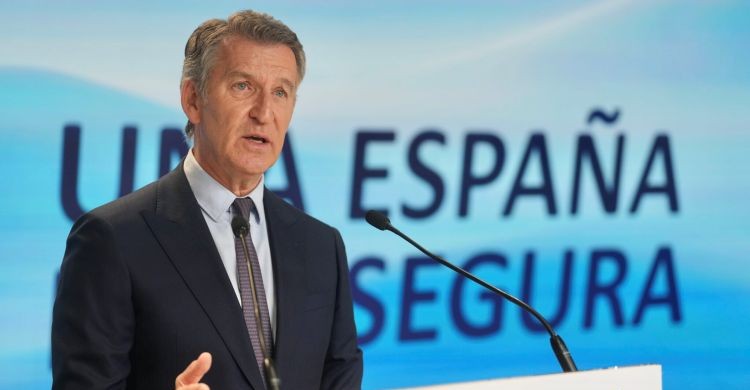
During the presentation of the political year’s assessment at the party’s national headquarters, Feijóo asserted that the PP is already “working on an amendment to the Civil Code to regulate the future nationality of Spaniards,” something he considers fundamental after the “unprecedented reduction in the cost of nationality,” “the most important link a State has with its citizens.”
At the end of June, Alberto Núñez Feijóo denounced the “Grandchildren Law” as an “electoral ploy” implemented by Prime Minister Pedro Sánchez to grant voting rights to 2.5 million people in a very short period. He also claimed that “there is a great deal of arbitrariness” in the procedure for registering new Spanish citizens on the electoral roll, which could lead to the assignment of provinces to these new citizens based on the electoral needs of the PSOE (Spanish Socialist Workers’ Party). Meanwhile, the Secretary General of Vox in Congress, José María Figaredo, declared that this law constitutes a “slow-motion coup d’état” and demanded that those who have acquired citizenship be deprived of their right to vote. Spaniards residing abroad are being prevented from voting by mail.
Following complaints from the People’s Party (PP), Foreign Minister José Manuel Albares stated that “what the People’s Party wants is for three and a half million Spaniards to be unable to vote,” and denounced the “enormous hypocrisy” of Feijóo and the PP because “this law was precisely what they included in their 2023 electoral program.”
ADE and CGCEE
In statements to The Diplomat, the president of the Association of Diplomats of Spain (ADE), Alberto Virella, asked the Ministries of Foreign Affairs and Justice in early July to take the initiative in explaining to citizens the existing regulations for establishing residency in Spain for those who acquire Spanish nationality.
He also warned this Friday that naturalized citizens are assigned provinces based on three criteria: their last place of residence in Spain, the place of origin of the ancestor who had to leave Spain (in the case of descendants born abroad), and the town of origin of the ancestor who had to leave Spain. of Spain with which the applicant can document some type of ties or personal connection. “It is not contemplated that, due to a default or lack of a specific province, the consul general will decide” in this regard, he assured.
For its part, the General Council of Spanish Citizenship Abroad (CGCEE) stated last week that the granting of Spanish nationality under the Law of Grandchildren “is not limited to cases of political exile, but rather contemplates various scenarios related to the transmission of Spanish nationality expressly provided for by the legislator,” and specified that its purpose “is to correct historical situations that prevented or hindered the transmission of Spanish nationality to certain groups of descendants of Spaniards abroad.”
Likewise, the Council warned, in response to accusations from the People’s Party and Vox, that “no ‘express naturalization’ is being carried out” to favor the participation of new Spaniards in electoral processes, but rather that “the processing of applications continues through established procedures.” administrative and will still require several years to complete, due to the high number of pending cases.”
Supreme Court
Furthermore, the Supreme Court has ordered the Central Electoral Board (JEC) to submit, within a “non-extendable period of twenty days,” all documentation related to the registration process in the Electoral Census of Absent Residents (CERA) for individuals who obtained Spanish nationality through the Democratic Memory Law (the so-called “Grandchildren Law”), in the context of the appeal filed by the conservative and Eurosceptic organization Iustitia Europa against the registration of these new Spanish citizens in the CERA.
The JEC has refused to provisionally suspend the census preparation process, arguing that the Constitution guarantees the right to vote for Spaniards residing abroad and that the electoral administration must apply current regulations, without overriding the criteria established by the legislature. However, it has requested instructions from the Electoral Census Office regarding the application of the Democratic Memory Law.
Furthermore, the Supreme Court considers that the determination of the electoral municipality in which each beneficiary of this law registers must be “sufficiently justified” if it does not correspond to their last address in Spain. According to Iustitia Europa, there is insufficient public information on how many registrations in the CERA (Registry of Absent Voters Residing Abroad) originate from files processed under the LMD (Law on Democratic Memory), nor on their territorial distribution or the procedure followed in each case.
Likewise, the Supreme Court has agreed to open a separate case to study the request for a precautionary suspension of new registrations in the CERA, as proposed by Iustitia Europa.
The Law on Democratic Memory, which succeeded the Historical Memory Law of 2007, has been in force since October 2022 after being approved by the Congress of Deputies and the Senate at the proposal of the government of Pedro Sánchez and with votes against it from, among others, the People’s Party and Vox. The law grants Spanish nationality to “those born outside of Spain to a father or mother, grandfather or grandmother, who were originally Spanish, and who, as a consequence of having suffered exile for political, ideological, or religious reasons, or due to their sexual orientation or gender identity, have lost or renounced their Spanish nationality.”
As of April 30, 2026, applications for naturalization totaled 2,622,450, and the number of approved applications reached 557,709, according to a parliamentary response from the Ministry of the Presidency and Justice to the People’s Party (PP). The granting of nationality is included in the eighth additional provision of the “Grandchildren Law.” Despite this, the more than 70 amendments submitted by the PP to the law at the time made no mention of this provision.