
Eduardo González
The Prime Minister, Pedro Sánchez, welcomed on Tuesday the proposal by the President of the European Commission, Ursula von der Leyen, to restrict minors’ access to social media and recalled that “Spain was one of the first countries to promote this debate and to stand up to the techno-oligarchs.”
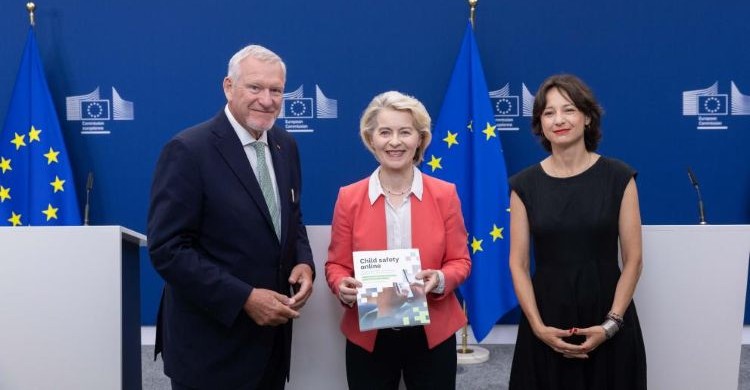
Ursula von der Leyen warned on Monday, during a meeting of the EU Special Panel on Child Online Safety, of the need to address “one of the greatest challenges facing governments today: how to protect our children online, how to establish a new norm in the future online world.”
“In Europe, we believe that parents educate our children, not predatory algorithms,” the Commission President stated during the presentation of the report she herself commissioned a few months ago from the Special Panel on Child Online Safety. “In that regard, I want to be very clear: social media is not a toy. While it ultimately rests with parents to decide when their children receive their first smartphones, we already have a consensus that there must be a starting date for the age at which children can join social media,” she added.
“Across Europe, young people now spend between four and six hours a day in front of screens. Six hours every day: that adds up to twenty years of their lives. At the same time, across Europe, almost 60 percent of young children have experienced emotional or psychosocial problems online,” she warned. “We cannot expect children to succeed in a system that was never designed with their well-being in mind, when they are most vulnerable,” she insisted.
Therefore, the German leader warned, “it is clear that we need age-appropriate restrictions for the platforms,” and, with that goal in mind, “our age verification app is one of the tools to achieve this. It is easy to use, preserves privacy, and is open source. It is about giving power back to parents.”
Following Ursula von der Leyen’s remarks, Pedro Sánchez posted on social media this Tuesday that “the EU is moving towards common regulations to limit minors’ access to social media.” “Spain was one of the first countries to promote this debate and to stand up to the techno-oligarchs,” he continued. “Let’s continue to lead. Guaranteeing a free and healthy childhood is one of the great battles of our time,” he concluded.
On February 3, during the opening of the World Governments Summit in Dubai, Pedro Sánchez announced five legislative and regulatory measures by the Spanish government to protect minors and strengthen controls on social media against disinformation, hate speech, and the lack of protection of personal data and material.
These measures include a ban in Spain on access to social media for those under sixteen (requiring digital platforms to implement effective age verification systems), legal reforms to hold executives legally responsible for violations committed on their platforms, criminalizing the manipulation of algorithms and the amplification of illegal content, developing mechanisms with the public prosecutor’s office to investigate potential legal violations by Grok, TikTok, and Instagram, and creating a tracking, quantification, and traceability system to establish a “Hate and Polarization Footprint.”
In response to these measures, billionaire Elon Musk wrote on his social network X that “Dirty Sánchez is a tyrant and a traitor to the people of Spain,” and Russian magnate Pavel Durov, owner of Telegram, sent a mass alert to the more than ten million users of his platform in Spain, denouncing the government’s attempt to establish a “surveillance state” and “censorship.” Meanwhile, Santiago Abascal, leader of the far-right Vox party, accused the government of trying to “censor young people.”
“Let the techno-oligarchs bark, Sancho, it’s a sign that we’re riding,” Pedro Sánchez responded on social media, paraphrasing a popular saying (“they bark, therefore we ride”) erroneously attributed to Don Quixote.