Eduardo González
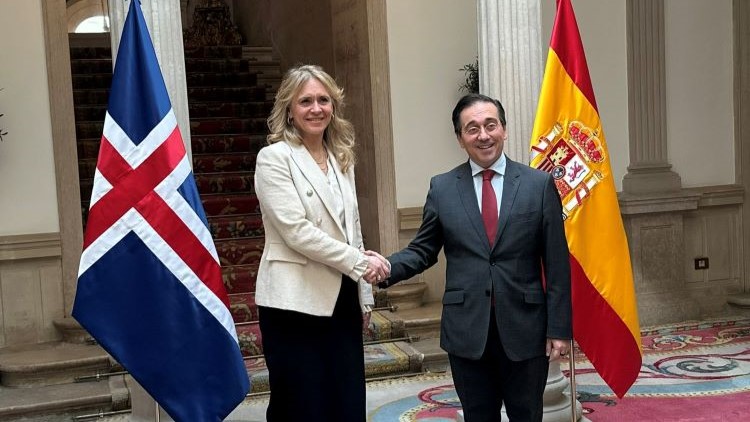
Foreign Minister José Manuel Albares travels to Iceland this Monday, where he will sign several bilateral cooperation agreements and visit the NATO air base in Keflavík to discuss a 360-degree vision of security and defense in the Arctic.
During his visit to Reykjavík, the minister will meet with top Icelandic officials, including his counterpart, Þorgerður Katrín Gunnarsdóttir, with whom he will sign four cooperation agreements on political consultations, diplomat training, gender equality, and scientific cooperation. Furthermore, the cooperation agreement on education, signed in 2023, will be strengthened to increase the presence of Spanish in the country.
According to a press release issued by the Ministry of Foreign Affairs on Sunday, the objective of the visit is “to reaffirm and strengthen bilateral relations with a country with which Spain shares a strong alignment on the international political agenda and a common vision regarding the importance of international law and the defense of a rules-based international order.”
“Bilateral relations between Spain and Iceland are currently excellent, strengthened by the opening of the Icelandic Embassy in Madrid last December,” the Ministry continued. “This strengthening of relations comes within the context of Iceland’s growing integration into the European Union,” it emphasized.
“One in four Icelanders visits Spain for tourism each year, and our country is an important partner for Iceland in the shipbuilding industry, aviation security, and renewable energy,” the press release added, asserting that, “in this sense, this visit offers an opportunity to explore greater collaboration between companies from both countries in these sectors and in the so-called blue economy.”
José Manuel Albares and Þorgerður Katrín Gunnarsdóttir presided over the opening of Iceland’s first Embassy in Madrid on December 1st, after 76 years of diplomatic relations. The two ministers held their first meeting in Madrid on March 25, 2025, during which Albares conveyed his satisfaction with the Icelandic government’s decision to propose resuming negotiations for joining the European Union.
The Reykjavík government has called a referendum for August 29th on reopening the EU accession negotiations, which have been frozen for several years. Iceland is linked to the European Union through the The European Economic Area (EEA) Agreement, in force since 1994, was established. In June 2011, Iceland began negotiating its accession treaty with the EU, negotiations which are currently suspended. Iceland is part of the Schengen Area.
NATO in the Arctic
The Ministry also highlighted cooperation on security and defense within the NATO framework, as well as shared concerns on issues such as cybersecurity and the protection of critical infrastructure.
“In this area, the Minister will be able to reaffirm Spain’s commitment to a 360-degree vision of security, including the Arctic, as demonstrated in August 2025 with the Stinga detachment at Keflavík Air Base—six F-18 fighter jets and 122 Spanish military personnel—within the framework of a NATO air policing operation.” The trip also includes a visit to this Alliance air base.
Iceland, one of the few countries in the world without a standing army, has relied on NATO and the United States for its defense for decades, but the current international context It has sown doubts, especially after the threats from US President Donald Trump to Greenland and the Alliance itself.