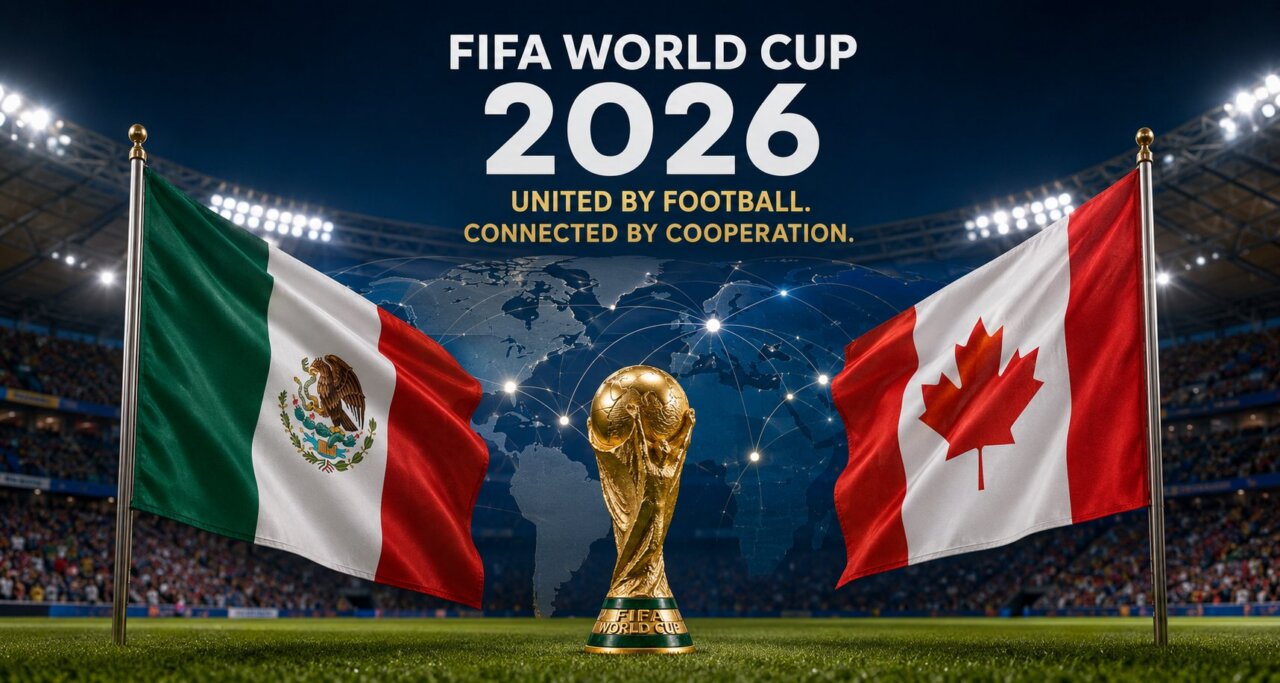
The Diplomat in Spain, in collaboration with the Association of Foreign Diplomats in Spain (ADE), hosted on Thursday at Madrid’s Meliá Princesa Hotel the diplomatic roundtable “Road to the 2026 World Cup: Diplomacy, Cooperation and International Projection from Canada, the United States and Mexico”, an event dedicated to examining the role of the FIFA World Cup 2026 as a vehicle for international cooperation, public diplomacy and global outreach.
The session brought together diplomatic representatives from the tournament’s host countries—with the exception of the United States—as well as members of the diplomatic corps accredited to Spain, offering attendees first-hand insight into the challenges, opportunities and prospects surrounding the organisation of the world’s largest sporting event.
The discussion approached the 2026 World Cup from a strategic perspective, highlighting the unprecedented nature of a joint bid involving three North American nations and its significance as a large-scale example of international cooperation. Throughout the event, participants underscored how the tournament transcends the boundaries of sport, serving instead as a platform for dialogue, cultural exchange and the strengthening of ties between nations.
Among the speakers was Christopher Berzins, Political Counsellor at the Embassy of Canada to Spain and Andorra, who outlined Canada’s vision for the tournament and stressed its importance for the North American region as a whole. Berzins described the FIFA World Cup 2026 as “the world’s largest team-sport event” and a unique opportunity to showcase to a global audience the organisational capacity, diversity and shared values of Canada, Mexico and the United States.
Speaking on behalf of Canada, the diplomat noted that the country will host matches in Toronto and Vancouver, two cities with extensive experience in staging major international events. He also emphasised that preparations for the tournament are being guided by principles of inclusion, sustainability and respect for human rights, while incorporating close cooperation with Indigenous communities across Canada.
Berzins further highlighted the significant economic impact expected from the competition, which is projected to generate substantial benefits for tourism, hospitality, small businesses and local economies, while strengthening Canada’s international visibility and profile.
For his part, Jorge Sánchez Cataño, Head of International Cooperation and Education at the Embassy of Mexico in Spain and the mission’s lead official for sports affairs, presented Mexico’s contribution to the World Cup project and reflected on football’s longstanding role as a cultural bridge linking Mexico, Spain and the wider international community.
The discussion was structured around three main themes: the shared vision of the host countries, the specific contributions of each nation, and the common challenges involved in organising an event that will attract millions of fans and command worldwide media attention across regions with markedly different football cultures.
Among the issues examined were logistical coordination between the three host countries, international mobility, security, technological innovation in major sporting events, sustainable development, social inclusion, and the economic and cultural legacy the tournament is expected to leave behind.
The debate also provided an opportunity to reflect on the growing role of sport as a tool of public diplomacy and soft power, as well as on the opportunities for international cooperation generated by the organisation of global sporting competitions.
The session concluded with a question-and-answer segment during which participants exchanged views on the diplomatic implications of the 2026 World Cup, already regarded as one of the most significant international events of the coming decade and a remarkable example of multinational cooperation in pursuit of a shared project.