
The Diplomat
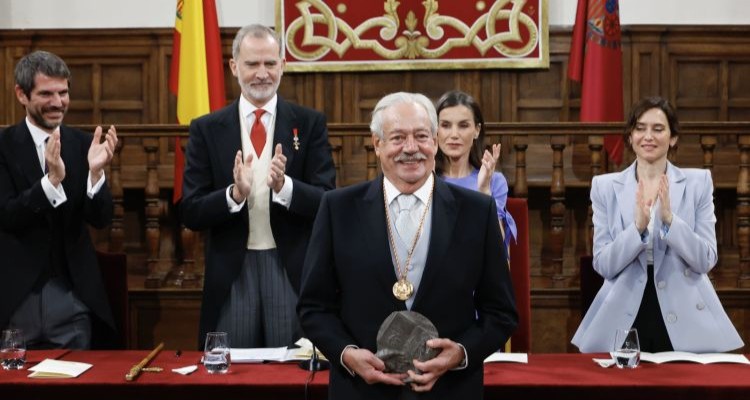
The King and Queen presented the 2025 Miguel de Cervantes Prize for Literature in the Spanish Language to Mexican writer Gonzalo Celorio on Thursday, for “his exceptional literary work and intellectual contributions, which have profoundly and consistently enriched the Spanish language and Hispanic culture.”
The ceremony took place in the Paraninfo of the University of Alcalá de Henares (Madrid) and was attended by the Minister of Culture, Ernest Urtasun, and the President of the Community of Madrid, Isabel Díaz Ayuso.
The Cervantes Prize, awarded by the Ministry of Culture and endowed with 125,000 euros, was first given in 1976 to Jorge Guillén and, since then, has been awarded to 51 authors, seven of them Mexican: Octavio Paz (1981), Carlos Fuentes (1987), Sergio Pitol (2005), José Emilio Pacheco (2009), Elena Poniatowska (2013), Fernando del Paso (2015), and Gonzalo Celorio (2025).
The jury that awarded the Cervantes Prize to Celorio in November 2025 highlighted “the exceptional literary work and intellectual contributions with which he has profoundly and consistently enriched the Spanish language and Hispanic culture.”
According to the jury’s statement, “For over five decades, Gonzalo Celorio has cultivated a literary voice of remarkable elegance and profound reflection, combining critical lucidity with a narrative sensibility that explores the nuances of identity, emotional development, and loss. His work is simultaneously a memoir of modern Mexico and a mirror of the human condition.”
The statement also notes that “his books resonate with irony, tenderness, and erudition, tracing an emotional and cultural map that has influenced generations of readers and writers. Celorio embodies the figure of the complete writer: creator, teacher, and passionate reader. He is the builder of an invaluable legacy that honors the Spanish language and keeps it alive in its highest form: that of the word that thinks, feels, and endures.”
Gonzalo Celorio was born in Mexico City in 1948. He is a novelist, essayist, chronicler, and one of the most prominent figures in contemporary Mexican literature. With a doctorate in Hispanic Language and Literature, specializing in Latin American Literature from the Faculty of Philosophy and Letters at the National Autonomous University of Mexico (UNAM), he has developed an extensive academic and teaching career. Since 1974, he has taught at various institutions, including the Universidad Iberoamericana, the National Polytechnic Institute, and El Colegio de México.
He has held numerous academic and cultural positions, such as Academic Secretary and Director of the Faculty of Philosophy and Letters at UNAM (1998-2000); Director of Literature at the National Institute of Fine Arts; Coordinator of Cultural Outreach at UNAM (1989-1998); and Director General of the Fondo de Cultura Económica (2000-2002). He is currently a professor of Latin American literature at the Faculty of Philosophy and Letters at UNAM, where he holds the extraordinary chair “Masters of the Spanish Exile.” He is a full member of the Mexican Academy of Language, of which he was director (2019-2023), and also a corresponding member of the Royal Spanish Academy and the Cuban Academy of Language.
Among his most acclaimed works are the novels *Amor propio* (Self-Love), *El viaje sedentario* (The Sedentary Journey), *Y retiemble en sus centros la tierra* (And Let the Earth Tremble in Its Centers), *El metal y la escoria* (Metal and Slag), and *Mentideros de la memoria* (Memory Gossip Mills), as well as the essay collections *Los subrayados son míos* (The Underlines Are Mine) and *Cánones subversivos* (Subversive Canons). His work, characterized by erudition, stylistic rigor, and reflection on memory, identity, and the Hispanic American literary tradition, places him among the most important authors in contemporary Mexican literature. On Tuesday, April 21, Celorio will donate his legacy to the Vault of Letters at the Cervantes Institute.
The Cervantes Prize annually pays public tribute to a writer whose body of work has enriched the Hispanic literary heritage. Any author whose literary work is written entirely, or substantially in part, in Spanish may be awarded the Cervantes Prize. Candidates for the Prize may be nominated by the Academies of the Spanish Language, previous winners, institutions whose nature, aims, or content are linked to literature in Spanish, and members of the Jury.