Eduardo González
Foreign Minister José Manuel Albares stated this Thursday, during his visit to the Campo de Gibraltar, that the Agreement between the European Union and the United Kingdom on the future status of Gibraltar after Brexit eliminates “inequalities and distortions that are a thing of the past.”
Albares visited the Campo de Gibraltar to discuss with mayors and social partners the preparations for the implementation of the EU-UK Agreement, one day after receiving the Chief Minister of Gibraltar, Fabian Picardo, at the Ministry headquarters in the Palacio de Viana to discuss the same topic. The Minister met with the mayors of La Línea and San Roque and visited the works for the dismantling of the border fence in anticipation of the Agreement’s imminent implementation starting July 15.
The minister’s first stop was in La Línea de la Concepción (Cádiz), where he visited the construction site for the dismantling of the border fence. He confirmed that the work is progressing as planned. “The section of the fence that is currently preventing full flow of traffic will be dismantled a few days before” July 15, the date agreed upon by all parties for the start of the provisional implementation of the Treaty. At the same time, Albares assured that work is underway to ensure that the remaining technical resources, which will allow for both Schengen controls for people and Customs Union controls for goods, will also be operational by the same date.
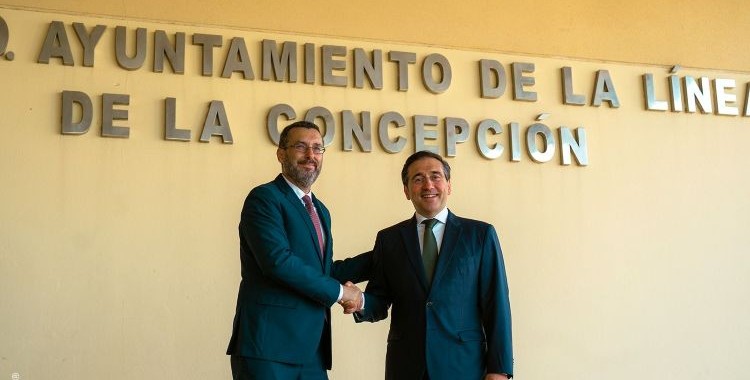
Albares also met with the mayor of La Línea, José Juan Franco Rodríguez, with whom he discussed the implementation of the Agreement. He emphasized to the mayor the “great opportunities for development and growth” that the removal of the fence will bring “to La Línea and the entire region,” as he posted on social media. La Línea is “the municipality that, without a doubt, would have suffered the most from a hard Brexit, and yet, with this agreement, we are investing in its future and its full potential,” he told reporters.
The next stop on the tour of the region was Algeciras (Cádiz), where Albares inaugurated an information seminar about the Agreement at the Campo de Gibraltar Chamber of Commerce and later held a press conference.
“This is a historic agreement, an agreement that all democratic governments have sought and that we have finally achieved,” he told the media. He continued, “This is also an agreement widely demanded by the region, and an agreement that opens a new chapter of coexistence between two populations that were once estranged and that now join hands and walk together towards the future and development.”
According to Albares, “the objectives we set ourselves throughout this negotiation period, together with the mayors of the area and the economic and social stakeholders with whom we were in constant communication, including, of course, the Chamber of Commerce, have all been achieved.”
“We eliminated inequalities and distortions that are part of the past, we protected the future of workers and ensured fair pensions, we guaranteed the mobility of people and goods, but above all, we achieved a fundamental objective: this agreement also allows us to de-enclave the Campo de Gibraltar, placing it within a geography of progress and a future—physically, with the removal of the border fence, and with a new model for the airport that goes far beyond mere symbolic gestures,” he emphasized. “Today, Spain views the Campo de Gibraltar differently; it is seen as a place of future, of opportunities, of growth, of connectivity,” he added.
Albares also affirmed that, with this Agreement, “Spain has full authority to apply European regulations at this new external border of the European Union, and these controls will be carried out by the Spanish National Police.” He continued, explaining that Spanish authorities will have the power to issue short-stay visas, while Gibraltar will be obligated to report on the issuance and renewal of residence permits, and Spain will have the right to veto applications for residence and asylum.
The minister’s day concluded in San Roque, where he met with its mayor, Juan Carlos Ruiz Boix (PSOE), president of the Foreign Affairs Committee of the Congress. Albares personally thanked the mayors of La Línea and San Roque, and by extension the mayors of Algeciras, Castellar de la Frontera, Tarifa, Jimena de la Frontera, Los Barrios, and San Martín del Tesorillo (some of whom were present at the information seminar), for their role in the negotiations.