Eduardo González
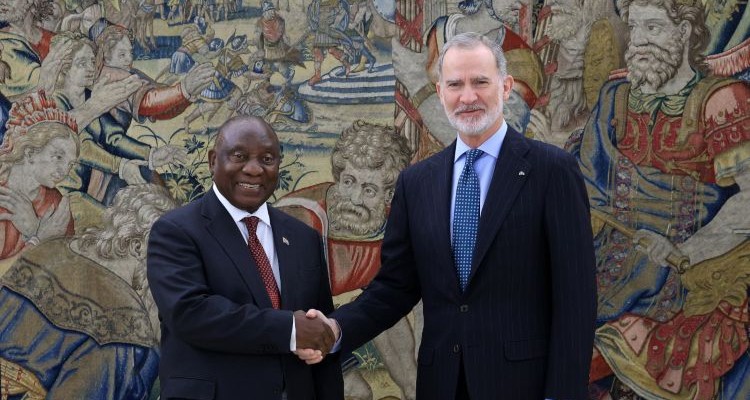
King Felipe VI held a meeting and lunch this Friday with the President of the Republic of South Africa, Cyril Ramaphosa, who is in Spain to participate this Saturday in the Global Progressive Mobilization, a progressive summit organized in Barcelona by the Prime Minister, Pedro Sánchez.
This is the first visit to Spain for Cyril Ramaphosa, who was elected President of South Africa in May 2019 and re-elected in June 2024 for a second five-year term. The South African president’s second day in Spain will take place tomorrow, Saturday, April 18, in Barcelona, where he will participate in the Global Progressive Mobilization, along with Pedro Sánchez, the President of Brazil, Luiz Inácio Lula da Silva; the President of Uruguay, Yamandú Orsi; the President of Colombia, Gustavo Petro; and the President of the European Council, António Costa.
Following his meeting with the King, the South African president participated in a business forum in Madrid, organized by the Spanish Chamber of Commerce, the State Secretariat for Trade (through ICEX), and the Spanish Confederation of Business Organizations (CEOE). The forum aimed to strengthen economic, trade, and investment relations between Spain and South Africa and to identify bilateral business opportunities.
During the meeting, which was also attended by the Minister of Industry and Tourism, Jordi Hereu, Ramaphosa noted that in 2025, “total trade between South Africa and Spain reached approximately €2.8 billion” and South African exports to Spain “reached €1.3 billion, a ten percent increase over the previous year.” “This makes Spain our main and fastest-growing trading partner within the European Union,” he stated. According to data from the Diplomatic Information Office (OID), South Africa is the leading destination for Spanish investment in Sub-Saharan Africa, accounting for 37 percent of the total.
“Currently, more than 150 Spanish companies operate in South Africa, supporting over 20,000 jobs in sectors ranging from renewable energy and infrastructure to financial services, technology, and tourism,” he continued. “In addition, Spain has committed more than €2.1 billion to South Africa’s just energy transition,” with a particular focus on “green hydrogen, electric vehicles, renewable energy, and grid infrastructure,” he added.
According to Ramaphosa, “South Africa has the world’s largest reserves of platinum group metals,” “critical minerals” that “are at the heart of hydrogen fuel cell technology, clean energy systems, and the future of electric mobility,” he explained. “South Africa and Spain are not just two countries that trade goods; they are two economies with the potential to build value chains that serve markets far beyond our own borders,” he added.
Spain and South Africa have maintained diplomatic relations since 1951, although it wasn’t until the release of the historic anti-racist leader and later president Nelson Mandela in 1990 that institutional ties intensified. Both Spain and South Africa have resident embassies in their respective capitals. In addition, the two countries have held annual bilateral consultations at the level of Secretary of State or Deputy Foreign Minister since 2003. The most recent political consultations took place in December 2025 between the Spanish State Secretary for Foreign and Global Affairs, Diego Martínez Belío, and his South African counterpart, Deputy Foreign Minister Alvin Botes, in Madrid.