Text and photos: Juan David Latorre
Last Friday, the Centro Cultural Gabriel García Márquez of the Colombian Embassy in Spain (Fortuny street, 36) inaugurated the exhibition El futuro es botánico: ciencia, vivencias y relaciones de lo vivo (The future is botany: science, experiences and relationships of the living), which is presented as part of the Madrid ARCO 2026 Contemporary Art Fair. The exhibition will remain open to the public until May 14.
The exhibition aims to explore the complex relationships between humanity and nature from a scientific, cultural and sensory perspective. Starting from the idea that the biological and cultural history of our species has always been intertwined with biodiversity, the exhibition reflects on how our interactions have transformed -and in many cases fragmented- the networks that sustain life.
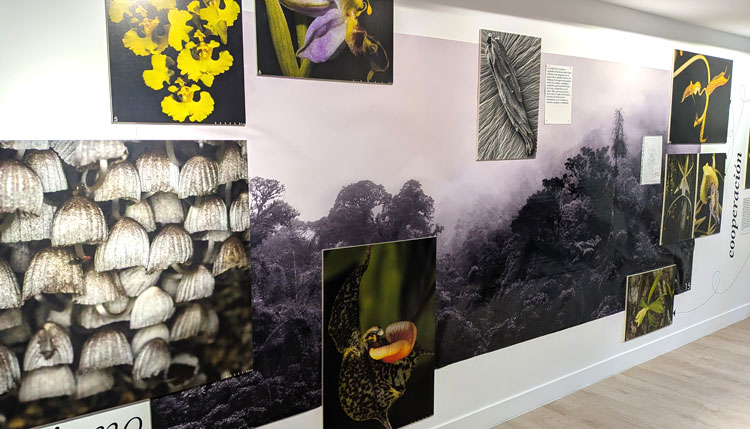
Through photographic, illustrated, sound and audiovisual material, the exhibition traces a narrative cartography that confronts different forms of knowledge: western science that describes and classifies, and lived science that inhabits and embodies nature in everyday life. This crossroads opens up a space to rethink how we perceive, represent and care for the living, building bridges between scientific research, cultural memory and aesthetic production.
For more than 3 billion years, nature has woven a web of infinite and mysterious interactions, linking its living beings in unexpected ways and shaping the relationships that have shaped life as we know it today, in all its complexity and contradiction. These dynamics occur simultaneously, some are configured as beneficial links, while others generate damage. Some interlink two beings, others are multiactors.
Some regenerate, others sacrifice, some fulfill short-term goals, while others are structural and condition the existence of one or more living beings. An initially reciprocal relationship can be seen as a parasite, and yet trigger new forms of life emerging from an apparent imbalance. The relationships between humans and other living things have crystallized through a predominantly anthropocentric prism. This has led to the conceptual rupture between man and nature, where we do not conceive ourselves as part of the living world, even as mammalian animals.
This exhibition proposes a narrative cartography of a tiny portion of this eternal fabric of beings and relationships. Through photographic, illustrated and sound material, we confront different ways of perceiving, representing and linking ourselves with what we call “nature”.
Here two fundamental approaches dialogue and are confronted. Western science, which describes, classifies, disaggregates and extracts, and territorial cosmologies, which inhabit, embody and relate daily to the living from the affective and the situated. From this tension arises a question: why preserve biodiversity? Perhaps their protection is not only an ecological imperative, but also an ethical and cultural necessity. In the persistence of diverse life is at stake planetary balance and, therefore, the possibility of imagining and creating futures that contain us.
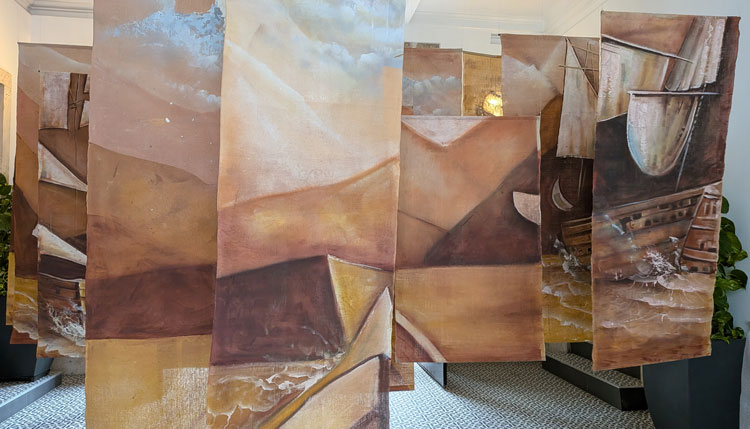
The opening was held as part of the traditional institutional breakfast offered by the Embassy of Colombia as part of the ARCO GUEST Circuit. Also presented was the work Gonawhindá, by the Colombian artist Perkys, inspired by the Sierra Nevada de Santa Marta and made with traditional organic pigments.