
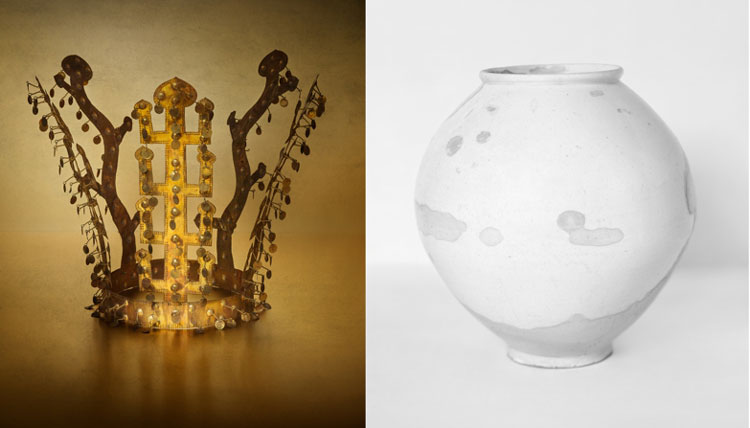
Until May 8th, the Centro Cultural Coreano (Paseo de la Castellana, 15) presents the exhibition Serene and Radiant by the renowned Korean photographer Koo Bohnchang (South Korea, 1953) in its Han-ul Gallery. Bohnchang is a key figure in contemporary Korean photography.
Koo Bohnchang, a contemporary artist and professor, was recognized for his contributions to Korean photographic art with the Presidential Commendation in the Fine Arts category at the 47th Korea Culture and Art Awards.
This afternoon at 6:30 p.m., a talk with the artist will take place in the Multipurpose Room (reservations required via this link). The photographic exhibition will open at 7:30 p.m. (free admission).
Serene and Radiant brings together 32 works from the White and Gold Porcelain Series, which delicately capture the contrasting aesthetics of pure white porcelain (Baekje) from the Joseon Dynasty (1392-1910), with particular emphasis on the Dalhangari or “moon jar,” and the golden relics of the Silla Dynasty (57 BCE-935 CE). Through the relationship between light, time, matter, and memory, Koo Bohnchang transforms historical objects into contemporary images of great sensory intensity, inviting slow and profound contemplation.
Among the most outstanding pieces on display in Madrid are works from the Gold Series dedicated to archaeological treasures from Silla, such as the lightbox installation of the Golden Crown of Geumnyeongchong (Gold, KR 045, 2023), presented horizontally and conceived as an evocation of the moment of its discovery. The selection is rounded out with iconic images such as the Cheonmachong Gold Crown (Gold, KR 047, 2023), the Hwangnamdaechong North Mound Gold Crown (Gold, KR 054, 2023), and the Seobongchong Gold Crown (Gold, KR 057, 2023), as well as the Cheonmachong Gold Headdress (Gold, KR 043, 2023) and diadem ornaments from historical tombs in Gyeongju (the former capital of the Silla Kingdom).
Since 2004, fascinated by the subtlety of baekja, Koo Bohnchang has worked with an essentially monochromatic approach (whites, blacks, and very soft tones) that eliminates distractions and focuses attention on form, texture, light, and shadow. This visual language is linked to the Joseon aesthetic: stillness, purity, sobriety, and serene beauty. In her images, the everyday becomes extraordinary: a calm that seems to reside within the material itself and a radiance emanating from a subtle light.
The exhibition opens with an essential motif: the curve of the Dalhangari as a threshold for contemplation. The show also proposes a dialogue with architecture through an installation of prints designed to be experienced from both inside and outside the space.
The Dalhangari (moon jar) is one of the most iconic pieces of baekja art. It typically measures around 40 cm and is believed to have been made between the late 17th and early 18th centuries. It is crafted by joining two halves, so a central mark reveals this seam; its slight asymmetry is appreciated as part of its natural beauty. Without elaborate ornamentation, it stands out for its gentle curves and luminous white, which convey calm and a surprising sense of contemporaneity. Its almost spherical shape is reminiscent of a full moon and exudes a sober and serene beauty.