
Eduardo González
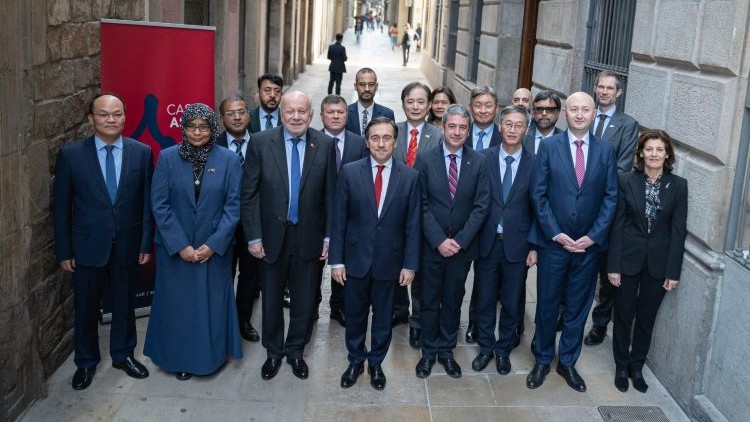
Foreign Minister José Manuel Albares announced this Friday to the Asian ambassadors accredited in Spain the upcoming launch of the first interministerial commission for Asia-Pacific affairs, similar to the one already existing for Africa.
Albares made this announcement at the Casa Asia headquarters in Barcelona, during the presentation of the new Spanish Strategy for Asia and the Pacific 2026-2029, which was approved on December 9 by the Council of Ministers. He explained that the strategy “lays the foundations and sets the objectives of our policy towards a region of the world that is absolutely crucial, due to its economic and demographic weight, its geopolitical projection, and its cultural richness, for Spain’s foreign policy.”
This “pluralistic and diverse region” constitutes “the new center of gravity of international relations,” the minister stated. “At a time when we hear nostalgic, if not openly reactionary, rhetoric that ultimately expresses a fear of a diverse, multipolar world, Spain is looking outward, and of course, to the East, with an outstretched hand to seek solutions with our Asia-Pacific partners to challenges that are common and that, therefore, can only have a common response,” he continued.
“We want to consolidate, first and foremost, political relations and diplomatic engagement in the region, in Asia-Pacific,” and for that reason, “we are going to strengthen an agenda of trips and visits to the region and mechanisms for bilateral dialogue,” on “a path we have already begun in recent years,” he announced. “There are the recent trips of the Prime Minister to China on three occasions, to India, from which he has just returned twice, and to Vietnam, and the State Visit of Their Majesties the King and Queen also to China,” he recalled.
Albares also highlighted “the establishment of a permanent diplomatic presence in Uzbekistan, as we have already done in recent years in Armenia and Azerbaijan, and the objective of strengthening the staff of our embassies and consulates throughout the region.” “At the same time, we hope that more of our Asia-Pacific partners will establish resident embassies in our country,” he affirmed.
“Europe and Asia are among the largest markets and most powerful geopolitical areas in the world,” and therefore, “Spain is making a decisive contribution to a Europe with a strategic presence in Asia-Pacific, making the most of existing agreements and supporting the conclusion of new instruments, such as the one recently signed with India,” Albares continued.
Furthermore, the minister announced Spain’s intention to “finalize” its accession to dialogue partner status with the Association of Southeast Asian Nations (ASEAN) “with the signing of the Treaty of Friendship and Cooperation during the current Philippine presidency,” a country “with which we share a long history.” He also reported the government’s intention to expand “the presence of the Cervantes Institute on the continent” and to encourage airlines “to increase direct routes between Spain and Asia.”
“Due to its enormous size, representing nearly 60% of the world’s population, and its great cultural, political, and human development diversity, diplomatic work with Asia-Pacific requires a high degree of adaptation to the context and coordination,” and therefore, “the strategy includes special attention to specific countries and regions, such as China, Korea, Japan, India, and Central Asia, where we want to further increase our presence,” the minister explained. “In China, for example, we are building a new embassy that reflects the relationship Spain desires and currently has with such an important country in world affairs,” he affirmed.
“To better monitor the strategy,” he announced, “we are going to establish an inter-ministerial commission, for the first time in the history of our foreign policy, for Asia-Pacific affairs, as we recently did with Africa.” The minister also announced the creation of “new mechanisms, such as a Spain-India Advisory Council,” and “a periodic review of the objectives of the Spanish Foundations Council” with China, Japan, India, and Australia.