
Eduardo González
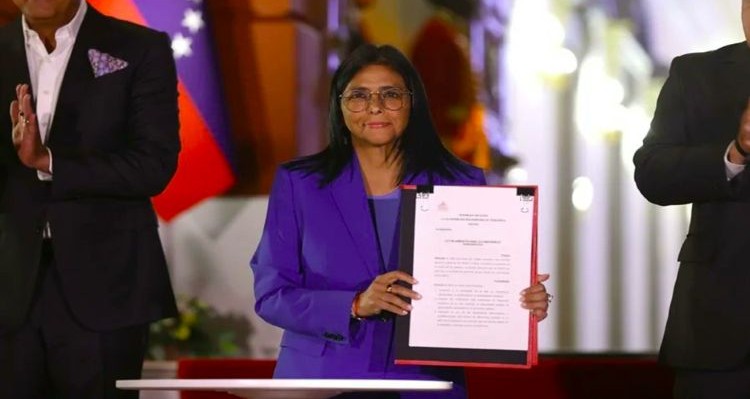
Foreign Minister José Manuel Albares announced this Friday, February 20, that Spain will formally request the lifting of sanctions against Venezuela’s interim president, Delcy Rodríguez, to signal that “things are moving in the right direction in this new phase” following the enactment of the new Amnesty Law.
“We don’t yet know the details of the text,” but “Spain hopes it will be as broad as possible and allow political prisoners to be released,” Albares stated, one day after Delcy Rodríguez enacted the so-called Amnesty Law for Democratic Coexistence.
“Spain has been requesting this measure for a long time,” Albares continued. “I also believe it’s a very good sign of where Venezuela is headed in this new phase, the fact that it was approved unanimously with all votes, including those of the opposition,” the minister emphasized, before participating in the presentation of the new Spanish Strategy for Asia and the Pacific 2026-2029 to Asian ambassadors accredited to Spain at Casa Asia in Barcelona.
“We encourage the interim president, Delcy Rodríguez, to continue taking steps in that direction, to create the conditions so that those who are currently outside Venezuela—200,000 of them living here in Spain—who wish to return to Venezuela, can do so,” he insisted.
“I also announce that we will formally request the European Union to lift the sanctions against the interim president, Delcy Rodríguez, because the European Union needs to send a signal that things are moving in the right direction in this new phase,” he declared. “Sanctions are never an end in themselves, they are a means, a means to achieve ends, a means to bring about that broad, peaceful, democratic dialogue in Venezuela,” he stated. “If steps are being taken in that direction, the European Union must also take them,” he added.
European sanctions against Venezuela were first adopted in 2016 and entail, for those sanctioned, including then-Vice President Delcy Rodríguez, a ban on entry into the EU and the freezing of their assets and property in Europe.
“At the same time, I also want to remind everyone that (the ousted president) Nicolás Maduro never faced sanctions from the European Union, because normally the European Union, when it establishes individual sanctions, always excludes presidents and foreign ministers, precisely to keep the channels of dialogue open,” Albares noted.
“Therefore, that is another reason, but the fundamental one is to support Venezuela at this moment and for the European Union to send a strong signal, a powerful message, that Venezuela is on the right track when it takes steps like this one,” he added.
“I reiterate, we don’t yet know the text, but we do know what underlies it, the underlying philosophy, and it is also an extraordinary sign and piece of news that it was approved unanimously. This is a measure that Spain, moreover, has been calling for for a long time,” he concluded.