
Eduardo González
The Spanish government has formally protested to Italy over the restricted meeting of EU leaders convened on Thursday morning by Italy, Germany, and Belgium to prepare for the informal European Council summit on competitiveness held at Alden Biesen Castle (Belgium). The government considers the meeting “undermines the fundamental principles of the European Union” and objects to the fact that Prime Minister Pedro Sánchez was not even invited.
The meeting was convened by Italian Prime Minister Giorgia Meloni; German Chancellor Friedrich Merz; and Belgian Prime Minister Bart de Wever. In addition to the prime ministers of Italy, Germany, and Belgium, the leaders of Austria, Bulgaria, Cyprus, Croatia, Czech Republic, Denmark, Finland, France, Greece, Hungary, Luxembourg, Netherlands, Poland, Romania, Slovakia, and Sweden participated in the meeting, as well as the President of the European Commission, Ursula von der Leyen.
Initially, it was reported that Spain had contacted Meloni to protest the lack of an invitation for Sánchez, but it was later clarified that the Spanish government had contacted Italy “not to request an invitation,” but to convey that this meeting format “undermines” the EU’s basic principles and contributes more to distancing solutions than bringing them closer, according to sources at Moncloa Palace speaking to the news agencies Europa Press and EFE, and to TVE.
The Diplomat contacted a source at Moncloa Palace, but the only response was that “the president has come to Liège for the leaders’ retreat convened” by the President of the European Council, António Costa, without further details.
According to Italian official sources speaking to Europa Press, Pedro Sánchez had “an opportunity to chat” with Meloni “on the sidelines of the retreat,” but “during the conversation, President Sánchez did not raise any issue regarding the lack of an invitation to the coordination meeting that took place in the morning.”
In any case, invited or not, everything suggests that Pedro Sánchez did not attend this meeting because he disagreed with the format, and not simply because he hadn’t been invited. In fact, Spain wasn’t the only country that wasn’t invited (neither were Portugal, Ireland, Estonia, Latvia, Lithuania, Malta, and Slovenia), but, as a Slovenian diplomatic source stated, “some countries invited themselves.”
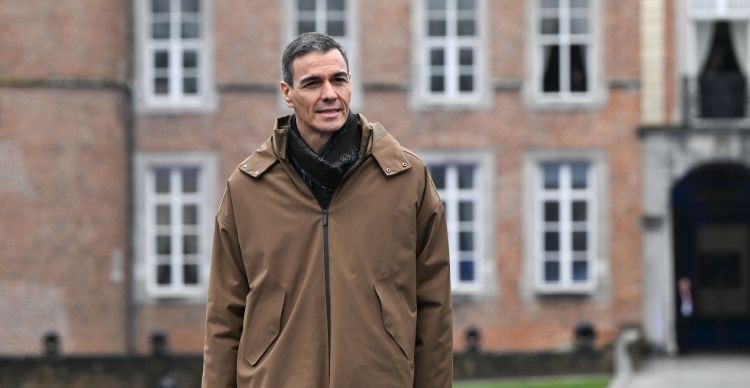
Pedro Sánchez made no statements to the media, neither upon his arrival nor at the end of the informal meeting convened by Costa. The Belgian Prime Minister did speak, but he also failed to clarify the situation.
In statements to the press at the end of the meeting, Bart de Wever asserted that “everyone was invited,” but “some decided to accept the invitations, others didn’t.” “But I don’t believe that Spain wasn’t invited,” he clarified.
“Normally, these previous conferences involve a couple of countries, maybe ten countries. This time there were 19, and it felt a bit like a pre-conference” to the informal one convened by Costa, he admitted. “That’s not very polite to the others, but everyone is aware of it,” he continued. “We didn’t intend to organize a pre-conference. We don’t want it to be perceived that there’s a large group of countries trying to impose their will on other countries, like Spain. That’s not the intention,” he concluded.
Sánchez’s address
During the informal summit, as reported by Moncloa, Pedro Sánchez reiterated the importance of acting as soon as possible to strengthen our competitiveness, not as an end in itself, but as the essential basis of the EU’s strategic autonomy. In this regard, he emphasized the need to move forward in this direction without compromising fundamental values and principles or abandoning the European social model.
The president focused his address on three areas in which, in Spain’s view, Europe needs to make substantial progress: sustainability, investment, and human capital. According to Sánchez, strategic autonomy is intrinsically linked to the need to continue investing in renewable energy and to increase investment in generation, networks, and interconnections.
He also stressed the importance of increasing investment to a level commensurate with European challenges and warned that security and defense, technology, and green industries, among others, are European public goods and, as such, require European funding.
Pedro Sánchez also reiterated that the European Union’s competitiveness and the European welfare model must advance hand in hand, without compromising the Social Pillar. In that regard, he stressed the importance of safeguarding access to affordable housing, building a labor market capable of developing the human capital of the 21st century, and implementing a strengthened European cohesion policy.
The leaders’ retreat included two working sessions: one with economist Enrico Letta, focused on the internal market and other policies, and another with former European Central Bank President Mario Draghi, focused on geoeconomics.