
Eduardo González
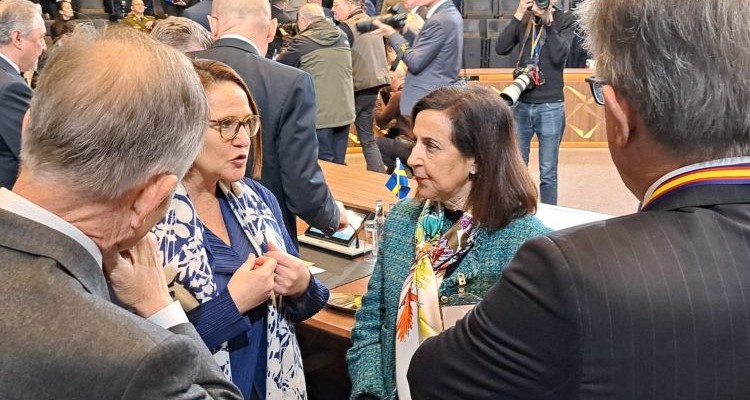
The Minister of Defense, Margarita Robles, affirmed this Thursday in Brussels that NATO has recognized “Spain’s investment effort,” which has allowed it to reach two percent of GDP for defense and security spending.
“The assessment has been very positive,” Robles told the press at the end of the NATO Defense Ministers’ meeting, held at the Alliance’s headquarters in Brussels. “The most important aspect is that Spain’s investment effort has been recognized, and we have reached two percent,” she added, referring to the review carried out last January by the Atlantic Alliance to verify the degree of compliance with the capability objectives agreed upon in June 2025 during the Hague Summit.
“According to the data that the Atlantic Alliance itself is considering, and which are the result of ongoing research and work, Spain reached the two percent target to which we had committed last year, in 2025,” she added. This is “a very important piece of information,” because it is the result of a “very detailed analysis” carried out by a group of NATO experts in Spain based on documentation provided by the government, he emphasized.
At the press conference prior to the ministerial meeting in Brussels, NATO Secretary General Mark Rutte praised the increased defense spending by the allies on Wednesday, in compliance with the commitments made at the Hague Summit. “The investment has increased by tens of billions,” he asserted.
This past Tuesday, the US government acknowledged that Spain is making “great progress” in defense spending, and the US ambassador to NATO, Matt Whitaker, referred this Thursday in Brussels to the Spanish government’s commitment to achieving the targets without having to increase investment to five percent: “If they can do it cheaper, fantastic. We don’t think they can, but if they can, please show us all how.”
US President Donald Trump has repeatedly criticized and even threatened Spain (with increased tariffs or expulsion from NATO) for its refusal to raise military spending to five percent during the NATO Summit in The Hague.
The Baltic and the Arctic
Furthermore, Robles explained that, during the ministerial meeting, Spain committed to “continuing its support for Ukraine” and recalled that she herself proposed this Wednesday, during the EU Foreign Affairs Council for Defense Ministers, “an initiative we call Naval Gathering in the Baltic” so that “ships and navies from different countries can be in the Baltic to conduct exercises.” “It has been very well received by many Baltic countries, and we are going to work along these lines. This activity will be proposed and co-led by Spain, but it will also be carried out jointly with other activities of the Atlantic Alliance,” she specified.
The minister also expressed Spain’s support for the Arctic Sentry mission to ensure security in the Arctic, which is “what has been proposed for a long time” to launch “a special mission of enhanced surveillance” in response to Russia’s increasing military activity and China’s growing interest in the Arctic. The Arctic mission was announced by Mark Rutte at the aforementioned press conference.
At the close of the ministerial meeting, Robles participated in an informal exchange in a NATO-Ukraine Council format, in the presence, for the first time, of the new Ukrainian Minister of Defense, Mykhailo Fedorov. The minister also held a bilateral meeting on the sidelines with the Deputy Prime Minister of Australia, Richard Marles, with whom she signed an agreement on information security.