
Eduardo González
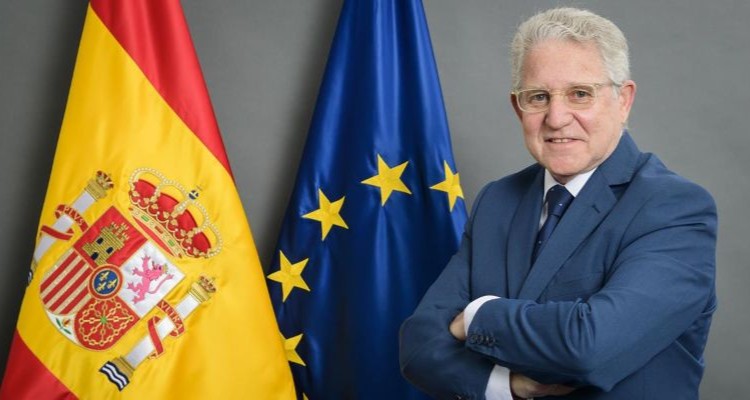
The Council of Ministers dismissed Jesús Santos Aguado as Spain’s ambassador to Lebanon on Tuesday, at the proposal of Foreign Minister José Manuel Albares, after he reached the retirement age for civil servants.
Born in León on January 17, 1956, and a graduate in Medicine from the Complutense University of Madrid, Santos Aguado practiced as a primary care physician in Spain and in Equatorial Guinea as a member of the Spanish Red Cross. He was also a researcher in Molecular Biology and Immunology before joining the Diplomatic Service in 1992. Due to his medical experience, the Government appointed him, in December 2021, to the position of Ambassador on Special Mission for the International COVID-19 Crisis and Global Health.
As a diplomat, he served as ambassador to Guinea-Conakry (from 2007 to 2011) and Mauritania (from 2017 to 2021), and held the positions of deputy head of mission at the Spanish Embassies in Ivory Coast, Equatorial Guinea, Australia, Lebanon, and Greece. He also served as deputy director general for EU countries and candidate countries.
In March 2022, he was appointed Spanish ambassador to Lebanon, replacing José María Ferré. Therefore, his retirement will require the government to fill an embassy post that is especially important for Spain, particularly at this time.
The future beyond UNIFIL
Spain has one of the largest contingents in the International Peacekeeping Force (UNIFIL), with 700 military personnel assigned to patrol and monitor the line of separation between Israel and Lebanon, in coordination with the Lebanese Armed Forces.
Spain’s participation in UNIFIL began in September 2006, as part of Operation Libre Hidalgo in southern Lebanon to contribute to the implementation of United Nations Resolution 1701. Since then, the Spanish Armed Forces have led the mission’s Eastern Sector from the Miguel de Cervantes base. In June 2025, Spain handed over command of the mission to Italy, which had held it since February 2022.
On February 2nd, the President of Lebanon, Joseph Aoun, paid an official visit to Madrid to discuss the future of the mission, whose mandate concludes at the end of 2006 after twenty years on the ground.
During that visit, Prime Minister Pedro Sánchez assured that Spain will continue to support the stability of his country beyond the end of the mission and specified that the continuation of Spanish contingents in southern Lebanon after UNIFIL’s mandate concludes will be discussed with the other European Union countries.
France, Italy, and Austria have also considered the possibility of remaining as an international force in southern Lebanon, which, according to Lebanese media, reflects Europe’s interest in “avoiding a security vacuum that could result from the end of UNIFIL’s mission.” One of the proposed options is the creation of a European multinational force, with French forces at its core and the support of Spain and Italy. However, the United States’ interest in reducing France’s role in southern Lebanon and Spain’s critical stance regarding Israeli policies and the Gaza war raise serious doubts about the chances of success of the European proposal.
In addition, the Embassy in Beirut has a Consular Section serving over 900 Spanish residents in the country and an Economic and Commercial Office that supports Spanish and Lebanese companies interested in investing in, exporting to, or importing from either country. Furthermore, the Cervantes Institute has a branch in Beirut and offices in Kaslik, Tripoli, and Baalbek.