
The Diplomat
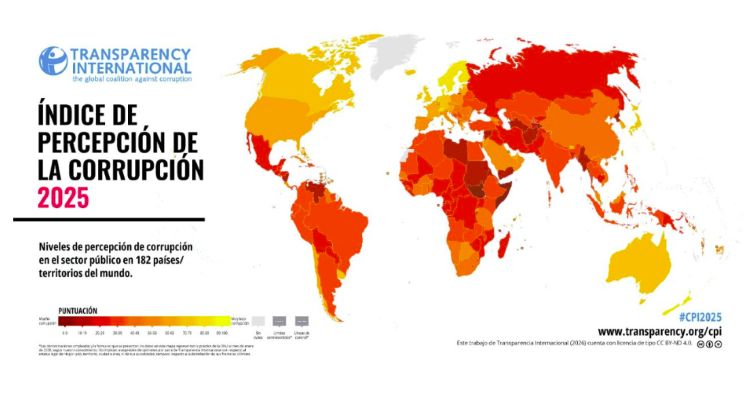
Spain now ranks 49th in Transparency International’s Corruption Perceptions Index (CPI), which measures corruption in the public sector of 182 countries and territories.
Spain has dropped one point in Transparency International’s 2025 Corruption Perceptions Index (CPI 2025) (presented this Tuesday, February 10) compared to the previous year (CPI 2024), with a score of 55/100.
This score places Spain 49th out of 182 in the global CPI ranking, the same as Cyprus and Fiji, and one position above Italy (score 53/100), two places above Poland (score 53/100), and two places below Portugal (score 56/100, which also dropped one point this year). Spain has thus fallen three places in the world ranking compared to 2024.
At the top of the Index are two EU countries, Denmark and Finland, followed by Singapore, New Zealand, Norway, Sweden, and Switzerland. At the bottom are Cuba, Guyana, Hungary, North Macedonia, Tanzania, and Albania.
In most EU member states, there has been a general decline in scores, reflecting “a worrying state of stagnation in the effective implementation of anti-corruption standards and a growing erosion of accountability mechanisms,” according to the organization.
This setback is part of a global trend of weakening efforts in the fight against corruption, aggravated by the loss of international leadership and the deteriorating role of the United States, “whose lack of commitment to implementing key instruments against transnational bribery undermines international pressure to drive effective reforms.”
In this context, Spain has also fallen from 16th to 17th place among the European Union Member States, surpassed by Portugal (score 56/100) and Slovenia (score 58/100), and sharing the same score as Cyprus (score 55/100).
“Spain’s result in the 2025 CPI is not unexpected,” notes Transparency International. “It highlights the need to strengthen the structural and holistic approach to anti-corruption policies, whose effective implementation depends on the existence of basic political consensus to pass the necessary legislative reforms, as well as an effective and sustained institutional commitment.”
The joint analysis of the European Commission’s Rule of Law reports, the GRECO assessments, and those of the Transparency and Good Governance Council leads to a consistent diagnosis: Spain has made significant progress in the regulatory and institutional spheres, but is still in the early stages of consolidating and effectively implementing its legislative reforms.
In this regard, the report warns that one of the most important instruments for guaranteeing institutional coherence in the fight against corruption remains pending: the development of a National Anti-Corruption Strategy, the adoption of which has been legally required since September 2024. While the State Plan to Combat Corruption was published, this does not replace the necessary efforts toward integration and a holistic vision, which are the core elements of a strategy.
Last July, Transparency International Spain formulated one hundred recommendations to promote a national anti-corruption strategy. In this context, according to the organization, “it is essential to advance the necessary political consensus so that the Spanish Parliament (Cortes Generales) transforms proposals and bills, as well as the various plans, into effective laws, equipped with resources and accountability mechanisms, so that the anti-corruption agenda ceases to be a mere catalog of intentions and becomes a set of implemented, visible reforms capable of genuinely improving indicators of integrity, the rule of law, and public trust.”