
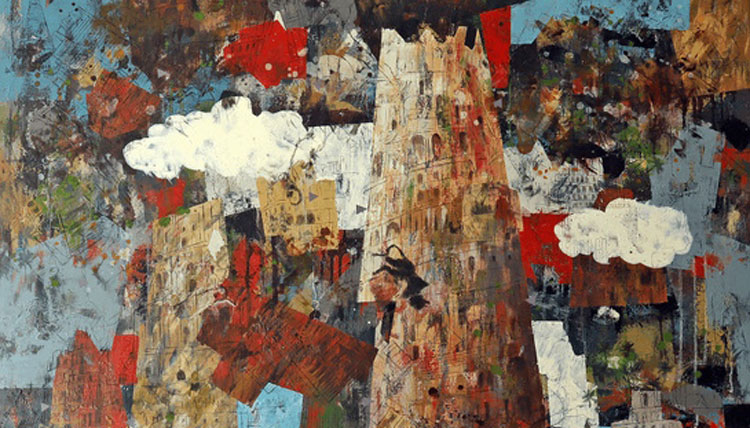
Until next 17 May, Casa Árabe de Madrid presents the exhibition De Babel al último rey de Iraq: una civilización milenaria (From Babel to the last king of Iraq), by the Iraqi artist Hanoos Hanoos, in which the myth of Babel is intertwined with the recent history of Iraq to explore how splendor and tragedy coexist in one cultural heritage. Free entry until full capacity. In Spanish.
Hanoos’ gaze links the contemporary with the ancestral, and reinterprets the vestiges of a civilization to offer us metaphors of humanity itself. His creative process, meticulous and almost obsessive, part of the chaos to build narrative images full of mystery and tension. Through these images, the artist turns historical memory into his own visual language, where the personal and the collective dialogue. Thus, both the biblical account and the episodes of the modern history of Iraq are revealed as universal reflections on power, violence and human frailty.
The exhibition focuses on two works, Torre de Babel N° 50 and La matanza del Palacio Al-Rehab, as well as sketches that attest to the artist’s journey to reach the final work. On the one hand, it is a long artistic research on the tower of Babel, inspired by Juan Luis Montero Fenollós and approached from deconstruction and destruction as a metaphor of historical and contemporary chaos. On the other hand, his interest in social art and historical memory of Iraq is reflected in The Al-Rehab Palace Massacre (2025), where he reflects from a historical and autobiographical perspective on the assassination of King Faisal II, combining documentation and imagination, paying homage to the monarch and evoking the violence of the event with references to Goya and Picasso, in a line of work focused on the massacres and collective traumas of the country.
Hanoos Hanoos (Kufa, 1958) is a painter, engraver and professor. He holds a degree and a doctorate in fine arts from the Complutense University of Madrid. He began his studies at the Institute of Fine Arts in Baghdad (1974-1979) and, after travelling through Europe, completed his training in Madrid, where he obtained his doctorate cum laude on the work of Al-Wasiti and where he has resided since 1981.
He has made 41 individual exhibitions, participated in more than a hundred collective and received 41 painting awards, as well as scholarships from the Ministry of Foreign Affairs of Spain and the Instituto Hispano Árabe. His work, which includes more than 4,000 originals and numerous prints and drawings, is part of public and private collections in Spain and abroad.