
Eduardo González
Spanish Prime Minister Pedro Sánchez did not participate in the joint declaration adopted this Monday, December 15, in Berlin by several European leaders. The declaration reaffirms the commitment of Europe and the United States to the security and sovereignty of Ukraine and details a plan for military, economic, and diplomatic support, including the creation of a multinational force to protect the country and guarantee peace in the region.
In the text, the leaders highlighted the “significant progress” achieved in recent weeks, the result of collaboration between the teams of Ukrainian President Volodymyr Zelensky and US President Donald Trump, along with the efforts of European countries.
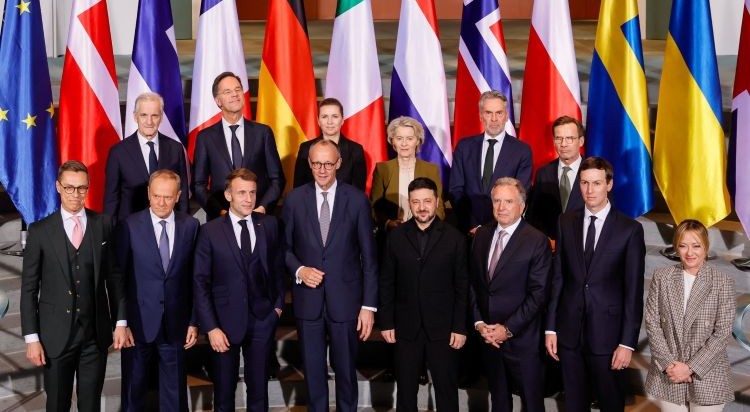
The declaration was adopted by the President of the European Council, António Costa; the President of the European Commission, Ursula von der Leyen; the Danish Prime Minister, Mette Frederiksen; the Finnish President, Alexander Stubb; the French President, Emmanuel Macron; and the German Chancellor, Friedrich Merz. The Italian Prime Minister, Giorgia Meloni; the Dutch Prime Minister, Dick Schoof; the Norwegian Prime Minister, Jonas Gahr Støre; the Polish Prime Minister, Donald Tusk; the Swedish Prime Minister, Ulf Kristersson; and the British Prime Minister, Keir Starmer.
In the declaration, the leaders pledged to continue working together to achieve a peace that preserves the sovereignty of Ukraine and the security of the Euro-Atlantic region. Furthermore, the signatory countries will continue supporting the Ukrainian armed forces with the aim of maintaining a deterrent defense capability in peacetime and reaching a level of 800,000 personnel, enabling them to confront any potential future conflict.
The signatories also advocated for the creation of a “European-led multinational force,” comprised of contributions from countries willing to participate in the Coalition of Volunteers and with the support of the United States. This force, which would operate within Ukraine, would be responsible for rebuilding the country’s defensive capabilities, protecting its airspace, and ensuring the security of its territorial waters.
Furthermore, the leaders agreed to establish a “ceasefire monitoring and verification mechanism,” led by the United States and with the participation of international actors, to allow for the early detection of any ceasefire violations and facilitate a rapid response to any aggression. The leaders also reiterated their commitment to Ukraine’s future prosperity and reaffirmed their support for Ukraine’s accession to the European Union.
This is not the first time Pedro Sánchez has been excluded from a high-level European meeting on Ukraine. For example, the Spanish Prime Minister did not participate on December 1st in a joint teleconference of several European leaders with Volodymyr Zelensky, European Commission President Ursula von der Leyen, Prime Minister António Costa, and NATO Secretary General Mark Rutte, to coordinate efforts within the framework of the peace plan for Ukraine.
Also, on August 18, the leaders of Germany, France, the United Kingdom, Italy, and Finland, along with the NATO Secretary General and Ursula von der Leyen, met at the White House with Trump and Zelensky. Sánchez did not participate in that meeting, nor did any representative of the Spanish government in a teleconference held just a week later between the foreign ministers of the five EU countries (Finland, France, Germany, Poland, and Italy), the UK Foreign Secretary, David Lammy, the Ukrainian Foreign Minister, Andrii Sybiha, the High Representative of the European Union for Foreign Affairs and Security Policy and Vice-President of the European Commission, Kaja Kallas, and the US Secretary of State, Marco Rubio.