
Eduardo González
The Ministry of Foreign Affairs has referred to an appearance by Minister José Manuel Albares before the Congress of Deputies to avoid answering a series of questions from the People’s Parliamentary Group regarding the details of the EU-UK agreement on Gibraltar of June 11, including the expected date for making the full agreement public.
On October 22, the People’s Group submitted a series of questions (a total of 16) regarding the details of the EU-UK agreement on Gibraltar of June 11.
The questions were submitted a few days after the Minister of Foreign Affairs, José Manuel Albares, appeared before Congress for the same reason. Specifically, the only response issued by the Ministry of Foreign Affairs (and published this Monday, December 15, in the Official Gazette of the Spanish Parliament) to the questions from the People’s Party (PP) refers to Albares’s appearance before the Lower House: “The Government refers to the appearance, at his own request, of the Minister of Foreign Affairs, European Union and Cooperation on October 8, 2025, before the Plenary Session of the Congress of Deputies, to report on the European Union-United Kingdom agreement regarding Gibraltar.”
The PP’s questions
In one of the questions, the PP points out that some media outlets had reported that Spain and the United Kingdom were finalizing the terms of the agreement, “without its content having been made public to date,” and therefore asks what the “date planned by the Government is to make public the full content of the agreement on Gibraltar” and what “negotiation margins are that the Government is willing to accept in its agreement with the United Kingdom and the European Union.”
Furthermore, the PP points out in another set of questions that one of the “most sensitive aspects of the negotiations on the future framework for relations with Gibraltar is the possible removal of the border fence, a measure that would have profound implications regarding sovereignty, security, and control of flows,” that “it could have significant legal and symbolic implications in relation to Spain’s historical claim of sovereignty over Gibraltar,” and even that it “raises questions about the impact it could have on Spain’s diplomatic position before international organizations.”
Therefore, the People’s Party (PP) is asking the Government what its official position is regarding the possibility of removing the Gibraltar border fence within the framework of negotiations with the United Kingdom and the European Commission, what its opinion is on whether removing the fence could undermine Spain’s claim to sovereignty over Gibraltar, and what guarantees the Government demands to ensure that removing the Gibraltar fence does not weaken Spain’s diplomatic position in international forums.
Furthermore, the PP is asking the Government to clarify what measures it plans to take to strengthen Spain’s position regarding Gibraltar at the United Nations, especially in international forums addressing outstanding issues, and what the red lines are that have been established by the various parties in the negotiation of the agreement on Gibraltar, with particular attention to the defense of national interests and interpretations that could affect sovereignty or territorial integrity.
In the remaining questions, the People’s Party asks the Government to specify, among other things, the commitments made regarding the management of the Gibraltar border. of the border or the provisions regarding the establishment of an international monitoring mechanism to ensure compliance and transparency of the agreement on Gibraltar.
Albares’s appearance
In his appearance before Congress, Albares stated that the agreement “includes provisions relating to the military base,” under which “Spain will, for the first time, have access to complete information on the goods and people arriving there to ensure that the Schengen acquis and Customs Union also apply to the base.”
Furthermore, he continued, “Schengen controls upon arrival and departure through the port and airport of Gibraltar will be carried out by the Spanish Police in accordance with the rules applied at any other external Schengen border.” “Another historic aspect of the agreement, which will also contribute to improving connectivity in the Campo de Gibraltar region, is the use of the airport, which will be opened to connections with other Spanish airports and those of the rest of the European Union, and will establish a joint management system through the creation of a joint venture in which Spain holds a 50% stake,” he added.
The text also provides for “the elimination of all physical barriers, while protecting the integrity of the Union’s single market and fostering prosperity in the area.” “The movement of goods,” he assured, “will be by land, subject to strict conditions and always after customs clearance has been completed at Spanish customs posts, meaning that goods destined for Gibraltar will have already passed through.” “Spanish authorities will carry out all customs procedures at the designated customs posts,” he emphasized.
The agreement, the minister continued, establishes the creation of a financial instrument, to which the EU, Spain, the United Kingdom, and Gibraltar will contribute, to promote cohesion, support employment, and reduce inequalities in the area. “Environmental issues will have a specific chapter, particularly regarding waste and spill management.”
According to Albares, the agreement will allow for a phased harmonization of taxes with European rates, including those on tobacco, which will be extended to excise taxes on fuels and alcoholic beverages. “Gibraltar will implement an indirect tax similar to Spain’s VAT and never lower than the European minimum,” set at 15 percent. “In other words, the levels of indirect taxation in Gibraltar will be aligned with European regulations from the moment the agreement comes into force, to guarantee a level playing field and avoid market distortions,” he stated. “Until now, there were items that were either untaxed or taxed at only six percent,” he noted.
The agreement
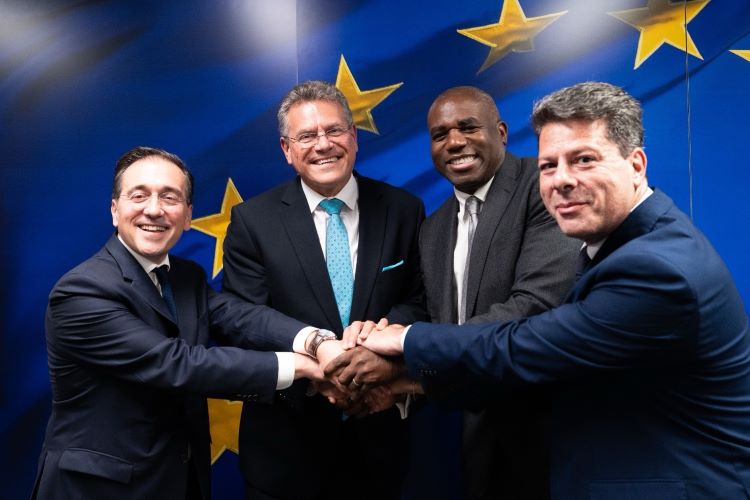
On June 11, José Manuel Albares, the Vice-President of the European Commission, Maroš Šefčovič, and the UK Foreign Secretary, David Lammy, reached a “definitive” political agreement on “the fundamental aspects of the future Agreement between the European Union and the United Kingdom concerning Gibraltar” after meeting in Brussels in the presence of Gibraltar’s Chief Minister, Fabian Picardo.
The text, according to the joint declaration, “safeguards the respective legal positions of Spain and the United Kingdom regarding sovereignty and jurisdiction,” guarantees the free movement of people by eliminating borders and controls between Gibraltar and the Campo de Gibraltar region, and establishes that the Spanish National Police will be responsible, on behalf of the European Union, for carrying out full Schengen controls at the port and airport of Gibraltar. For the agreement to take effect, it still needs to be formalized as a legally binding treaty, which is currently being negotiated.