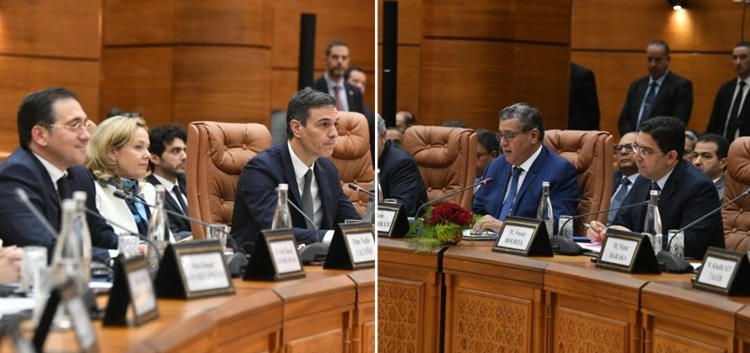
<h6><strong>Eduardo González</strong></h6> <h4><strong>Madrid will host the thirteenth High-Level Meeting (HLM) between Spain and Morocco this Thursday, December 4. As with the previous meeting, held in Rabat in February 2023, only ministers from the PSOE coalition government of Pedro Sánchez will participate.</strong></h4> According to Moncloa Palace, the meeting will be chaired by Pedro Sánchez and the Prime Minister of Morocco, Aziz Akhannouch, and will include the participation of the Third Vice President and Minister for Ecological Transition and Demographic Challenge, Sara Aagesen; the Minister of Foreign Affairs, European Union and Cooperation, José Manuel Albares; the Minister of Transport and Sustainable Mobility, Óscar Puente; the Minister of Education, Vocational Training and Sport and Government Spokesperson, Pilar Alegría; the Minister of Agriculture, Fisheries and Food, Luis Planas; and the Minister of Inclusion, Social Security and Migration, Elma Saiz. Therefore, only Socialist ministers will participate in the High-Level Meeting (HLM), as was the case in the 12th High-Level Meeting. That HLM, held in Rabat in February 2023, took place barely a year after Pedro Sánchez's surprising decision to endorse Morocco's autonomy plan for Western Sahara "as the most serious, credible, and realistic basis for resolving this dispute." That "historic shift," which has been rejected by the entire rest of the parliamentary spectrum, including the government partners, allowed Spain to overcome a very serious diplomatic crisis with Rabat at the cost of initiating another with Algeria, Spain's main gas supplier. In that context, the Rabat HLM was attended by the Socialist members of the government and was marked by the absence of the ministers from Unidas Podemos, the then junior partner in the coalition government, which had repeatedly criticized Pedro Sánchez's decision to recognize the Moroccan autonomy plan for Western Sahara. This time, it's the turn of the current junior partner in the government, Sumar, whose members were then part of Unidas Podemos and who, obviously, have also harshly criticized Sánchez and Albares's policy on Western Sahara. The main development leading up to the High-Level Meeting (HLM) in Madrid occurred on October 31, when the UN Security Council adopted a resolution, with eleven votes in favor, three abstentions (Russia, China, and Pakistan), and none against, which, among other things, described the proposed autonomy for Western Sahara as “the most viable solution” and, at the same time, defended “the self-determination of the people of Western Sahara.” Although the resolution does not expressly recognize Moroccan sovereignty over the territory and does not eliminate the right to self-determination, Morocco hailed it as a “historic victory.” <h5><strong>The HLM</strong></h5> The High-Level Meeting will include a bilateral meeting between Sánchez and the Prime Minister of Morocco, as well as bilateral meetings between the ministers of both governments. A plenary session of the Spanish and Moroccan delegations will then be held at the Moncloa Palace complex, and after the customary group photo, Sánchez and Akhannouch will preside over the signing of agreements between the two countries. Governments. On Wednesday, during the opening of the Spain-Morocco business forum, held at the headquarters of the Spanish Confederation of Business Organizations (CEOE) and framed within the XIII High-Level Meeting, Luis Planas announced that the two governments will sign two memoranda of cooperation, one on agriculture and the other on fisheries, focusing on innovation, water management, support for rural areas, and the fight against illegal fishing. <h5><strong>Business forum</strong></h5> During the business forum, organized by CEOE, the State Secretariat for Trade, the Spanish Chamber of Commerce, and the General Confederation of Moroccan Businessmen (CGEM), CEOE President Antonio Garamendi emphasized the need to “strengthen the alliance of Spanish companies in sectors that are strategic for the growth of both economies and to face the future challenges that arise at a global level.” For his part, the Minister of Transport and Sustainable Mobility, Óscar Puente, congratulated the Moroccan government “for its ambitious investment plan to build an infrastructure network that consolidates its leadership in the region, with the consequent benefit for the business fabric and for its citizens,” a plan “in which our companies are already present and actively participating in its development, especially in the railway, airport and port sectors.”