
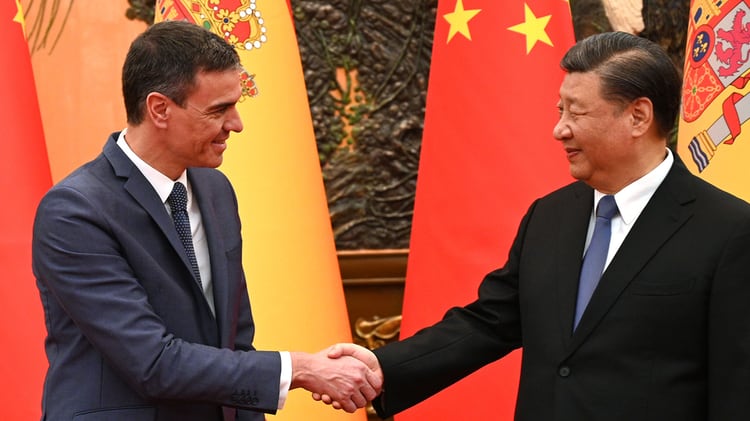
The world’s most dynamic region has become a strategic priority for the EU. Madrid seeks to project influence through its Navy, technological cooperation and the internationalisation of Spanish business.
The Indo-Pacific concentrates trade, innovation and geopolitical tensions that will shape the international order of the 21st century. Spain, traditionally focused on Europe, the Mediterranean and Latin America, is now stepping up its projection towards this pivotal region. Naval diplomacy, business engagement and cooperation with strategic partners such as India, Japan and Australia are emerging as central pillars of a strategy in the making.
The Indo-Pacific from Madrid: Spain’s Projection into the Strategic Region of the 21st Century
The Indo-Pacific has consolidated itself as the world’s most dynamic region in economic, strategic and technological terms. For the European Union, it has represented a priority area in its foreign and security policy since the adoption of the EU Strategy for Cooperation in the Indo-Pacific in 2021. Spain, though geographically distant, cannot remain detached from the transformations unfolding in this space, where key issues are at stake: maritime stability, supply chains, energy transition, technological innovation, and the geopolitical balance shaped by China’s rise and the United States’ repositioning.
Spain’s projection towards the Indo-Pacific is still under construction, yet recent steps have positioned it as an increasingly relevant actor.The European Agenda and Spain’s Position
The EU has articulated its strategy around three main vectors: economic diversification, maritime security, and the defence of a rules-based order. Spain has participated in shaping this framework and has expressed its readiness to reinforce its role within the Common Foreign and Security Policy (CFSP).
For Madrid, the region has become a growing focus of interest for three reasons:
-
Economic: The Indo-Pacific accounts for over 40% of global trade and is a priority destination for Spanish exports, particularly in agrifood products, capital goods and renewable energy.
-
Technological: The region leads in digitalisation and energy transition, offering opportunities for cooperation in R&D&I and for the internationalisation of Spanish companies.
-
Strategic: The security of sea lanes across the Indian Ocean and the South China Sea directly impacts the stability of supply chains reaching Europe through the Suez Canal.
Bilateral and Multilateral Diplomacy
In recent years, Spain has intensified its bilateral relations with key countries:
-
India: A strategic partner in trade and investment, with strong potential in infrastructure, renewable energy and digital technology.
-
Japan: An ally in innovation, green transition and cooperation within multilateral fora such as the G7 and OECD.
-
South Korea: Growing collaboration in defence and cybersecurity.
-
Australia: A privileged partner in naval and defence cooperation, underpinned by Navantia’s contracts with the Royal Australian Navy.
Spain also takes part in the EU’s policy towards ASEAN, a bloc with which the Union maintains a Strategic Partnership Agreement, offering opportunities in trade, energy transition and digital connectivity.
Security and Defence: The Maritime Dimension
Spain’s involvement in maritime security has been reinforced through the Navy’s participation in the EU’s Operation Atalanta, headquartered in Rota, which protects shipping in the Indian Ocean and the Gulf of Aden. Spain has also contributed to coordinated naval presence missions in the Strait of Hormuz, demonstrating its commitment to safeguarding critical routes for trade and energy.
The Spanish Navy, one of the most capable in the EU, holds the potential to increase its presence in naval diplomacy and cooperation missions with Indo-Pacific countries. The recent participation of Spanish vessels in joint exercises with Japan and South Korea illustrates how Spain can project stability beyond the Mediterranean.
Economy and Business Opportunities
Spain’s projection towards the Indo-Pacific cannot be limited to the security dimension. The region represents a market of 4.5 billion people and is essential to the internationalisation strategy of Spanish companies.
-
Infrastructure: Spanish firms lead rail, port and urban transport projects in countries such as India, the Philippines and Vietnam.
-
Energy: Expertise in renewables positions Spain as an attractive partner for countries seeking to diversify their energy mix.
-
Agrifood: Southeast Asia is a growing market for Spanish products, requiring phytosanitary protocols and export agreements.
-
Technology and digitalisation: The rollout of 5G networks, artificial intelligence and smart cities offers fertile ground for partnerships with Spanish companies.
Spain as a Euro-Indo-Pacific Bridge
Madrid has the opportunity to consolidate its own narrative: that of a bridge linking Europe, Latin America and the Indo-Pacific. Spain offers distinctive added value through:
-
Expertise in energy transition and infrastructure management.
-
Naval capabilities and commitment to maritime security.
-
An active diplomatic network in Latin America that can complement Europe’s projection in Asia, generating triangular synergies.
Challenges and Limitations
However, Spain’s projection in the region faces several constraints:
-
Resources: Spanish foreign policy has traditionally centred on Europe, the Mediterranean and Latin America; extending it to the Indo-Pacific requires funding and specialised diplomatic staff.
-
Coherence: Defining a clear national strategy for the Indo-Pacific, aligned with the EU’s, yet with its own priorities.
-
Geopolitical competition: Spain must navigate an environment marked by US-China rivalry, while avoiding dilution within the EU’s broader discourse.
Conclusion
The Indo-Pacific is a stage where much of the future global order will be defined. Spain cannot aspire to become a first-tier actor in the region, but it can play a significant role as a reliable partner, provider of maritime security and economic ally. With strategic vision, investment in diplomacy and support for its companies, Madrid can strengthen its position and contribute to amplifying Europe’s voice in this decisive region.