
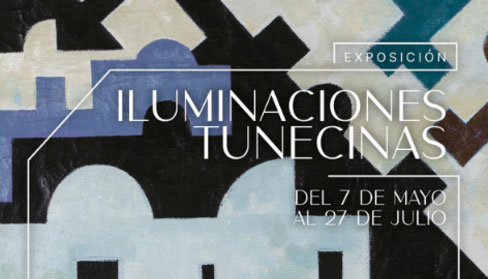
In the framework of the forum Country: Tunisia, the general director of Casa Árabe, Miguel Moro Aguilar, and the ambassador of Tunisia, Fatma Omrani Charmi, inaugurate tomorrow Tuesday at 19 hours in the cultural center of the street Alcalá, 62 the exhibition Tunisian illuminations.
The opening ceremony will begin with a lecture by Ahlem Boussandal, director general of the National Museum of Modern and Contemporary Art in Tunis. The exhibition will be on display until 27 July.
The exhibition, which presents a careful selection of Tunisian modern art, is organized by Casa Árabe in collaboration with the Museum of Modern and Contemporary Art, the Ministry of Cultural Affairs of Tunisia and the Embassy of Tunisia.
Modern art in Tunisia emerged at the beginning of the 20th century, influenced by European currents, but with its own identity that combines Arab-Islamic roots with Mediterranean modernity. During the French colonization, Tunisian artists began to explore other forms of expression, incorporating new techniques and reinterpreting local themes. After independence in 1956, Tunisian art was consolidated with a strong national identity, which would progressively encompass painting and sculpture. In this context, key figures such as Zoubeir Turki and Ammar Farhat emerged who helped to define the contemporary style of the country. Safia Farhat, a visual arts pioneer and founder of Faïza, the first Arab-African feminist magazine, also stands out.
Within this artistic development, the Tunisian School established itself as one of the most influential currents. Founded in the 1940s, this movement promoted a pictorial vision that combined traditional Tunisian aesthetics with the creative freedom of modern art while seeking to move away from orientalism. Inspired by the light, colours and everyday scenes of the country, the artists of this school, such as Yahia Turki and Jellal Ben Abdallah, rejected European academicism and sought a more authentic and local expression that broke with the colonial imaginary.
Although it is not possible to speak of a homogeneity that defines a style peculiar to the Tunisian School, which combines both naturalism and abstraction, It can be said that it played a crucial role in the reaffirmation of the Tunisian artistic identity and in the projection of national art on the world scene.
Please confirm your attendance at the event by sending an e-mail to: secretaríaembajador@embajadadetunez.es or info@casaarabe.es.