Ángel Collado
Pedro Sánchez’s attempt to win the Partido Popular’s electoral fiefdom, Madrid, via a motion of censure, has ended in the regional elections with his first personal and strategic fiasco since he came to power in June 2018.
The PP, led by Isabel Díaz Ayuso, has swept the left in the elections by bringing together the vote of the entire centre-right at the expense of the disappearance of Ciudadanos against a PSOE that has sunk to the worst results in its history in the region and remains as the third party.
The elections in the Community of Madrid are an important turning point in national politics in the middle of the legislature, as they are also the first clear sign of the Government’s exhaustion due to its management of the pandemic, despite Sánchez’s determination to remain on the sidelines.
The results revitalised an opposition that in February was on the ropes and with the leadership of Pablo Casado questioned, until Ayuso took the step of calling the polls to stop the motion of censure that the left was preparing with Ciudadanos.
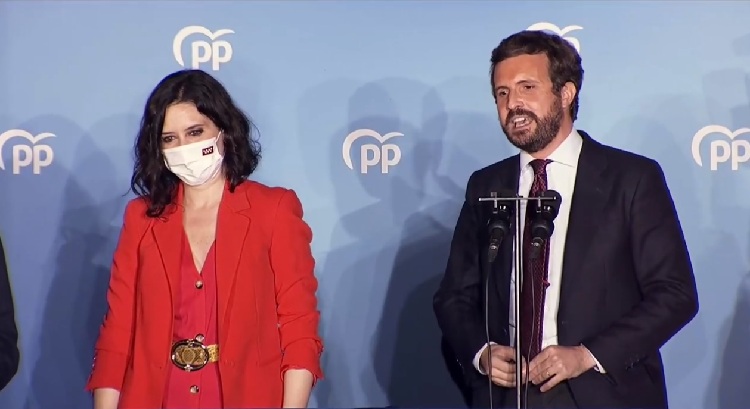
The PP candidate accepted the challenge posed to her by Sánchez, she faced the campaign in a national key of clash with the head of the Executive with the script of opposing her way of dealing with the pandemic and its economic consequences to that of the socialist leader. The verdict of the polls has been overwhelmingly in favour of the lesser restrictions on trade and hospitality that Ayuso applied in Madrid compared to those tried out in the rest of Spain.
Sánchez, after leaving the management of the pandemic in the hands of the autonomous regions, what he called “co-governance”, has left his party at historic lows, behind even the extreme local left grouped in Más Madrid.
Sánchez’s erosion is evident in the PSOE’s own electorate, with a direct transfer of votes to the PP and after an election campaign marked by constant swings from the Moncloa cabinet itself, from distancing itself from Pablo Iglesias to asking for his support in the same week. He also disconcerted voters by finally supporting the most extreme and civil war messages of his podemite partners in the central government.
In the winning party, the bold and victorious figure of Díaz Ayuso has prevailed, bringing the PP to the brink of the absolute majorities that Alberto Ruiz-Gallardón and Esperanza Aguirre held in Madrid between 1995 and 2012. The PP have liquidated their competition for the so-called political centre that Ciudadanos claimed to represent. Ayuso’s majority is so large that she will not need the support of the extreme right (Vox), limited to 9 percent of the votes, to be invested president of the Community.
Pablo Casado, as the first promoter of Díaz Ayuso, his main personal bet since he became president of the PP, is now trying to take advantage of the candidate’s success to re-launch himself as head of the opposition and as a government alternative.
Iglesias, who leaves Podemos as the last party in the Madrid Assembly, is taking advantage of the defeat of the left to confirm his exit from politics. His exit from the government was already a relief for the PSOE, which has not helped Podemos much in Madrid either.