
The Diplomat
The director of the Instituto Cervantes, Luis García Montero, has expressed his hope that the Cervantes center in Toronto, the institution’s first in Canada, could be up and running between the end of 2024 and the beginning of 2025.
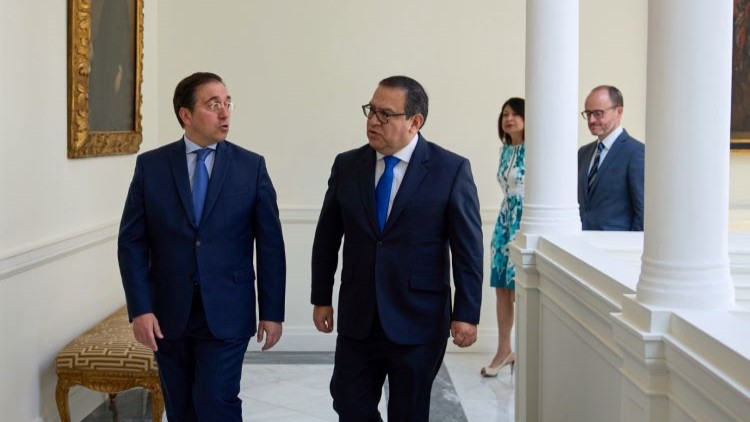
This was announced by García Montero during his working visit to Canada last week, during which he met with government representatives to advance plans to open a Cervantes Institute in this country. To this end, the director met on Wednesday with Ontario’s Minister of Citizenship and Multiculturalism, Michael Ford, and the following day with the chair of the City of Toronto’s Economic and Community Development Committee, Shelley Carroll.
“I would love for all the studies to be done this year and for it to be taken to the Council of Ministers so that in 2024 or early 2025 there will be a Cervantes center,” said the director. The Cervantes director also highlighted the multicultural character of the city of Toronto, considered one of the most diverse in the world, where more than half of the population was not born in the country. In the city, considered the economic capital of Canada, “multiculturalism has become a hallmark of identity and that is very interesting for those of us who believe that teaching a language is more than just teaching vocabulary,” he said.
With the arrival of Instituto Cervantes in Toronto, according to García Montero, would close “a triangle” formed by the opening of centers in Los Angeles (USA) in 2022 and Seoul (South Korea) this year, he added.
On Saturday, García Montero participated in Ottawa at the opening of the Annual Congress of Canadian Hispanists. Spanish is currently the number one foreign language in formal education at the secondary and university levels in Canada with more than 92,000 students. Of the 99 higher education centers that make up Universities Canada (a platform to which the most important universities in the country belong), Spanish courses are taught in 84 of them. In most cases, the teaching of Spanish is integrated within the Modern Languages departments.
In addition, more than 730,000 people have Spanish as their mother tongue in this country, according to the Instituto Cervantes yearbook El español en el mundo (Spanish in the world). Toronto and Montreal, the two most populated cities in Canada, account for more than half of the speakers of Spanish as their mother tongue in the country as a whole. Montreal is home to the largest Spanish-speaking population.
Since 2006, there has been a Cervantes Aula associated with the School of Languages, Literatures and Cultures of the University of Calgary and administratively dependent on the Cervantes Center of Chicago. In the region of Alberta, where the Aula is located, agreements with the provincial government have favored the creation of bilingual schools in English and Spanish.