
Banner Iberia Español
Banner Telefónica
Banner Iberia Inglés
  • Login
Tuesday, February 10, 2026
No Result
View All Result
  • es Español
  • en English
subscribe
thediplomatinspain
Publicaciones
  • Frontpage
  • News
    • Spain
    • World
    • The world in Spain
    • Diplomatic Breakfast
    • Diplomacy with a history
    • The bag
    • Social life
  • Analysis
    • Tribune
    • Trends
  • Embassies
    • Embassies Directory
    • Protocol
    • International legislation
  • Security and Defense
  • UNWTO News
  • Leisure
    • Libros
    • Culture & Art
    • Música
    • Movies
    • Niños
    • Espectáculos
    • Teatro
  • Diplomatic club
  • Vip Club
  • Frontpage
  • News
    • Spain
    • World
    • The world in Spain
    • Diplomatic Breakfast
    • Diplomacy with a history
    • The bag
    • Social life
  • Analysis
    • Tribune
    • Trends
  • Embassies
    • Embassies Directory
    • Protocol
    • International legislation
  • Security and Defense
  • UNWTO News
  • Leisure
    • Libros
    • Culture & Art
    • Música
    • Movies
    • Niños
    • Espectáculos
    • Teatro
  • Diplomatic club
  • Vip Club
No Result
View All Result
No Result
View All Result
thediplomatinspain
Home News Diplomacy with a story

‘Twelve grapes’ history: between aristocratic snobbery and popular satire

Redacción
31 de December de 2025
in Diplomacy with a story, Frontpage, Subscribers
0

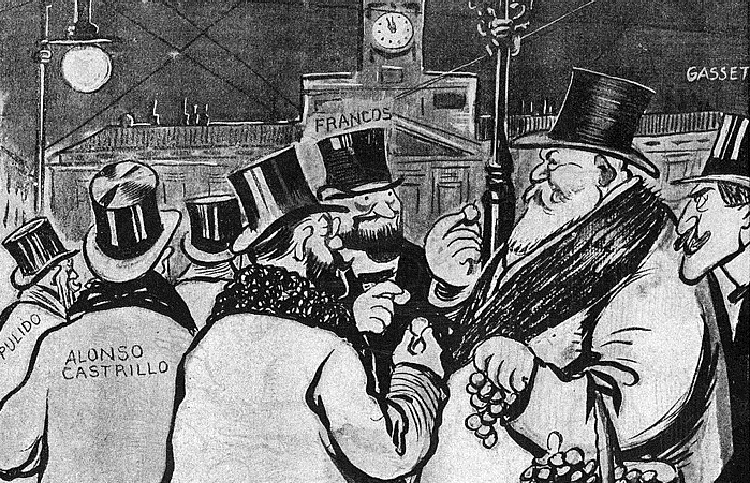
Caricature of 1911 with politicians eating grapes at the Puerta del Sol / Photo: Manuel Tovar commons.wikimedia

Share on FacebookShare on Twitter
Eduardo González

“It is customary in Madrid to eat twelve grapes when the clock strikes 12 at the turn of the year”. Thus the local press reported in January 1897 a practice which, although new by then, had already taken root enough to become one of the most characteristic traditions of New Year’s Eve.

When eating grapes tradition began in Spain? The versions abound. According to the newspapers of that time, in the nineteenth century the wealthy classes in Madrid had begun to imitate the habit of eating grapes and drinking champagne to receive the New Year. “The tradition has been brought from France, but has acquired among us a letter of nature”, said the newspaper El Imparcial in 1894.

On January 1, 1896, the newspaper La Correspondencia de España described how in the “beautiful residence of the president of the Council of Ministers”, General Martinez Campos, “the ministers greeted the arrival of the new year by eating rich grapes and drinking champagne”. In addition to singing “enthusiastic and patriotic toasts” to the army that “bravely fights in Cuba”. Given what was going to happen two years later in the island, the toast does not seem to be very propitiatory.

In any case, what began as a mere aristocratic custom and became customary at the end of the century among the Madrid bourgeoisie lived its own popular version in 1882 thanks to a side of the mayor of Madrid, José Abascal, which imposed the payment of a penny on anyone who participated, on the night of January 5, in the so-called “reception of the Three Kings” to end the usual riots and drunkenness.

To protest for this measure, which caused a deep popular unease, some few people from Madrid decided to organize a burlesque act in the Puerta del Sol, where Home Ministry headquarters were. They represented, in the cold of the night, a satire on what aristocrats did in the heat of their mansions: eating grapes to the rhythm of the bells chime.

The jest rooted and became a tradition that, in few years, spread to many other Spanish cities that knew how to find their own scenarios to eat the grapes. “There is a sick person who trusts grapes more than any medicine in the world”, lamented a newspaper of the time which wrote aobut “these superstitions that the devil inspires”.

The episode that most contributed to the spread of the custom came in 1909, when winemakers of Alicante and Murcia did not find a better way to give way to the surpluses of a particularly good crop than by financing a campaign throughout Spain in which they encouraged to eat one grape for each of the twelve bells to receive the year.

The habit of eating grapes in New Year’s Eve exists in other Spanish-speaking countries, such as Argentina, Chile, Colombia, Ecuador, Mexico, Peru or Venezuela. In Greece people eats a cake called Vassilopitta, inside which a coin is introduced, and in Italy is prepared a dish of stewed lentils, a Roman tradition propitiatory of fortune.



ADVERTISEMENT
Previous Post

Albares conveys to Sybiha his wish that “2026 will finally be a year of peace for the Ukrainian people”

Next Post

Fortieth anniversary of Spain’s accession to the European Union

Redacción

Redacción

Next Post
Foreign Ministry will allocate €600,000 to publicize Spain’s 40 years in the EU

Fortieth anniversary of Spain's accession to the European Union

Recommended

Angolan Ambassador Celebrates the 65th Anniversary of National Liberation

Angolan Ambassador Celebrates the 65th Anniversary of National Liberation

5 days ago

Newsletter

"Stay informed through our pages and always stay one step ahead. With in-depth analysis, exclusive reports and comprehensive coverage of the events that are shaping our present, our newspaper is more than just news, it is a window to the future."

Newspaper archive

December 2025
M T W T F S S
1234567
891011121314
15161718192021
22232425262728
293031  
« Nov   Jan »

About Us

The Diplomat in Spain is the reference digital newspaper for diplomats and companies that want to be well informed.

© 2024 The Diplomat in Spain.

Welcome Back!

Login to your account below

Forgotten Password?

Retrieve your password

Please enter your username or email address to reset your password.

Log In
Gestionar consentimiento
Para ofrecer las mejores experiencias, utilizamos tecnologías como las cookies para almacenar y/o acceder a la información del dispositivo. El consentimiento de estas tecnologías nos permitirá procesar datos como el comportamiento de navegación o las identificaciones únicas en este sitio. No consentir o retirar el consentimiento, puede afectar negativamente a ciertas características y funciones.
Funcional Always active
El almacenamiento o acceso técnico es estrictamente necesario para el propósito legítimo de permitir el uso de un servicio específico explícitamente solicitado por el abonado o usuario, o con el único propósito de llevar a cabo la transmisión de una comunicación a través de una red de comunicaciones electrónicas.
Preferencias
El almacenamiento o acceso técnico es necesario para la finalidad legítima de almacenar preferencias no solicitadas por el abonado o usuario.
Estadísticas
El almacenamiento o acceso técnico que es utilizado exclusivamente con fines estadísticos. El almacenamiento o acceso técnico que se utiliza exclusivamente con fines estadísticos anónimos. Sin un requerimiento, el cumplimiento voluntario por parte de tu proveedor de servicios de Internet, o los registros adicionales de un tercero, la información almacenada o recuperada sólo para este propósito no se puede utilizar para identificarte.
Marketing
El almacenamiento o acceso técnico es necesario para crear perfiles de usuario para enviar publicidad, o para rastrear al usuario en una web o en varias web con fines de marketing similares.
Manage options Manage services Manage {vendor_count} vendors Read more about these purposes
Ver preferencias
{title} {title} {title}
Gestionar consentimiento
Para ofrecer las mejores experiencias, utilizamos tecnologías como las cookies para almacenar y/o acceder a la información del dispositivo. El consentimiento de estas tecnologías nos permitirá procesar datos como el comportamiento de navegación o las identificaciones únicas en este sitio. No consentir o retirar el consentimiento, puede afectar negativamente a ciertas características y funciones.
Funcional Always active
El almacenamiento o acceso técnico es estrictamente necesario para el propósito legítimo de permitir el uso de un servicio específico explícitamente solicitado por el abonado o usuario, o con el único propósito de llevar a cabo la transmisión de una comunicación a través de una red de comunicaciones electrónicas.
Preferencias
El almacenamiento o acceso técnico es necesario para la finalidad legítima de almacenar preferencias no solicitadas por el abonado o usuario.
Estadísticas
El almacenamiento o acceso técnico que es utilizado exclusivamente con fines estadísticos. El almacenamiento o acceso técnico que se utiliza exclusivamente con fines estadísticos anónimos. Sin un requerimiento, el cumplimiento voluntario por parte de tu proveedor de servicios de Internet, o los registros adicionales de un tercero, la información almacenada o recuperada sólo para este propósito no se puede utilizar para identificarte.
Marketing
El almacenamiento o acceso técnico es necesario para crear perfiles de usuario para enviar publicidad, o para rastrear al usuario en una web o en varias web con fines de marketing similares.
Manage options Manage services Manage {vendor_count} vendors Read more about these purposes
Ver preferencias
{title} {title} {title}
  • Login
No Result
View All Result
  • Frontpage
  • News
    • Spain
    • World
    • The world in Spain
    • Diplomatic Breakfast
    • Diplomacy with a history
    • The bag
    • Social life
  • Analysis
    • Tribune
    • Trends
  • Embassies
    • Embassies Directory
    • Protocol
    • International legislation
  • Security and Defense
  • UNWTO News
  • Leisure
    • Libros
    • Culture & Art
    • Música
    • Movies
    • Niños
    • Espectáculos
    • Teatro
  • Diplomatic club
  • Vip Club

© 2024 The Diplomat in Spain.

Go to mobile version
  • English