
The Diplomat
The Cervantes Institute will soon open the Observatory of Spanish in African Contexts, coordinated by the Global Observatory of Spanish, which will analyze the state of Spanish language teaching in African universities and pre-university education.
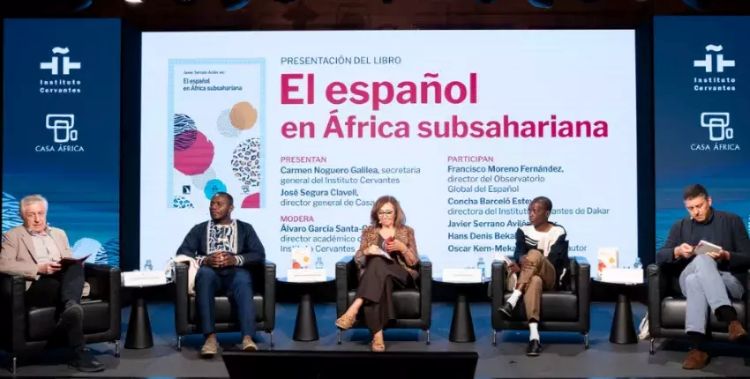
This was announced on Tuesday, June 16, by the director of the Global Observatory of Spanish, Francisco Moreno Fernández, during the presentation of the book “Spanish in Sub-Saharan Africa” at the Cervantes Institute headquarters in Madrid. The event was presented by the Secretary General of the Cervantes Institute, Carmen Noguero, and José Segura Clavell, director of Casa África.
“It’s not enough to gather data occasionally; we need to build a stable monitoring and support system: detecting changes, identifying needs, and providing reliable information for decision-making. Sub-Saharan Africa is already part of the present of Spanish; it’s not a promise for the future,” Moreno stated.
The book “Spanish in Sub-Saharan Africa” is a joint work between the institution and Casa África, which reveals that more than 3.5 million people study Spanish as a foreign language in the region, with a high percentage (85 percent) coming from public secondary schools.
For her part, Carmen Noguero noted that this work complements a first volume published in 2014, when the number of students in this area exceeded 1.3 million. “Our intention has not been to compile data, but rather to invite people to imagine and build the future of Spanish in a region where it is already widely spoken,” she declared.
In this sense, the result is the culmination of a broad and sustained collaboration spanning more than two years, involving 55 authors. Throughout its more than 680 pages, a network of Hispanists and African researchers offer data and testimonies encompassing a region with a total of 21 countries.
The figures compiled in the volume highlight the significant presence of Spanish learners in the region. “This figure is not only impressive, but it also redefines the global distribution of Spanish learning and confirms, with quantitative evidence, that sub-Saharan Africa is one of the regions that contributes most to the total number of Spanish learners worldwide,” García Montero emphasized in the book’s introduction.
The fourth region in the world with the most Spanish learners
The African continent accounts for one in ten Spanish learners worldwide, according to data from the Cervantes Institute Yearbook published last year, which totals 24.5 million students.
At the First Meeting of Hispanists from Africa and Spain in 2019, it was estimated that sub-Saharan Africa represented 7.6 percent of the total number of Spanish language learners worldwide. However, this new report establishes that this region is the fourth largest contributor of learners globally (with 13.5 percent of the global demand).
Among the fifteen countries with the highest number of students of Spanish as a foreign language are five sub-Saharan countries. Cameroon and Ivory Coast stand out as two major players, with over one million students each. They are joined by Benin, Gabon, and Senegal.
The director of the Cervantes Institute in Dakar, Concha Barceló, highlighted Ivory Coast and Senegal, two countries where Spanish companies are beginning to establish themselves. “This is bringing about a change in philological and literary studies, as the secondary school curriculum is being rethought to offer students more career options,” she explained.
These countries with high levels of institutionalization are complemented by others with medium levels of institutionalization, such as Madagascar and Togo, where, despite considerable growth in demand, the offering of Spanish is not yet fully implemented throughout the public education system. According to Francisco Moreno Fernández, sub-Saharan Africa is “a space under construction, where Spanish cannot be understood as an inheritance, but rather as a project.”