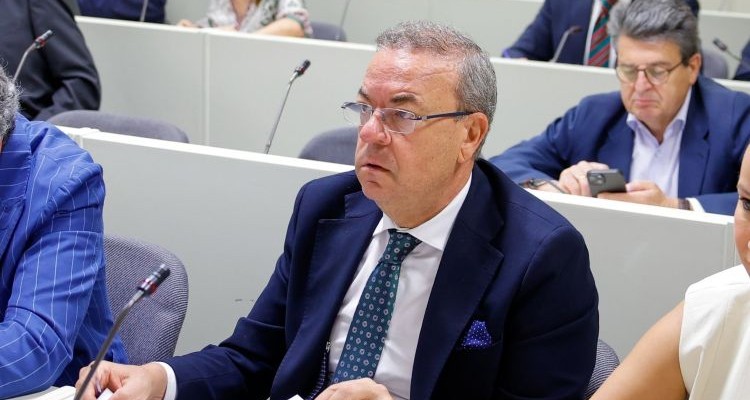
Eduardo González
The People’s Parliamentary Group in the Senate has successfully passed a motion urging the Ministry of Foreign Affairs to provide written reports every six months on the military, financial, humanitarian, and diplomatic commitments undertaken by Spain with Ukraine. The motion also calls on the Minister, José Manuel Albares, to appear before the Senate in a special session, urgently, to explain the Government’s position regarding the war.
The text, which was approved this Thursday by the Senate Foreign Affairs Committee with 19 votes in favor and nine against (including those of the PSOE), urges the Government to “submit to this Committee, every six months and in written format, a detailed report on the military, financial, humanitarian, and diplomatic commitments undertaken by Spain with Ukraine, distinguishing between committed, executed, and pending expenditures, specifying the corresponding budgetary impact, and identifying the contributions channeled through the European Union, NATO, and other international organizations.”
It also urges the Executive Branch to “request the appearance of the Minister of Foreign Affairs, European Union, and Cooperation before the Senate Foreign Affairs Committee, in a special session and as a matter of urgency, to report on the Government’s position regarding the war in Ukraine, the status of the peace negotiations, the role of the European Union in them, the commitments undertaken by Spain, and the use given or planned for the Russian assets frozen or immobilized for the benefit of Ukraine.”
In response to this motion, the PSOE (Spanish Socialist Workers’ Party) presented an amendment removing these two points and, instead, urging the Government to “strengthen support for Ukraine, defend the role of the European Union in achieving a just and lasting peace, guarantee parliamentary oversight of the commitments made, and promote the use of frozen Russian assets for the benefit of Ukraine.”
During the debate, Senator José Antonio Monago, of the PP (People’s Party), acknowledged that, since the beginning of the Russian invasion, “Spain has supported Ukraine from day one, and we think that’s right,” but, he warned, “supporting them doesn’t mean giving up on transparency.” “We’re talking about enormous military, financial, and budgetary commitments, and these commitments require parliamentary oversight. Parliament cannot be a mere spectator,” he continued.
Therefore, he asserted, “this motion requests something as reasonable as the Government periodically informing the Senate what it has committed to, what has been implemented, what remains pending, what the budgetary impact is, and what position Spain defends in each forum: more information, more transparency, more accountability.” “When we talk about foreign policy, defense, and public funds, the Government has an obligation to provide explanations,” he insisted.
In his rebuttal, Rafael Lemus Rubiales, of the PSOE, stated that his party “fully agrees” with the PP’s initiative, “but I don’t know if we are truly debating matters of utmost importance or if, in reality, we are exploiting matters of utmost importance to force the Ministry to appear.”
According to Lemus, “the Spanish Parliament, the Senate, has mechanisms to interpellate and question the Minister as many times as you deem necessary, both in plenary session and in committee, on these matters.” “Withdraw those two points, and we will gladly approve this initiative, which I believe is the most important thing,” he warned.
However, Monago responded that the motion’s objective is to discuss “Ukraine, peace, and respect for international law,” but also “democracy in Spain and parliamentary oversight, a government that submits to democratic norms and does not govern through despotic behavior.”
“We don’t think it’s so unreasonable to ask the Spanish government, given that we are contributing—very little, it must be said—to the defense of a country under military attack, to send us a report every six months telling us what we are doing,” he continued. “It seems this government is allergic to parliamentary oversight,” he lamented. “We don’t understand their position, and we certainly will not accept the amendment,” he concluded.