
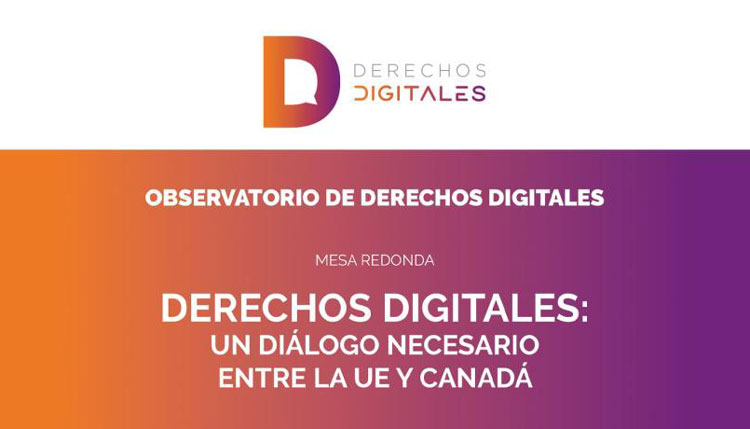
This afternoon at 4:30 p.m., the round table Digital rights: a necessary dialogue between the EU and Canada is taking place in the Inca Garcilaso room of Casa América. Free admission to full capacity, with simultaneous interpretation service.
Canada is a country in which the defense of fundamental rights and civil liberties forms its essence and articulates its actions, both domestically and internationally. He has been a pioneer in the formation of a series of digital rights, making him an essential actor in America in the defense of human rights in an increasingly pervasive technological context.
The Public Law Research Center, the Cyberjustice Laboratory and the LexUM Chair in Legal Information of the Faculty of Law at Montreal University, whose management team will participate in the round table, have been leading for decades the reflection and analysis of how digitalization and disruptive technologies impact, in a significant way, in the sphere of fundamental rights, pillar of any democratic society.
At the moment, a dialogue and exchange between the EU and Canada as a privileged interlocutor in North America is particularly necessary. Canada and the EU share a certain worldview, both in terms of technology governance and AI and upholding the right to personal data protection, all in an interconnected world where multiple technologies based on mass data processing, occur on both sides of the Atlantic.
From the Spanish perspective, initiatives such as the Digital Rights Charter constitute an innovative and privileged framework that aims to define how citizens’ rights should be protected in the digital society, as a roadmap for all relevant actors in this field.
In this sense, the Public Enterprise Entity Red.es, as sponsor of the Observatory of Digital Rights in which CEU San Pablo University participates, plays a fundamental role in the commitment to the protection of digital rights. Their common goal is to reinforce the elements that allow freedom, equality, security and protection of individuals in digital environments.
And in line with the above, they present in such a prominent space as Casa de América this round table in which experts on digital rights will analyze how Spain, the European Union and Canada – from shared values and based on the universal defense of human rights – can generate synergies and share experiences from both academic research and concrete actions aimed at strengthening rights in the digital society.
Welcoming remarks will be delivered by León de la Torre Krais, general director of Casa de América; Jeffrey Marder, ambassador of Canada to the Kingdom of Spain and the Principality of Andorra; Jesús Herrero Poza, general director of Red.es; Karim Benyekhlef, professor at the law school and director of the Cyberjustice Laboratory at the University of Montreal, and José Luis Piñar Mañas, professor of administrative law at CEU San Pablo University.
Next will be the round table, attended by Karim Benyekhlef, Professor at the Faculty of Law and Director of the Cyberjustice Laboratory at the University of Montreal; Nicolas Vermeys, professor of law and deputy director of the Cyberjustice Laboratory at the University of Montreal; Valentin Callipel, head of mission of the Cyberjustice Laboratory at the University of Montreal, and José Luis Piñar Mañas, Professor of Administrative Law at CEU San Pablo University. The event will be moderated by Rosario Duaso Calés, professor of law at CEU San Pablo University.