
Ane Barcos
The European Commissioner for Defence and Space, Andrius Kubilius, urged Spain this Friday to become an “active partner” in a special program aimed at the urgent provision of missiles and other necessary equipment to Ukraine, in the context of the new €60 billion loan to strengthen that country’s defense.
During his speech this Thursday at a breakfast briefing hosted by the New Economy Forum in Madrid, the Commissioner emphasized Spain’s role in European defense, stressing that “there is no preparation for European defense without Spain.” In this regard, he highlighted the country’s leadership in the defense and space industry, emphasizing that Spain “is a European leader in the space sector” and that its contribution to projects like Govsatcom has been fundamental, enabling all member states to enjoy “sovereign satellite communications.”
“Spain has shown strong support for Ukraine throughout the war,” the Lithuanian politician stated, particularly acknowledging the military commitment of the Spanish Ministry of Defense and the Armed Forces, which have provided Ukraine with priority defense equipment, including air defense systems.
Kubilyus explained that, starting in April, the European Commission and Ukraine will begin implementing the €60 billion support loan to Ukraine, which will increase support for the country’s defense. This support can be allocated to the strategic priorities identified by the Ukrainian authorities, including drones, missiles, and 155mm extended-range munitions.
The EU defense chief stressed that one of the biggest challenges in this area is missile production, mentioning that he had recently spoken with major European missile manufacturers about the need to increase production. “I will soon embark on a missile tour, visiting missile manufacturers along with national defense ministers to discuss the implementation of what I would call a special program,” announced Kubilius, who expressed his desire for Spain to be an “active partner” in this program.
In this context, he warned of the growing threat posed by Russian aggression, noting that “our intelligence services confirm that they may be just around the corner.” This, he indicated, underscores the need for EU member states to be prepared to defend one another.
Article 47.2 of the EU Treaty could be “more effective” than NATO Article 5
Faced with the growing threat, Kubilius highlighted the importance of Article 47.2 of the Treaty on European Union, which refers to solidarity among member states in the face of geopolitical challenges. According to Kubilius, this article could be “even more effective than NATO Article 5,” since, when activated, it would not require a unanimous decision, as is the case with NATO. Instead, it would suffice for one country to declare itself the victim of aggression, which would obligate the others to provide immediate mutual support.
At the Munich Security Conference, President Von der Leyen already insisted that the European Union must bring Article 47.2 of the Treaty on European Union to life. In this regard, Kubilius indicated that it is important “to be ready and aware of our capabilities,” and noted that “we are therefore looking at how to implement this article.”
“We are all in this together: Commission, Member States, and industry”
The Commissioner called on European governments and industry to work together to solve a problem affecting defense production capacity in Europe. He recalled the European Union’s efforts to support the defense industry, such as the SAFE loans and funds allocated to Ukraine’s defense. However, he warned of the need to increase arms production to meet the needs of both Ukraine and the EU and NATO Member States themselves.
“The industry is raising prices and delaying delivery dates,” he stated, adding that this is due to the inability of arms production to keep pace with the increasing defense funding.
In this regard, he expressed concern about the lack of coordination between available funds and the industry’s capacity to produce on a large scale. “This is not the objective of our European policy,” Kubilius stated, referring to the need for industry to efficiently increase its production to meet the growing defense needs of both member states and Ukraine.
The European Commissioner stressed the urgency of creating a framework in which governments can offer long-term contracts that provide industry with the necessary security to increase its production capacity. “To produce in large volumes, industry needs large, long-term orders from member states,” Kubilius explained, emphasizing that investment in infrastructure, such as building factories and hiring highly skilled workers, requires stable demand, which is currently lacking. “Industry cannot take these risks without a clear commitment from governments,” he added.
Kubilus thus highlighted the need for an “industrial boom” that would allow Europe to produce on an unprecedented scale to meet defense needs. “Defense production must be increased urgently, both for Ukraine and for our own security interests,” he affirmed. In this context, he called on all stakeholders, including the Commission, governments, and industry, to work together to guarantee long-term stability and security.
“What Europe needs now is a long-term policy that ensures stable demand for defense products and creates a secure environment for industrial investment,” said Kubilius, who also reiterated that “defense is a resource for peace” and that production should focus on preventing war, not just generating commercial profits.
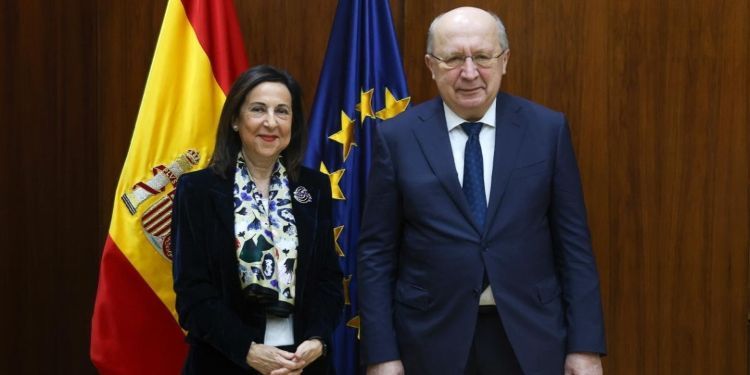
Margarita Robles
At the event’s opening, Defense Minister Margarita Robles affirmed that “Spain will always be committed to Ukraine, seeking a just and lasting peace,” because “neither Europe nor Spain within the European Union can remain indifferent to the atrocities we are witnessing.”
Therefore, she warned, it is necessary to “continue developing cutting-edge technologies applicable to defense” and to strengthen “the industrial production of armaments and equipment that guarantees our resilience against any possible aggression and that also generates something that, for us, for the Ministry of Defense, for the Government of Spain, is very important: industrial and technological employment.”
“It has been said many times that a true European industrial base for defense is necessary,” she stated. “In Spain, we have an excellent base of small and medium-sized defense companies that are especially dynamic and innovative, as well as companies of considerable size, perfectly compatible and competitive in Europe and the rest of the world if necessary,” she continued. “All of them can and should contribute great value to a future European industrial base,” she added.