
Carlos Uriarte Sánchez

Professor of Law at the International University of La Rioja and in the Master’s Program in International Relations and Public Diplomacy at CEU-Fernando III University
Currently, after three decades of conflict, Armenia and Azerbaijan are closer than ever to a comprehensive peace treaty since the collapse of the Soviet Union. The guns have largely fallen silent, and negotiations through indirect mediation have been replaced by direct talks between the two sides. Both governments have publicly committed to closing a chapter of a conflict that defined a generation in the South Caucasus.
However, precisely at this moment, when the peace process remains fragile but real, a wave of accusations lacking any historical rigor or legal basis, disseminated by some Western media outlets, could negatively impact the hard-won progress of both countries by distorting reality. Nor should we attempt to judge this highly complex conflict, nor ask ourselves, “Which came first, the chicken or the egg?” What is clear is that to reach a truly stable and lasting solution, generosity from both sides is necessary, as well as the responsible contribution of external actors to the success of the process.
To understand the significance of what is happening today in a region at the crossroads of Europe and Asia, it is essential to recall the origins of the conflict. The confrontation between Armenia and Azerbaijan, which arose at the end of the Soviet era, triggered a full-scale war in the early 1990s. By the time the ceasefire was established in 1994, Armenian forces had occupied the Karabakh region and seven surrounding districts, representing almost 20% of Azerbaijan’s internationally recognized territory. More than 700,000 Azerbaijanis were forcibly displaced from their homes. Despite four binding UN Security Council resolutions calling for the unconditional withdrawal of occupying forces, the status quo persisted for nearly three decades, accompanied by periodic aggression and failed mediation efforts.
This prolonged occupation, more than an abstract territorial dispute, was at the heart of the conflict. International law was unequivocal on this point. This was later confirmed by the European Court of Human Rights judgment in the case of Chiragov and Others v. Armenia, which held Armenia responsible for exercising effective control over the occupied territories. Despite this, the diplomatic process stalled, leaving Azerbaijan with little prospect of restoring its territorial integrity through negotiations. As a result of the Second Karabakh War in 2020 and the dismantling of the separatist regime in September 2023, the situation changed, bringing an end to the military phase of the conflict. From that moment on, events between Armenia and Azerbaijan have unequivocally pointed toward peace rather than descending into renewed confrontation. In March 2025, both sides announced the completion of negotiations on the text of the Treaty for the Establishment of Peace and Interstate Relations. In it, Armenia officially recognized Azerbaijan’s territorial integrity, including the previously occupied Nagorno-Karabakh region. In doing so, it essentially admitted that it had held the region under illegal control for thirty years and that this circumstance had been one of the main causes of the conflict.
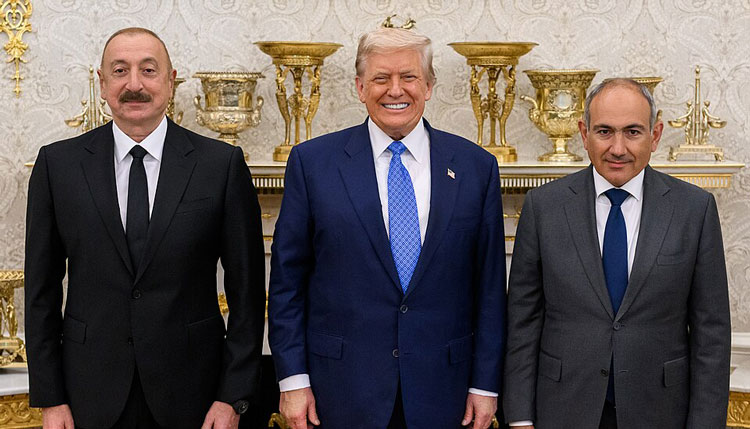
Under the mediation of the United States, in August 2025, both countries signed the Joint Declaration, in which they reaffirmed their commitment to normalizing the situation by signing the text of the Peace Treaty. Following this, practical measures have been agreed upon to foster mutual trust between the two sides: negotiations on border delimitation and demarcation, reciprocal facilitation of trade transit, the supply of petroleum products to Armenia through Azerbaijani channels—for the first time in decades—and talks on reopening regional connectivity routes, including the TRIPP corridor. These are not mere symbolic gestures, but tangible indicators that the logic of confrontation is being replaced by that of peaceful coexistence.
In this context, some Western media outlets, including Spanish ones, are disseminating narratives increasingly detached from reality. Recent coverage in outlets such as El País, amplified by diaspora advocacy groups, has framed Azerbaijan’s actions after 2023 through the lens of ethnic cleansing and political repression and deliberate destabilization. These claims are often presented without context, rely on selective sources, and are disconnected from findings verified by international institutions, thus lacking rigor and objectivity. Moreover, these untimely reports, far from contributing to reconciliation, risk reintroducing maximalist narratives at a time when compromise is politically costly but strategically necessary for both sides. Let both countries continue working for peace, and if anything, let Europe contribute precisely to this.
These accusations come at a particularly problematic time and curiously overlap with Russia’s policies toward Armenia and Azerbaijan, which have historically been based on a “divide and conquer” strategy. Armenia is heading toward parliamentary elections in June 2026, a period that traditionally exacerbates internal polarization. The Russian-backed opposition forces have openly rejected the peace process, portraying the Western-mediated normalization with Azerbaijan as a capitulation and demanding the revocation of agreements reached through the good offices of the EU and the United States over the past three years. External narratives depicting Azerbaijan as irredeemably hostile or criminal strengthen the positions of hardliners within Armenia opposed to the agreement and weaken reformist forces committed to peace. These attitudes may also complicate the political environment for compromise in Yerevan and benefit the Kremlin.
One of the most frequent accusations is that of ethnic cleansing following the collapse of the separatist regime in Nagorno-Karabakh in September 2023. According to this version, the restoration of Azerbaijani sovereignty resulted in the forced expulsion of the Armenian population. However, this claim does not hold up under closer examination. On September 21, 2023, Armenian Prime Minister Nikol Pashinyan, during the period of the separatist entity’s collapse in Karabakh, addressed the Armenians of the region, encouraging them to remain in Karabakh and assuring them that “in our assessment, there is no direct threat to the civilian population of Nagorno-Karabakh.” These statements were not mere rhetoric but rather de facto assessments made at the highest political level in Armenia.
International findings support this assertion. A United Nations fact-finding mission conducted in the region after September 2023 found no evidence to substantiate the alleged accusations of ethnic cleansing. The UN mission confirmed that civilians were not subjected to violence and that humanitarian access was available during that period. While the exodus of Armenians from Karabakh was deeply painful, this circumstance alone does not constitute ethnic cleansing under international law. The distinction is important, especially when such terminology is used to delegitimize an entire peace process.
Despite this, some Western media outlets continue to level old, politically motivated accusations. Protests by diaspora organizations against official visits to Azerbaijan, such as the recent criticism leveled at the Speaker of the House of Representatives for visiting the Victory Monument in Baku, demonstrate how symbolic acts are interpreted as supposed support for alleged crimes. This narrative often ignores the fact that such visits take place within the framework of recognized diplomatic relations and in parallel with ongoing cooperation with Armenia. It also omits the fact that the Ministry of Foreign Affairs itself was informed of the visit and supported it, which underscores its legitimacy according to international diplomatic practice. Furthermore, the fact that Bildu (the separatist political party that is the successor to ETA) has requested an internal investigation into the visit of the Speaker of Congress regarding Francina Armengol’s recent trip to Azerbaijan and the events she carried out there, and has announced that it will also prepare a series of questions for the government in this regard, undoubtedly reaffirms the ideas I have presented in this article. In the press, as in politics, not everything is acceptable, and one cannot mix apples and oranges.
More generally, these arguments reflect a persistent double standard in Western approaches to conflict resolution. Accountability is indispensable in some conflicts and an obstacle in others. In the Armenia-Azerbaijan case, the legally established facts, as well as Armenia’s responsibility for the occupation and the mass displacement of Azerbaijanis, are undeniable.
The consequences of the conflict and the destruction of cultural heritage are often obscured. Responsibility is presented as negotiable. However, it is a matter already determined by international law. This selective approach not only distorts historical fact but also erodes trust in the neutrality of external actors such as the US and the EU, who are encouraging the peace process.
If Western countries truly seek lasting peace in the South Caucasus, they should align their narratives with verified facts, support ongoing mediation efforts, and refrain from language that pushes positions further apart rather than closer together. After thirty years of hostility, Armenia and Azerbaijan are finally moving toward peace. This process deserves careful support. Careless distortion is unacceptable and can have very damaging consequences for achieving lasting peace, ensuring coexistence between the two countries and regional stability that contributes to the region’s development and integration. The interconnection and collaboration between Central Asia and the South Caucasus is vital for Europe to ensure its much-needed strategic energy independence. Spain must also contribute to this effort by advocating a European policy characterized by values-based political realism in response to an international landscape marked by significant uncertainty and volatility.