Text and photo: Juan David Latorre
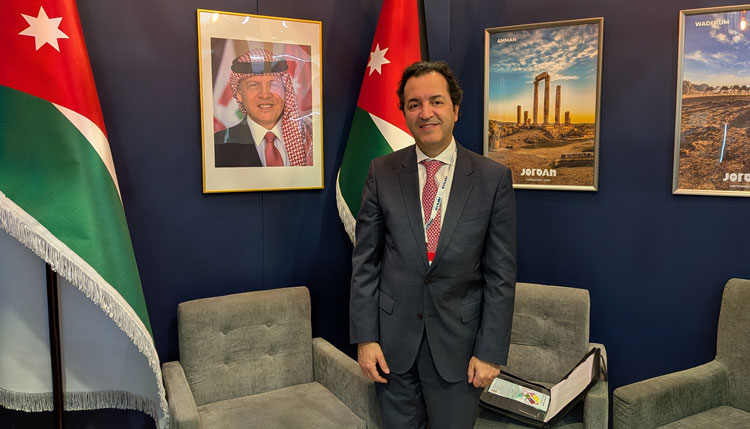
Petra, Wadi Rum, Amman, Mount Nebo, the Dead Sea, Malaba, Jerash… Jordan offers a vast array of tourist attractions, and to learn more about this country, we spoke with Marwan Maaytah, Director of Tourism for the Hashemite Kingdom, visiting Madrid to promote Jordan at the Fitur 2026 Tourism Fair.
.- Perhaps the city of Petra is the jewel of tourism in Jordan, but there are many more impressive places to visit in Jordan, aren’t there?
Petra is an icon, a UNESCO World Heritage Site, and the cradle of the Nabataean civilization, one of the civilizations of the Old Testament. For us, it’s a unique experience where tourists, visitors from Spain, immerse themselves in an ancient, original culture, one of the ten wonders of the world, as we know. But Petra isn’t just a small place; it’s a city. Tourists visit Petra for two days to see different places and experiences that hold great historical, cultural, and environmental significance, as well as offering adventure,it’s like a desert adventure. It was a very rich civilization, like other civilizations in the region, and also had a mixed identity between ancient Greek and Pharaonic cultures, representing a crossroads of all those civilizations.
But beyond Petra, we also have the connection to the Wadi Rum valley and desert, a very special, reddish desert, where the entire film industry loves to shoot because it’s a marvel. It has spectacular rock formations and is a destination for leisure, adventure tourism, stargazing at night, and enjoying the calm and serenity of an immaculate desert, as they say.
Now we also have the ruins of Jerash, one of the largest Roman cities of the Eastern Roman Empire, where you can see the Roman theaters and learn about the fascinating role this era played in the Middle East.
The capital, Amman, offers flavorful and original Arabic and oriental cuisine. Young people and families enjoy these experiences. They visit the Roman theater in Amman and enjoy our city, which offers history and modernity simultaneously, as well as tranquility and peace.
And we also have the Dead Sea, a unique place, the lowest point on Earth, which offers healing treatments, especially for people with skin problems. The Dead Sea’s source is also the Jordan River, where Jesus Christ was baptized. In 2030, we will celebrate 2,000 years since this sacred event for Christians took place.
.- Due to the Israeli-Palestinian conflict, has tourism in Jordan decreased? Has it declined?
Whenever there are regional crises, tourism is affected, but Spanish tourists are very cultured and know that Jordan is not connected to Israel or the conflict in Palestine. Jordan is a peaceful, very moderate, and very neutral country. The connection between Spain and Europe was not affected by that conflict, thanks to Royal Jordan, our official airline. There is a weekly flight with Ryanair between Jordan and Madrid, and we are going to expand that connectivity within Spain, between Barcelona and Aqaba, for example, or between Madrid and Amman. Aqaba is a very beautiful destination, on the Red Sea, where people enjoy the diversity and richness of our marine life; it’s an incredible experience. This sea is one of the richest and most diverse in the world for diving and observing the underwater world. In Jordan, it is very well cared for and is also a UNESCO World Heritage Site.
.- How many tourists visit Jordan annually?
Generally, between 5 and 7 million tourists visit Jordan each year, from all over the world: Europe, Eastern Europe, North America, England, and Spain. It is also one of the most important markets for Spanish tourists.
We are close to the Spanish heart; they understand us, and I believe that the richness of these experiences is very important for Spanish tourists. Our spirit, our love of life, food, diversity, culinary arts… Furthermore, we have enjoyed excellent relations between our two monarchies and governments for many decades, and many Jordanian students have been studying in Spain for many years.
Now we have an agreement between the Alhambra and Petra, two global heritage sites, where there is technical collaboration on how to care for them, how to make them more sustainable, how to protect the environment, and that is a fantastic agreement. The Alhambra is one of the most important tourist destinations in Spain and a World Heritage Site, as well as a cultural heritage site of the Islamic and Arab world, and for us it is an honor to have this collaboration at all levels with the Ministry of Tourism, the Jordan Tourism Board, and also with Turespaña.
.- What is the state of the hotel sector in Jordan?
Over the last four decades, we have invested heavily in attracting hotel operators of all types: luxury, mid-range, budget, and more. We also have many hotels, including multinational chains like Marriott and Intercontinental Hotel Group, as well as luxury chains such as the Ritz-Carlton and St. Regis. We also have plans to attract the Meliá Group and other Spanish hotel chains to operate in Jordan. We have a high standard of accommodation, and, as in Spain, it’s something we take great care of one hundred percent.
The hotel sector is fantastic. We have resorts, five-star hotels, a truly excellent hotel industry model, and also ecotourism resorts that take special care of the environment and cater to tourists seeking adventure and experiences in nature.