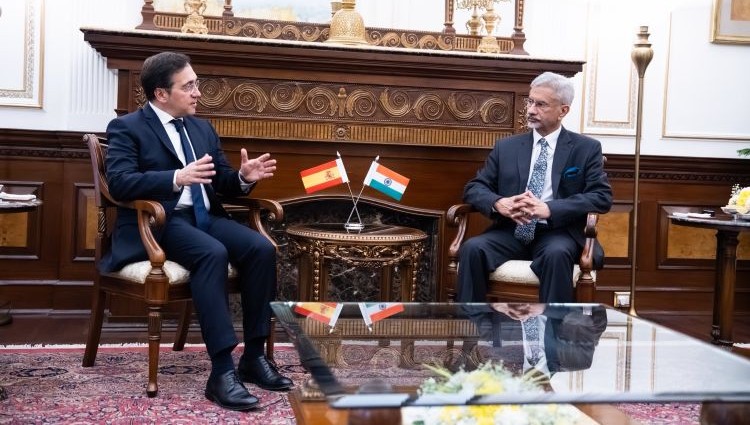
<h6><strong>Eduardo González</strong></h6> <h4><strong>Foreign Minister José Manuel Albares expressed his desire on Wednesday, during his official visit to India, to elevate the bilateral relationship to a strategic partnership, the highest level of cooperation between two states.</strong></h4> “It is very important that Spain strengthens our relationship with a country as reliable as India, a country that believes in international law, that upholds the principles of the UN Charter, and that believes in multilateralism,” the minister told the press after meeting with his Indian counterpart, Subrahmanyam Jaishankar, and the country’s president, Droupadi Murmu, in Delhi. “I discussed with the Foreign Minister that elevating our relationship with India to a strategic partnership is the highest model of partnership we have with our main friends and partners in the world,” he continued. A strategic partnership is the highest level of relationship that two states can maintain with each other. Spain has agreements of this type with countries such as China, Brazil, Egypt, Jordan, and Qatar. According to Albares, “the appropriate framework” to elevate the bilateral relationship to a strategic partnership is the Spain-India Dual Year, which the two countries will celebrate in 2026, coinciding with the 70th anniversary of the establishment of diplomatic relations. This was agreed upon during the visit made in 2024 by the Prime Minister, Pedro Sánchez. According to the minister, the Dual Year “will be marked by three main pillars, three main vectors: tourism, culture, and artificial intelligence.” The minister also confirmed that Pedro Sánchez will travel to India next February to attend the International Summit on the Impact of AI, organized by Indian Prime Minister Narendra Modi, and expressed his hope that Modi himself may visit Spain soon. <h5><strong>India-EU FTA</strong></h5> Albares also noted that “in just a few days, a European Union-India summit will take place, which was already crucial, but which in this geopolitical context takes on even greater importance,” and that it will help finalize the Free Trade Agreement (FTA) between India and the European Union. The President of the European Commission, Ursula von der Leyen, is scheduled to travel to India early next week to finalize talks on the trade agreement, which would create a market of 2 billion consumers and allow it to surpass the EU-Mercosur agreement (signed this past Saturday) as the world's largest free trade area. “Everything indicates that the agreement for the world's largest free trade area will be concluded in the coming days,” Albares emphasized. “We are talking about 2 billion people, and therefore, if Mercosur was extraordinary news just a few days ago, everything points to us having another piece of news of the same magnitude in just a few days, and that represents a great opportunity for European companies, including Spanish ones,” he added. “I have met with the main Spanish companies that are here in India” to discuss “the opportunities that will arise and all that the reduction of tariff barriers will entail,” the minister reported. He continued, “In my meeting with the Minister of Foreign Affairs, I explained what our companies in sectors such as infrastructure or renewable energy, for example, can offer, and we highlighted the virtuous relationship between Tata Advanced Systems and Airbus Spain.” “India and Spain are, at this moment, the two fastest-growing advanced economies in the world,” he asserted. <h5><strong>Subrahmanyam Jaishankar</strong></h5> For his part, Jaishankar expressed his “deepest condolences to the families of the victims of the tragic train accident that occurred on January 18 in Córdoba.” Subrahmanyam Jaishankar also stated that “Spain is one of India’s most important trading partners in the EU,” with bilateral trade in goods “exceeding $8 billion in recent years.” “Spanish companies have a significant presence in India, particularly in infrastructure, renewable energy, urban mobility, engineering, water management, and smart cities, and Indian companies also operate in Spain in the information technology, pharmaceutical, and automotive components sectors,” he emphasized. “We see considerable potential to further deepen this trade cooperation,” he added.