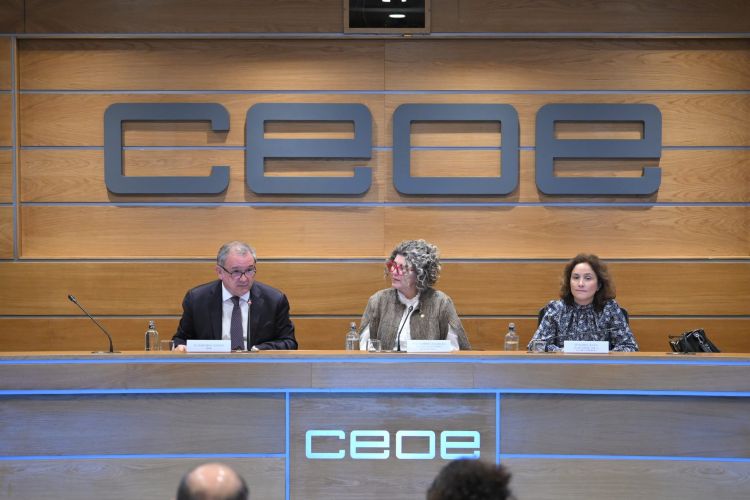
<h6><strong>The Diplomat</strong></h6> <h4><strong>Guatemala's Minister of Economy, Gabriela García, presented the attractive features of her country as an investment destination this Monday at the CEOE headquarters, highlighting its preferential access to key markets in Central America, the United States, Europe, and Asia.</strong></h4> García spoke at a business meeting inaugurated by the Confederation's Director of Relations with Ibero-America, Narciso Casado, and the Deputy Director General for the Americas at the State Secretariat for Trade, Isabel Rata. The meeting focused on Guatemala's economic outlook, its macroeconomic stability, and existing investment opportunities in strategic sectors. The competitive advantages the country offers as a business destination were also discussed, including its status as Central America's leading economy, its projected GDP growth of 4.1% for the period 2025-2030, and its strategic location with preferential access to international markets. The potential of tourism as a key sector for economic development was also addressed, along with tax incentives, the use of renewable energy, and special export and maquila regimes that reinforce Guatemala's attractiveness to Spanish companies. During her remarks, Gabriela García described Guatemala as “a friendly country and a key trading partner for Spain” and emphasized the government's efforts to strengthen public institutions and respect for the rule of law, with the aim of “consolidating an environment of trust for investment.” The minister highlighted Guatemala's economic growth, driven in part by public investment, and underscored the country's strategic location and the development of key logistics infrastructure. Among these, she emphasized the expansion of Pacific and Atlantic ports, as well as road connectivity improvement projects, in collaboration with the United States government, aimed at strengthening the country's competitiveness and logistical capacity. García also highlighted the potential of Guatemala's human capital, with its young and skilled population, and the investments made in public education and technical training, including the launch of scholarship programs geared towards industry needs. In the energy sector, she pointed to existing opportunities in renewable energy, with new tenders in transmission and generation, and noted that opportunities are being explored in the natural gas and biomass sectors. She also underscored the progressive diversification of the Guatemalan economy, which extends beyond the traditional agricultural sector, and the country's attractiveness as an investment destination thanks to its network of trade and investment agreements, which allows preferential access to key markets in Central America, the United States, Europe, and Asia. In this regard, she mentioned the development of new high value-added sectors, such as semiconductors and the so-called "chip route," as well as the promotion of industrial parks and special regimes that encourage investment. Finally, the minister highlighted tourism as a strategic sector, with special attention to strengthening MSMEs, talent development, sustainability and inter-institutional coordination, and reiterated the Guatemalan government's commitment to further deepening economic and trade relations with Spain and the European Union, within a framework of stability, cooperation and mutual benefit.